---
title: "Tipo, Como, Así: How Mexicans Say “About,” “Like,” and “Around”"
description: "Learn tipo, como, así, más o menos, and por ahí for approximate time, stories, prices, and plans in natural Mexican Spanish without confusion."
type: "article"
category: "phrases"
url: "https://consalsa.app/blog/approximation-mexican-spanish"
canonical: "https://consalsa.app/blog/approximation-mexican-spanish"
published: "2026-06-30"
updated: "2026-06-30"
author: "Andrey the Nomad"
site: "ConSalsa.App"
license: "https://consalsa.app/about"
---

# Tipo, Como, Así: How Mexicans Say “About,” “Like,” and “Around”
URL: https://consalsa.app/blog/approximation-mexican-spanish
Date: 2026-06-30
Updated: 2026-06-30
Category: phrases
Keywords: tipo meaning spanish, como approximation spanish, así mexican spanish, más o menos meaning, por ahí mexican spanish, mexican spanish approximation
Summary: Learn tipo, como, así, más o menos, and por ahí for approximate time, stories, prices, and plans in natural Mexican Spanish without confusion.

Quick answer:
- Tipo introduces an example, category, or rough comparison: tipo ocho means around eight-ish.
- Como softens numbers and descriptions; como veinte personas means approximately twenty people.
- Así often depends on gesture or shared context, while más o menos gives a plain approximate range.
- Por ahí can mean around that place, time, amount, or idea, so ask for one concrete detail when precision matters.

What you'll learn:
- How five approximation tools divide the work across time, quantity, description, and half-formed stories.
- Why deliberate vagueness can sound cooperative in casual talk instead of careless or dishonest.
- Which follow-up questions add precision without turning a relaxed plan into a cross-examination.
- How intonation and hand gestures change phrases that look almost empty on the page.

Don't sound gringo:
Do not force every tipo, como, or por ahí into a precise English equivalent. Ask what detail actually matters: time, place, amount, or confidence.

Body:

Your group chat says dinner starts <mark lang="es-MX">tipo ocho</mark>. You arrive at 7:58, then wonder whether everyone else missed a memo. They did not: <mark lang="es-MX">tipo</mark> was the memo.

<mark lang="es-MX">Tipo</mark>, <mark lang="es-MX">como</mark>, <mark lang="es-MX">así</mark>, <mark lang="es-MX">más o menos</mark>, and <mark lang="es-MX">por ahí</mark> give the useful shape of a time, quantity, place, or feeling without pretending it is exact. Sometimes that is plenty. Sometimes you need one more detail before you leave home.

## Five ways to be approximately right

| Tool | Main job | Example | Practical reading |
|---|---|---|---|
| Tipo | Example, category, rough comparison | Tipo ocho | Around eight-ish |
| Como | Approximate number or softened description | Como veinte | About twenty |
| Así | Manner, size, degree | Así de grande | This/that big |
| Más o menos | Plain approximation or so-so state | Más o menos una hora | About an hour |
| Por ahí | Loose place, time, route, amount | Como por ahí de las nueve | Around nine |

RAE gives <mark lang="es-MX">tipo</mark> a long list of jobs connected to models, classes, and characteristic examples.[^rae-tipo] Casual speech stretches that example-making function into “something like” or “around.” <mark lang="es-MX">Como</mark> has comparison built into its grammar, which makes approximation a natural extension.[^rae-como]

These words tell you that the information is useful, but loose around the edges.

<figure>
  <img src="/images/blog/pexels-approximation-library-conversation.jpg" alt="A group of friends having an animated conversation in a bright library." loading="lazy" />
  <figcaption>Approximation keeps a story moving when exact measurements are not the point. Photo by <a href="https://www.pexels.com/photo/group-of-people-talking-6684498/" target="_blank" rel="noopener noreferrer">Andy Barbour on Pexels</a>.</figcaption>
</figure>

## Tipo gives you a rough category

In English, “like” can introduce an example, a quote, or an approximation. Conversational <mark lang="es-MX">tipo</mark> overlaps with that territory, but it is not a universal swap.

<ul class="examples">
  <li class="example">
    <div class="es" lang="es-MX">Llego tipo ocho.</div>
    <div class="en" lang="en">I'll get there around eight.</div>
  </li>
  <li class="example">
    <div class="es" lang="es-MX">Es un lugar tipo cantina, pero más tranquilo.</div>
    <div class="en" lang="en">It's kind of a cantina-style place, but quieter.</div>
  </li>
  <li class="example">
    <div class="es" lang="es-MX">Quiero algo tipo esto, pero en verde.</div>
    <div class="en" lang="en">I want something like this, but in green.</div>
  </li>
</ul>

The first softens time. The second builds a rough category. The third points to a model. Do not add <mark lang="es-MX">tipo</mark> every time you would say “like” in English. Use it when the category or estimate is genuinely loose.

## Como softens the edges of numbers

Before a number, <mark lang="es-MX">como</mark> does a lot with very little.

| Exact claim | Natural approximation | Meaning |
|---|---|---|
| Son veinte personas | Son como veinte personas | There are about twenty people |
| Cuesta quinientos | Cuesta como quinientos | It costs around 500 |
| Llegó a las seis | Llegó como a las seis | They arrived around six |
| Caminamos una hora | Caminamos como una hora | We walked for about an hour |

Here <mark lang="es-MX">como</mark> marks the number as a usable estimate. RAE’s entry for <mark lang="es-MX">aproximadamente</mark> points to nearness rather than exactness; casual <mark lang="es-MX">como</mark> delivers that idea with less ceremony.[^rae-aproximadamente]

<div id="midpost-newsletter-slot"></div>

## Así needs the scene

<mark lang="es-MX">Así</mark> can mean “like this,” “like that,” “in this way,” or “so.” RAE’s definitions revolve around manner and degree.[^rae-asi] In conversation, the missing information may be sitting in a hand gesture, facial expression, object, or earlier sentence.

Someone saying <mark lang="es-MX">era así de grande</mark> while holding their palms apart has given you a size. On a transcript, the same sentence looks mysteriously unfinished. This is deictic language: words point to elements in the communication context, and face-to-face conversation supplies the target.[^cervantes-deixis]

<figure>
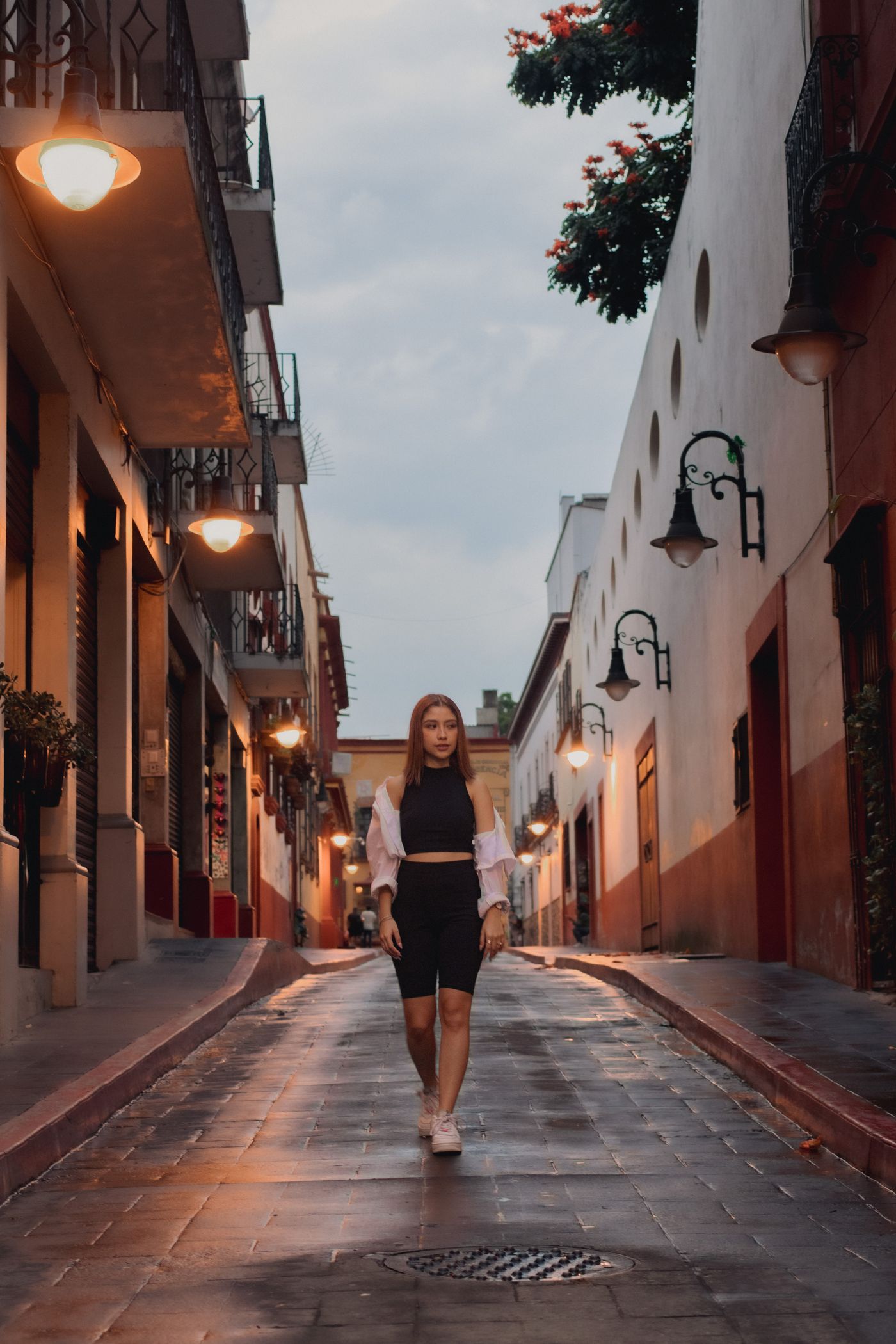
  <img src="/images/blog/pexels-approximation-cdmx-woman-walking.jpg" alt="A woman walking along a historic street in Mexico City at dusk." loading="lazy" />
  <figcaption>“Around there” makes sense when both people can see or picture the same part of the city. Photo by <a href="https://www.pexels.com/photo/woman-walking-on-street-in-town-14784969/" target="_blank" rel="noopener noreferrer">Un Buñuelo on Pexels</a>.</figcaption>
</figure>

## Más o menos is clear—until it describes your mood

<mark lang="es-MX">Más o menos</mark> is the safest general-purpose approximator here. Use it for time, cost, distance, quantity, or competence.

<ul class="examples">
  <li class="example">
    <div class="es" lang="es-MX">Falta más o menos media hora.</div>
    <div class="en" lang="en">There's about half an hour left.</div>
  </li>
  <li class="example">
    <div class="es" lang="es-MX">Entiendo más o menos.</div>
    <div class="en" lang="en">I understand more or less.</div>
  </li>
  <li class="example">
    <div class="es" lang="es-MX">—¿Cómo estás? —Más o menos.</div>
    <div class="en" lang="en">—How are you? —So-so.</div>
  </li>
</ul>

The third use is not numerical. The person may simply be having a rough day. You can leave a small opening with <mark lang="es-MX">¿todo bien?</mark> or <mark lang="es-MX">¿quieres contarme?</mark>

## Por ahí can point almost anywhere

<mark lang="es-MX">Por ahí</mark> can locate something loosely in space: “around there.” It can also loosen time, route, amount, or even a line of thought.

| You hear | Likely meaning | Useful follow-up |
|---|---|---|
| Vive por ahí | They live around there | ¿Por qué colonia? |
| Llego por ahí de las nueve | Around nine | ¿Te escribo cuando salga? |
| Cuesta por ahí de mil | Around 1,000 | ¿Ya con todo? |
| Va por ahí | That's roughly the idea | ¿Entonces así lo hacemos? |

<mark lang="es-MX">Por ahí</mark> can feel so under-specified that learners fire off four questions at once. Ask for the one detail that changes your next action. If you are choosing a Metro stop, ask for the neighborhood. If you are still sitting at home, ask when to leave.

<figure>
  <img src="/images/blog/pexels-approximation-garden-talk.jpg" alt="Two women talking beside a green garden pond." loading="lazy" />
  <figcaption>A relaxed clarification keeps the conversation open while making the plan usable. Photo by <a href="https://www.pexels.com/photo/casual-outdoor-conversation-among-friends-37071186/" target="_blank" rel="noopener noreferrer">Nowrin Sanjana on Pexels</a>.</figcaption>
</figure>

## When vagueness is social—and when it is a problem

Approximation lets a speaker contribute before every detail is settled. That is normal conversational work. Cervantes describes discourse markers as guides for interpretation rather than merely denotational content.[^cervantes-markers] These little words tell you, “Treat this as a useful sketch.”

But a sketch stops being enough when you need to buy a ticket, meet outside a locked building, pay a bill, take medicine, or catch the last train. Use warmer precision:

<ul class="examples">
  <li class="example">
    <div class="es" lang="es-MX">¿Como a qué hora para organizarme?</div>
    <div class="en" lang="en">Around what time, so I can plan?</div>
  </li>
  <li class="example">
    <div class="es" lang="es-MX">¿Por qué esquina más o menos?</div>
    <div class="en" lang="en">Around which corner?</div>
  </li>
  <li class="example">
    <div class="es" lang="es-MX">¿Son como quinientos o más cerca de mil?</div>
    <div class="en" lang="en">Is it around 500 or closer to 1,000?</div>
  </li>
</ul>

The phrase <mark lang="es-MX">para organizarme</mark> is a tiny social cushion. It explains why you need the number without accusing anyone of being vague.

## Try this the next time a plan gets fuzzy

When you hear an approximation word, identify its target.

Is the speaker blurring the time, number, category, place, manner, or confidence? Once you know that, decide whether the blur changes what you need to do. If it does, ask one calm question. If it does not, let the story breathe.

The useful skill is knowing when “eight-ish” is enough and when it needs to become an actual meeting time. Some parts of a plan can stay pleasantly loose. The part that leaves you standing outside a locked door probably cannot.

[^rae-tipo]: [Diccionario de la lengua española, tipo](https://dle.rae.es/tipo) — Real Academia Española.
[^rae-como]: [Diccionario de la lengua española, como](https://dle.rae.es/como) — Real Academia Española.
[^rae-aproximadamente]: [Diccionario de la lengua española, aproximadamente](https://dle.rae.es/aproximadamente) — Real Academia Española.
[^rae-asi]: [Diccionario de la lengua española, así](https://dle.rae.es/as%C3%AD) — Real Academia Española.
[^cervantes-deixis]: [Diccionario de términos clave de ELE, deíxis](https://cvc.cervantes.es/ensenanza/biblioteca_ELE/diccio_ele/diccionario/deixis.htm) — Instituto Cervantes.
[^cervantes-markers]: [Diccionario de términos clave de ELE, marcadores del discurso](https://cvc.cervantes.es/Ensenanza/biblioteca_ele/diccio_ele/diccionario/marcadoresdiscurso.htm) — Instituto Cervantes.

FAQ:
Q: What does tipo mean in Mexican Spanish?
A: Tipo can mean type or kind, but in conversation it also introduces an example or approximation, similar to like, kind of, or around.

Q: Does como mean approximately?
A: Yes. Before a number, time, or quantity, como often means about or approximately.

Q: What does por ahí mean in Mexico?
A: Depending on context, por ahí can mean around there, around that time, roughly that amount, or somewhere along those lines.

Q: Is más o menos negative?
A: Not always. It can give an approximate range, but as an answer to ¿cómo estás? it may suggest so-so.

Q: Why do Mexicans use así with hand gestures?
A: Así points to a manner, size, or degree that the shared situation or gesture supplies. Without that context, the phrase may feel incomplete.

Q: How do I clarify an approximate plan?
A: Ask one practical question such as ¿como a qué hora? or ¿por qué zona? That keeps the tone light while getting the detail you need.

Q: Is vague Mexican Spanish the same as being unreliable?
A: No. Approximation is normal in casual speech. Reliability comes from whether the person gives useful details and follows through when precision becomes necessary.

Sources:
- Diccionario de la lengua española, tipo: https://dle.rae.es/tipo
- Diccionario de la lengua española, como: https://dle.rae.es/como
- Diccionario de la lengua española, así: https://dle.rae.es/as%C3%AD
- Diccionario de la lengua española, aproximadamente: https://dle.rae.es/aproximadamente
- Instituto Cervantes, marcadores del discurso: https://cvc.cervantes.es/Ensenanza/biblioteca_ele/diccio_ele/diccionario/marcadoresdiscurso.htm
- Instituto Cervantes, deíxis: https://cvc.cervantes.es/ensenanza/biblioteca_ELE/diccio_ele/diccionario/deixis.htm

Related words: ahorita, al-rato, de-plano, que-rollo