---
title: "Cempasúchil: The Marigold Meant to Guide the Dead Home"
description: "Learn what cempasúchil means, why marigolds matter for Día de Muertos, and how to talk about the flower respectfully in Mexico."
type: "article"
category: "guides"
url: "https://consalsa.app/blog/cempasuchil-marigold"
canonical: "https://consalsa.app/blog/cempasuchil-marigold"
published: "2026-09-30"
updated: "2026-09-30"
author: "Andrey the Nomad"
site: "ConSalsa.App"
license: "https://consalsa.app/terms#ip"
---

# Cempasúchil: The Marigold Meant to Guide the Dead Home
URL: https://consalsa.app/blog/cempasuchil-marigold
Date: 2026-09-30
Updated: 2026-09-30
Category: guides
Keywords: cempasuchil meaning, marigold day of the dead, cempasuchil flower mexico
Summary: Learn what cempasúchil means, why marigolds matter for Día de Muertos, and how to talk about the flower respectfully in Mexico.

Quick answer:
- Cempasúchil is the orange marigold strongly associated with Día de Muertos in Mexico.
- Its color and scent are traditionally used to guide the dead back to the ofrenda.
- The word comes from Nahuatl roots often explained as twenty-flower or many-petaled flower.
- Use the flower respectfully; it is not just seasonal decor.

What you'll learn:
- What cempasúchil means and how to pronounce it gently.
- Why the flower appears on paths, arches, and ofrendas.
- How to ask for it at a market or flower stand.
- How to avoid treating a sacred seasonal symbol like a costume accessory.

Don't sound gringo:
Do not ask for flores de muerto at a stall. It is understood, but it is the tourist phrasing and it prices you accordingly. Ask for cempasúchil by name, say how many manojos you want, and the whole exchange changes register.

Body:

<mark lang="es-MX">Cempasúchil</mark> is the orange marigold that shows up everywhere in Mexico in late October, and the name is older than the holiday it now belongs to.

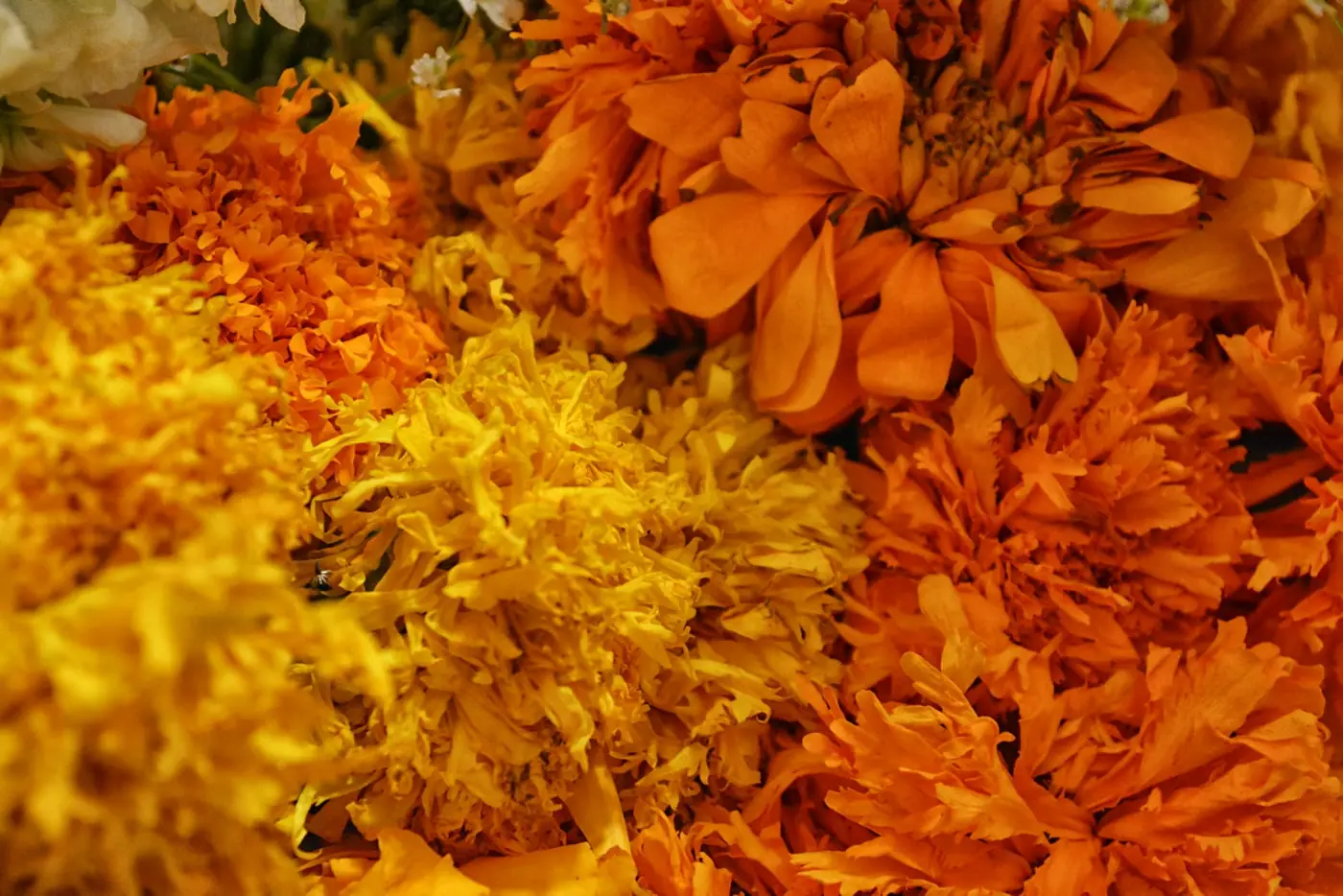
It comes from Nahuatl <mark lang="es-MX">cempohualxochitl</mark> — <mark lang="es-MX">cempoal</mark>, twenty, and <mark lang="es-MX">xóchitl</mark>, flower.[^uaeh] Twenty flowers, or, more loosely, a great many of them, which is what a single head of it actually looks like up close.

## The dictionary already explains why it works

The entry is unglamorous and it gives the game away: <em>Tagetes erecta</em>, a herbaceous plant of the composite family, cut leaves, **penetrating smell**.[^dem-cempasuchil]

That last part is the whole function. The flower is not on the path because it is pretty. It is there because you can smell it from a distance and see it in low light.

| What it does | How |
|---|---|
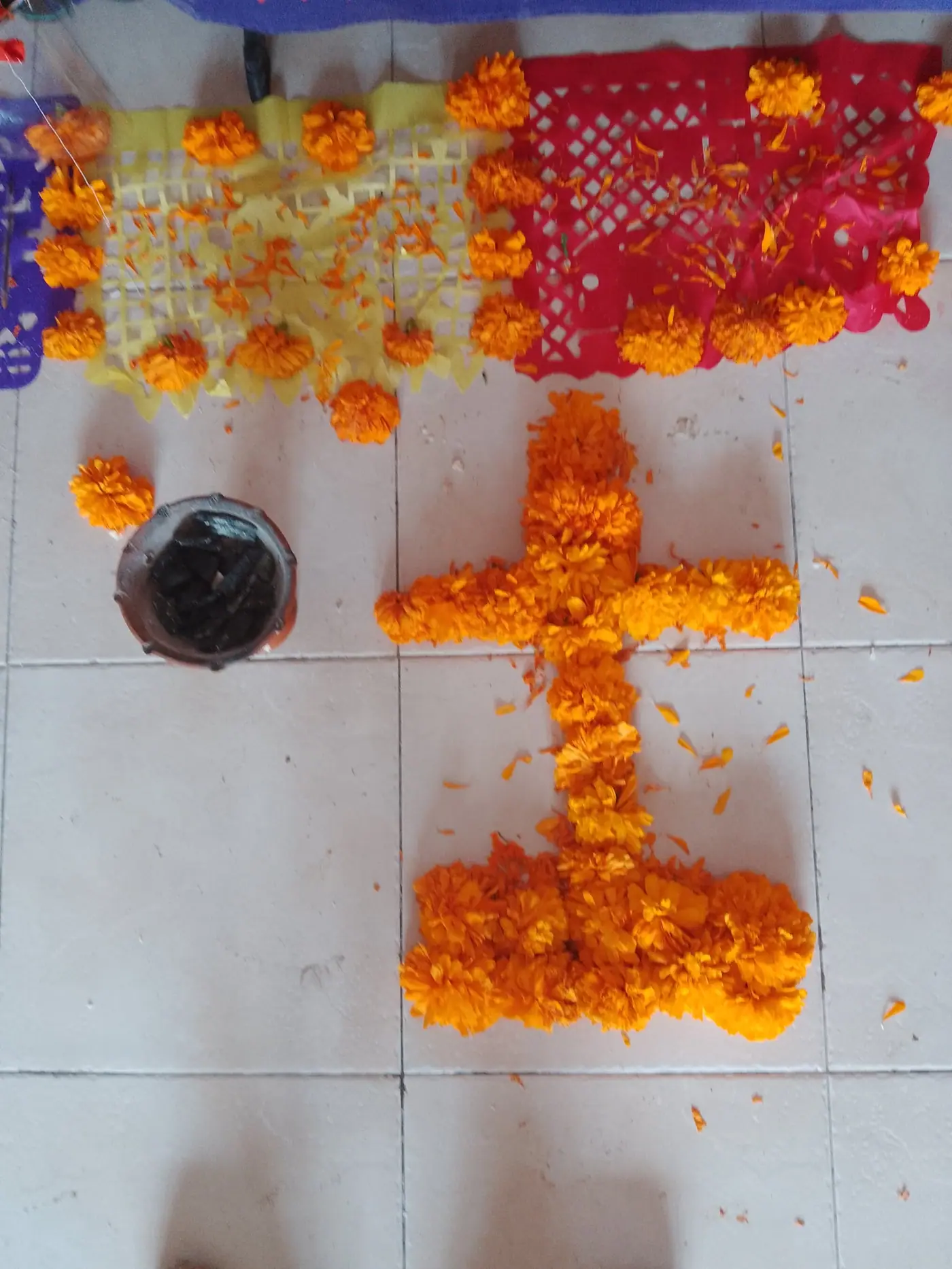
| marks the route | petals laid from the street door to the altar |
| carries in the dark | an orange that stays visible at dusk |
| announces the house | a scent strong enough to reach the sidewalk |
| dates the season | it is only everywhere for about three weeks |

The color lights the way and the aroma guides the souls — that is the traditional formulation, and families lay petal paths to lead their dead from the street to the <mark lang="es-MX">ofrenda</mark>.[^uaeh] UNESCO's inscription describes the same practice across Nahua, Maya, Zapotec and Mixtec communities.[^unesco]

<figure>
  <img src="/images/blog/optimized/cempasuchil-marigold-1-1400-2bfbfb30.webp" alt="Close-up of orange cempasuchil marigold flowers packed together" loading="lazy" />
  <figcaption>Twenty flowers, roughly. Up close a single head is a crowd of petals. Photo by ProtoplasmaKid, <a href="https://creativecommons.org/licenses/by-sa/4.0/">CC BY-SA 4.0</a>.</figcaption>
</figure>

## It was medicine long before it was a path

The part almost nobody outside Mexico knows: <mark lang="es-MX">cempasúchil</mark> is documented in the two great sixteenth-century sources on Mexica knowledge — the Códice Florentino and the Códice Badiano — as a remedy, used against digestive complaints.[^uaeh]

The Mexica treated it as a symbol of life and death together, not of mourning.[^uaeh] It sat with the sun and with renewal.

So the flower did not become sacred because of Día de Muertos. It was already carrying weight, and the holiday inherited it. That is a better answer than "it's the flower of the dead" if anyone asks you why it matters, and it is also why treating it as seasonal decor lands slightly wrong.

<div class="note-card is-tip">
  <span class="note-label">Worth saying out loud</span>
  <p>If you buy <span lang="es-MX">cempasúchil</span> for your own place in October, nobody minds at all — it is sold on every corner precisely so people will. The line people notice is treating it as a prop: a bunch on the table is normal, a bunch worn as a costume accessory reads differently. The flower is doing a job, and the job is not you.</p>
</div>

## It is a crop, on a deadline

This is a farmed product with a brutally short window. Puebla is the largest producer in the country, with over fifteen thousand tonnes of cut flower in a season,[^jornada-oriente] and essentially all of it has to move in the last two weeks of October.

Which explains the thing you will notice at the market: prices swing hard, and they swing late. The stalls are not being opportunistic so much as racing a flower that cannot wait.

<div class="chat-thread">
  <div class="chat-head"><span class="chat-avatar"></span><span>Puesto de flores, 28 de octubre</span><span class="chat-meta">the units are the whole conversation</span></div>
  <ul class="chat-msgs">
    <li class="out"><span class="es" lang="es-MX">¿a cómo el manojo de cempasúchil?</span><span class="en">how much for a bunch of cempasúchil?</span></li>
    <li class="in"><span class="es" lang="es-MX">a cincuenta, o tres por ciento treinta</span><span class="en">fifty, or three for a hundred and thirty</span></li>
    <li class="out"><span class="es" lang="es-MX">deme tres, y un poquito de pétalo suelto</span><span class="en">give me three, and a bit of loose petal</span></li>
  </ul>
  <p class="chat-read">He asked by the <span lang="es-MX">manojo</span> and got a bundle price instantly. <strong>The loose petals for the path are usually sold separately</strong>, often by the bag, and asking for <span lang="es-MX">pétalo suelto</span> is the move that marks you as someone actually building an altar.</p>
</div>

If you want the fuller version of buying flowers by the right unit, [Mercado Jamaica has its own vocabulary](/blog/mercado-jamaica-spanish) — that market runs on <mark lang="es-MX">gruesas</mark> and <mark lang="es-MX">manojos</mark> rather than stems, and knowing which one you are asking about changes the price you are quoted.
<div id="midpost-newsletter-slot"></div>

<figure>
  <img src="/images/blog/optimized/cempasuchil-marigold-2-1400-9460b5cf.webp" alt="A cross laid out in loose marigold petals on a tiled floor" loading="lazy" />
  <figcaption>Loose petals are a separate purchase. Laid on the ground they become a route, or a cross at the threshold. Photo by Macadventures2, <a href="https://creativecommons.org/licenses/by-sa/4.0/">CC BY-SA 4.0</a>.</figcaption>
</figure>

## The three weeks it exists

The flower has a window, and it is short. Stalls start carrying it seriously in the second half of October, everything peaks around the 30th and 31st, and by the first week of November it is gone from the corners it was spilling off a few days earlier.

Which makes it a seasonal marker in conversation as much as on an altar. <mark lang="es-MX">Ya hay cempasúchil</mark> works the way "the pumpkins are out" does in the US — it is a statement about the time of year, not about flowers. And <mark lang="es-MX">¿ya pusieron su ofrenda?</mark> becomes an ordinary question people ask each other at work, roughly as small talk, from about the 25th.

<ul class="examples">
  <li class="example">
    <div class="es" lang="es-MX">Ya hay cempasúchil en el mercado.</div>
    <div class="en" lang="en">The marigolds are out at the market.</div>
  </li>
  <li class="example">
    <div class="es" lang="es-MX">¿Ya pusieron su ofrenda?</div>
    <div class="en" lang="en">Have you all put your altar up yet?</div>
  </li>
  <li class="example">
    <div class="es" lang="es-MX">Compré de más, se me marchitó todo.</div>
    <div class="en" lang="en">I bought too much and it all wilted on me.</div>
  </li>
</ul>

That last one is the practical warning. Cut <mark lang="es-MX">cempasúchil</mark> does not last. If you are buying for the 2nd, buy on the 1st, not the weekend before.

## Saying it without stalling

Four syllables, stress on the third: **sem-pa-SÚ-chil**. The accent mark on the <mark lang="es-MX">ú</mark> is doing exactly what it looks like it is doing.

<div class="do-dont">
  <div class="dd-col dd-do">
    <p class="dd-title">Works</p>
    <ul>
      <li><b lang="es-MX">cempasúchil</b> said slowly. Nobody minds slow.</li>
      <li><b lang="es-MX">flor de cempasúchil</b> if you want a running start.</li>
      <li><b lang="es-MX">¿a cómo el manojo?</b> at a stall.</li>
      <li>Asking <b lang="es-MX">¿de dónde la traen?</b> — growers love this question.</li>
    </ul>
  </div>
  <div class="dd-col dd-dont">
    <p class="dd-title">Marks you</p>
    <ul>
      <li><b lang="es-MX">flores de muerto</b> — understood, but it is the visitor phrase.</li>
      <li>Calling it <b>Mexican marigold</b> while standing in Mexico.</li>
      <li>Asking for <b lang="es-MX">una flor</b> when you mean a bunch.</li>
      <li>Buying it on 2 November and expecting October prices.</li>
    </ul>
  </div>
</div>

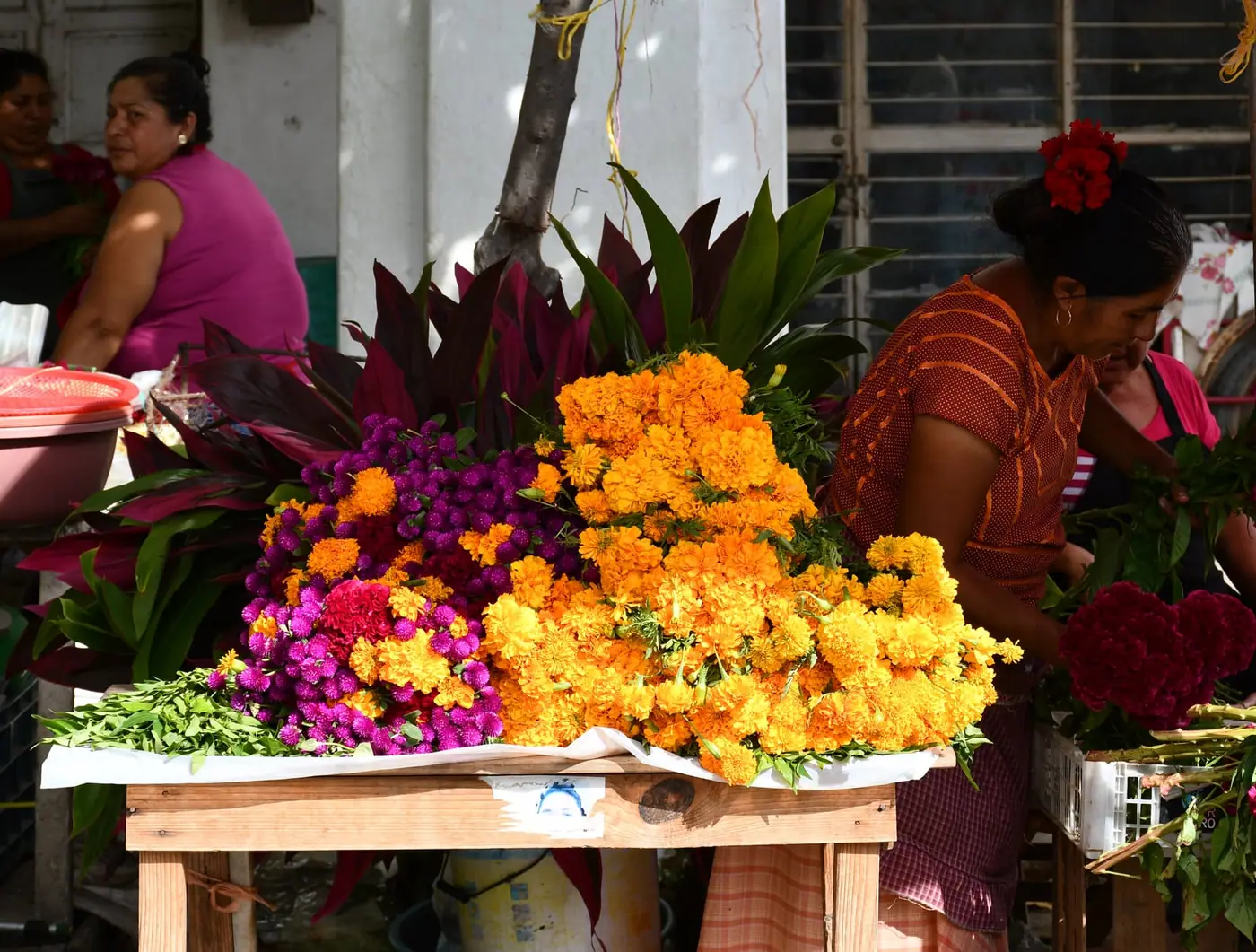
There is also a second flower you will see beside it, deep red, sold in the same bundles: <mark lang="es-MX">terciopelo</mark>, cockscomb. Ask for one and you will get one. Ask for <mark lang="es-MX">flores</mark> and you will get a decision made for you.

<figure>
  <img src="/images/blog/optimized/cempasuchil-marigold-3-1400-64a59b47.webp" alt="A market flower stall stacked with orange and magenta Day of the Dead flowers" loading="lazy" />
  <figcaption>Orange is cempasuchil. The deep red next to it is terciopelo, and it is a different order. Photo by Gzzz, <a href="https://creativecommons.org/licenses/by-sa/4.0/">CC BY-SA 4.0</a>.</figcaption>
</figure>

Three weeks a year the whole country smells faintly of this thing, and then it is gone until the following October. Buy it by name.[^inali]

*Hero photo by Pedro Alonso Benítez, [CC BY-SA 4.0](https://creativecommons.org/licenses/by-sa/4.0/).*

[^dem-cempasuchil]: [Diccionario del español de México, cempasúchil](https://dem.colmex.mx/ver/cempasuchil) - El Colegio de México
[^uaeh]: [UAEH, flor de cempasúchil: símbolo de tradiciones y conocimiento ancestral](https://www.uaeh.edu.mx/gaceta/3/numero33/noviembre/flor-de-cempasuchil.html) - Universidad Autónoma del Estado de Hidalgo
[^unesco]: [UNESCO, las fiestas indígenas dedicadas a los muertos](https://ich.unesco.org/es/RL/las-fiestas-indigenas-dedicadas-a-los-muertos-00054) - Lista Representativa del Patrimonio Cultural Inmaterial de la Humanidad, 2008
[^jornada-oriente]: [La Jornada de Oriente, Puebla primer lugar en producción de cempasúchil](https://www.lajornadadeoriente.com.mx/puebla/con-mas-15-mil-toneladas-obtenidas-puebla-es-primer-lugar-en-produccion-de-cempasuchil/)
[^inali]: [INALI, Día de Muertos, Patrimonio Cultural Inmaterial de la Humanidad](https://www.inali.gob.mx/detalle/2018-10-31-18-10-36) - Instituto Nacional de Lenguas Indígenas

FAQ:
Q: What does cempasúchil mean?
A: The name comes from Nahuatl, usually explained as twenty flower or many-petalled flower - a reference to the dense layers of petals rather than an exact count.

Q: How do you pronounce it?
A: sem-pa-SOO-cheel. The stress lands on the third syllable, and the ch is the same as in English chair.

Q: Why is it used for Día de Muertos?
A: Its color and its strong scent are traditionally understood to guide the dead back to the ofrenda. Petals are often scattered in a path from the door to the altar for exactly that reason.

Q: Is cempasúchil the same as a marigold?
A: It is a marigold, but a specific one - the large orange Mexican variety. The small garden marigolds sold elsewhere are relatives, not the same flower.

Q: When is it in season?
A: It is grown for late October and early November, and it appears in markets in enormous quantities in the weeks before Día de Muertos, then largely disappears.

Q: How is it sold?
A: By the manojo, the bunch, and by the whole plant. At the big flower markets it is also sold by the gruesa, which is twelve dozen.

Q: Can I buy it just as decoration?
A: You can, and plenty of people do. It is worth knowing what it signifies, though - during Día de Muertos it reads as part of a memorial rather than as seasonal color.

Q: Is there another flower used alongside it?
A: Yes. Terciopelo, the deep red cockscomb, and nube, the small white filler, are the other two you will see stacked beside it in the markets.

Sources:
- Diccionario del español de México, cempasúchil: https://dem.colmex.mx/ver/cempasuchil
- UAEH, flor de cempasúchil: símbolo de tradiciones y conocimiento ancestral: https://www.uaeh.edu.mx/gaceta/3/numero33/noviembre/flor-de-cempasuchil.html
- UNESCO, las fiestas indígenas dedicadas a los muertos: https://ich.unesco.org/es/RL/las-fiestas-indigenas-dedicadas-a-los-muertos-00054
- INALI, Día de Muertos, Patrimonio Cultural Inmaterial de la Humanidad: https://www.inali.gob.mx/detalle/2018-10-31-18-10-36
- La Jornada de Oriente, Puebla primer lugar en producción de cempasúchil: https://www.lajornadadeoriente.com.mx/puebla/con-mas-15-mil-toneladas-obtenidas-puebla-es-primer-lugar-en-produccion-de-cempasuchil/

Related words: neta, mande, padre, fresa