---
title: "What Goes on a Day of the Dead Altar: 9 Objects and What They Mean"
description: "Learn the Spanish for Day of the Dead altar objects: ofrenda, cempasúchil, velas, pan de muerto, calaveras, papel picado, and more."
type: "article"
category: "guides"
url: "https://consalsa.app/blog/day-of-the-dead-altar-objects"
canonical: "https://consalsa.app/blog/day-of-the-dead-altar-objects"
published: "2026-09-28"
updated: "2026-09-28"
author: "Andrey the Nomad"
site: "ConSalsa.App"
license: "https://consalsa.app/terms#ip"
---

# What Goes on a Day of the Dead Altar: 9 Objects and What They Mean
URL: https://consalsa.app/blog/day-of-the-dead-altar-objects
Date: 2026-09-28
Updated: 2026-09-28
Category: guides
Keywords: what goes on a day of the dead altar, day of the dead altar objects, ofrenda objects spanish
Summary: Learn the Spanish for Day of the Dead altar objects: ofrenda, cempasúchil, velas, pan de muerto, calaveras, papel picado, and more.

Quick answer:
- A Day of the Dead altar is usually called an ofrenda in Mexico.
- Common objects include candles, cempasúchil, photos, water, food, pan de muerto, papel picado, and sugar skulls.
- The objects welcome, honor, and remember loved ones who have died.
- Treat ofrendas as memory spaces, not photo props.

What you'll learn:
- The Spanish names for common altar objects.
- What each object is doing symbolically on an ofrenda.
- How to talk about an altar respectfully as a visitor or learner.
- What not to touch, move, joke about, or turn into content.

Don't sound gringo:
Do not call the candles velas if you want to sound like you have seen an ofrenda before. The thick short ones on an altar are veladoras, and the word is doing real work — a veladora is specifically the kind you light in homage. Same object, different job, different noun.

Body:

The altar is called an <mark lang="es-MX">ofrenda</mark>, and the word is literal: something offered, placed for a divinity or in memory of someone.[^dem-ofrenda] Not a display. An offering, with a recipient.

That is the key to the whole thing. Every object on it is there to do a job for a guest who is arriving tired, and once you know which job, the altar reads like a set table instead of a decoration.

## Everything belongs to one of four elements

The organizing logic most families use is elemental. Nothing is on there because it looked good.

| Element | Object | The job it does |
|---|---|---|
| water | <mark lang="es-MX">el agua</mark> | the journey is long and the guest arrives thirsty |
| wind | <mark lang="es-MX">el papel picado</mark> | it moves, so you can see the air is stirring |
| earth | <mark lang="es-MX">la comida</mark>, seeds, fruit | what the ground gave, given back |
| fire | <mark lang="es-MX">las veladoras</mark> | light to find the house by |

UNESCO inscribed the festivity on its Representative List of the Intangible Cultural Heritage of Humanity in 2008, describing it across Nahua, Maya, Zapotec and Mixtec communities as, above all, the return of the souls of the dead.[^unesco-ich][^inali]

Return is the operative word. You are not commemorating an absence. You are receiving somebody.

<figure>
  <img src="/images/blog/optimized/day-of-the-dead-altar-objects-1-1400-eba778b5.webp" alt="A home Day of the Dead altar with framed photographs, sugar skulls and marigolds" loading="lazy" />
  <figcaption>Not a display. A table set for someone expected. Photo by Luisroj96, <a href="https://creativecommons.org/licenses/by-sa/3.0/">CC BY-SA 3.0</a>.</figcaption>
</figure>

## The nine objects and what each one is for

| Object | Spanish | Why it is there |
|---|---|---|
| photograph | <mark lang="es-MX">la foto</mark> | names the guest; without it the altar is for nobody in particular |
| water | <mark lang="es-MX">el agua</mark> | thirst after the journey |
| salt | <mark lang="es-MX">la sal</mark> | purification, and it keeps the body from corrupting on the way back |
| candles | <mark lang="es-MX">las veladoras</mark> | light to navigate by |
| copal | <mark lang="es-MX">el copal</mark> | scent that clears the space |
| marigolds | <mark lang="es-MX">el cempasúchil</mark> | color and smell that mark the path |
| cut paper | <mark lang="es-MX">el papel picado</mark> | wind made visible |
| bread | <mark lang="es-MX">el pan de muerto</mark> | food, and a shape that is not accidental |
| sugar skulls | <mark lang="es-MX">las calaveritas</mark> | the guest, named, in sugar |

Three of these have more going on than the list suggests.

<mark lang="es-MX">Copal</mark> is a resin from trees of the Burseraceae family, burned to perfume a space with an intense aroma — and the dictionary sense points specifically at temples.[^dem-copal] It is not incense in the general sense. It is the pre-Hispanic ceremonial smoke, still doing the same job on a kitchen table in Iztapalapa.

<mark lang="es-MX">Veladora</mark> is not a synonym for <mark lang="es-MX">vela</mark>. A <mark lang="es-MX">veladora</mark> is a thick, low candle lit in homage, on altars.[^dem-veladora] The word already contains the purpose. Calling them <mark lang="es-MX">velas</mark> is not wrong, exactly, it is just the birthday-cake word.

And under all of it there is often a <mark lang="es-MX">petate</mark>, a mat woven from palm or tule — the thing people traditionally sleep on.[^dem-petate] Food goes on the <mark lang="es-MX">petate</mark> because the guest has come a long way and is going to rest.

<div id="midpost-newsletter-slot"></div>

## Why some altars have steps

The number of levels is not decoration either, and it varies by family and region.

<ol class="ladder">
  <li>
    <div class="rung-card">
      <span class="rung-label">two levels</span>
      <span class="rung-es" lang="es-MX">Cielo y tierra</span>
      <span class="rung-en" lang="en">Sky and earth</span>
      <span class="rung-note">The simplest and most common in a home. The photograph goes up, the food goes down.</span>
    </div>
  </li>
  <li>
    <div class="rung-card">
      <span class="rung-label">three levels</span>
      <span class="rung-es" lang="es-MX">Cielo, tierra e inframundo</span>
      <span class="rung-en" lang="en">Sky, earth and underworld</span>
      <span class="rung-note">The pre-Hispanic three-part cosmos, which in many households is also read through a Catholic lens.</span>
    </div>
  </li>
  <li>
    <div class="rung-card">
      <span class="rung-label">seven levels</span>
      <span class="rung-es" lang="es-MX">Los siete niveles</span>
      <span class="rung-en" lang="en">The seven levels</span>
      <span class="rung-note">The full version, read as the stages a soul passes on the way to Mictlán. You will see these in public and community altars more than in kitchens.</span>
    </div>
  </li>
</ol>

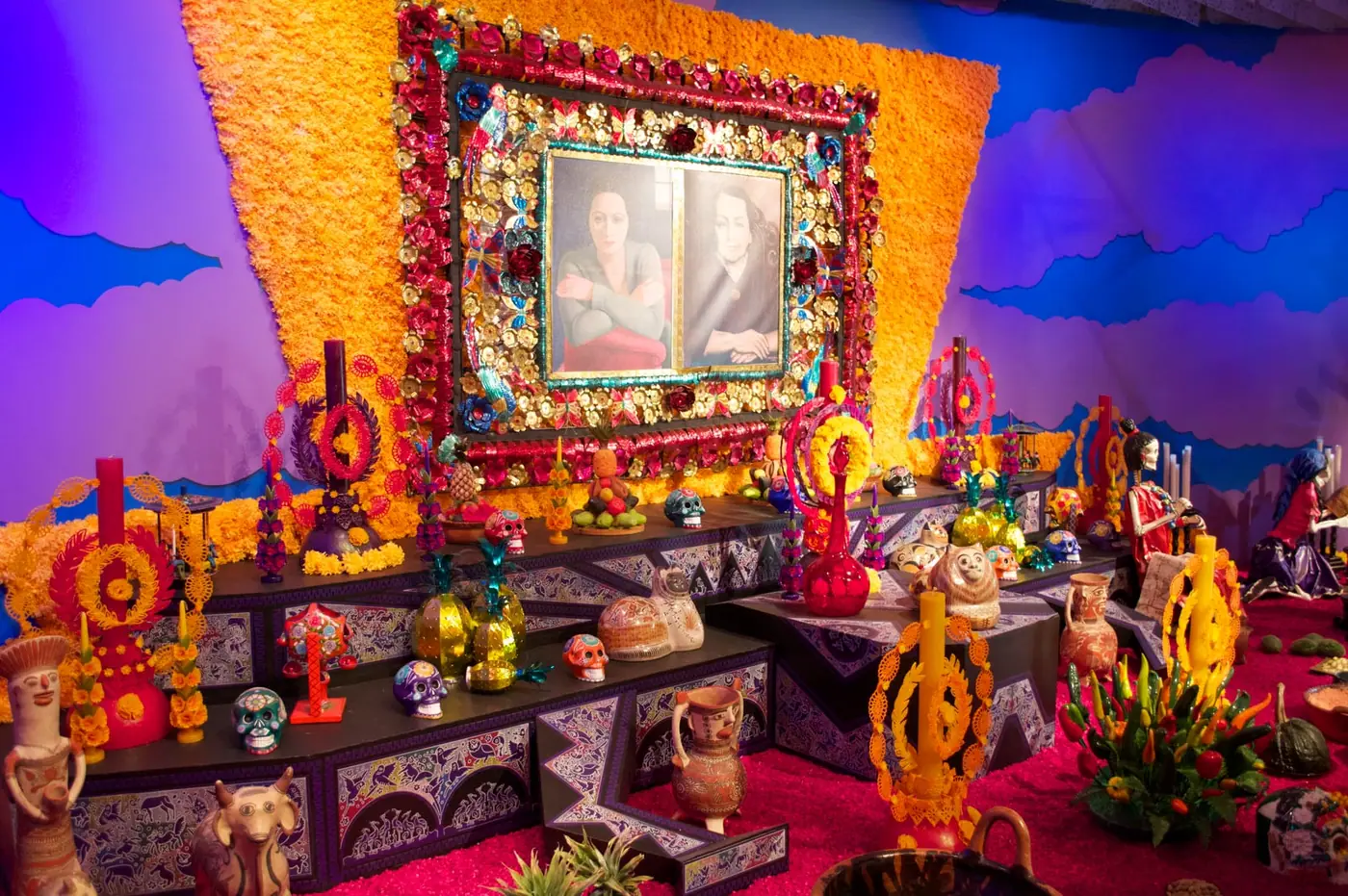
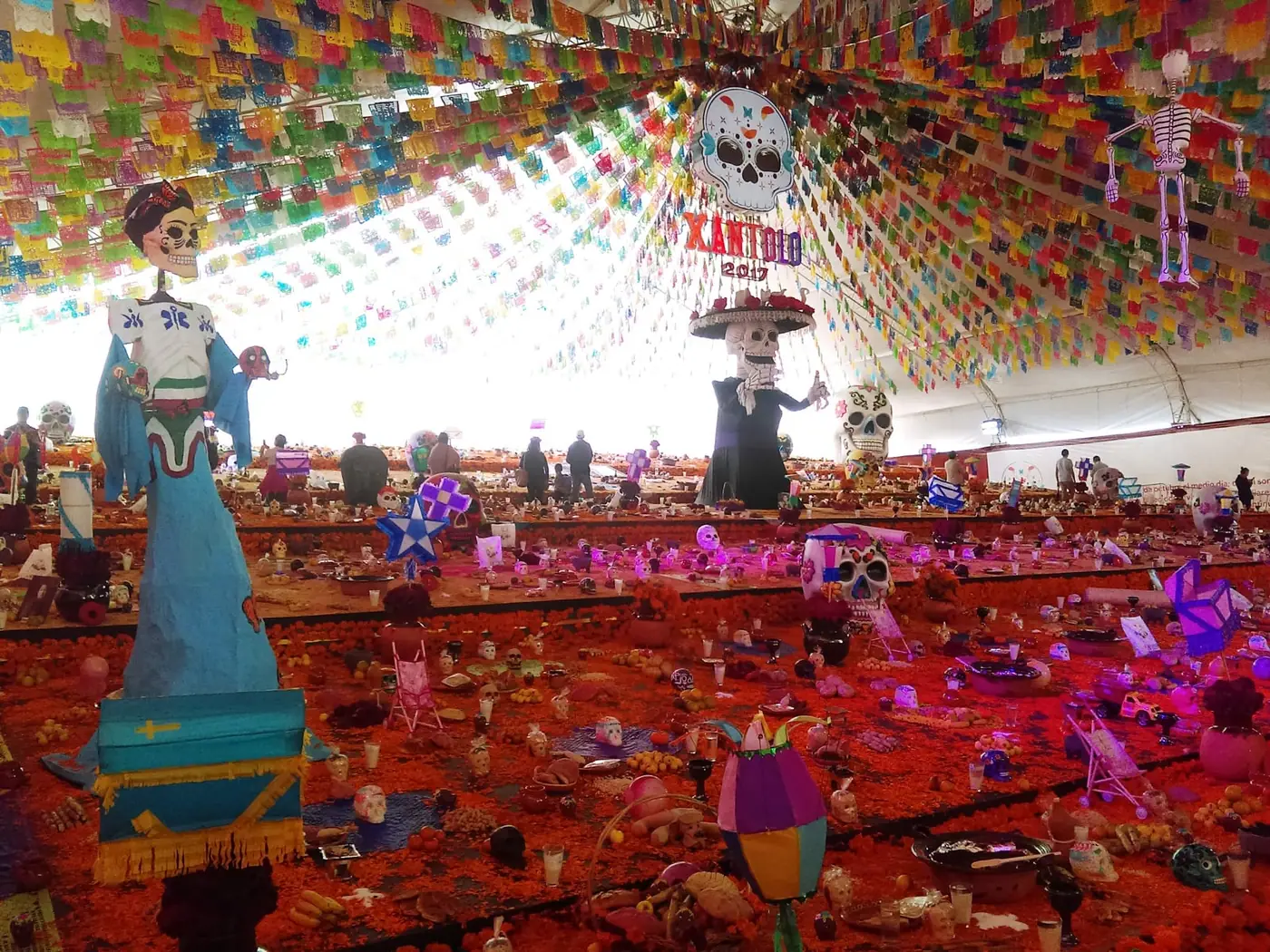
If you are shown a two-level altar in someone's apartment, that is not a small or lesser version. Most family <mark lang="es-MX">ofrendas</mark> are exactly that, and the seven-level ones you see photographed are usually institutional.

<figure>
  <img src="/images/blog/optimized/day-of-the-dead-altar-objects-2-1400-1fc7fe6c.webp" alt="A large multi-level public ofrenda in a plaza, covered in candles and marigolds" loading="lazy" />
  <figcaption>Levels are cosmology, not styling. The tall ones like this are usually public rather than domestic. Photo by RubeHM, <a href="https://creativecommons.org/licenses/by-sa/4.0/">CC BY-SA 4.0</a>.</figcaption>
</figure>

## Being shown one

An <mark lang="es-MX">ofrenda</mark> in a home is a private thing that you are being let into, which is a different situation from the ones in museums and plazas.

<div class="do-dont">
  <div class="dd-col dd-do">
    <p class="dd-title">Fine</p>
    <ul>
      <li>Asking who each photograph is. This is the point of the altar.</li>
      <li>Asking <b lang="es-MX">¿y a él qué le gustaba?</b> about the food chosen.</li>
      <li>Saying you are sorry for their loss, plainly.</li>
      <li>Asking before you photograph anything.</li>
    </ul>
  </div>
  <div class="dd-col dd-dont">
    <p class="dd-title">Not fine</p>
    <ul>
      <li>Moving an object to get a better shot.</li>
      <li>Eating anything on it before the family does.</li>
      <li>Calling it spooky, or comparing it to Halloween.</li>
      <li>Treating a stranger's altar as a photo backdrop.</li>
    </ul>
  </div>
</div>

<div class="note-card is-safety">
  <span class="note-label">The one that gets people</span>
  <p>The food on an <span lang="es-MX">ofrenda</span> is not out for guests. It is set for a specific dead person, chosen because it was theirs, and it usually gets eaten by the family afterwards — the belief being that the essence has already been taken. Helping yourself to a <span lang="es-MX">pan de muerto</span> off an altar is the single most common foreign mistake and the one people remember.</p>
</div>

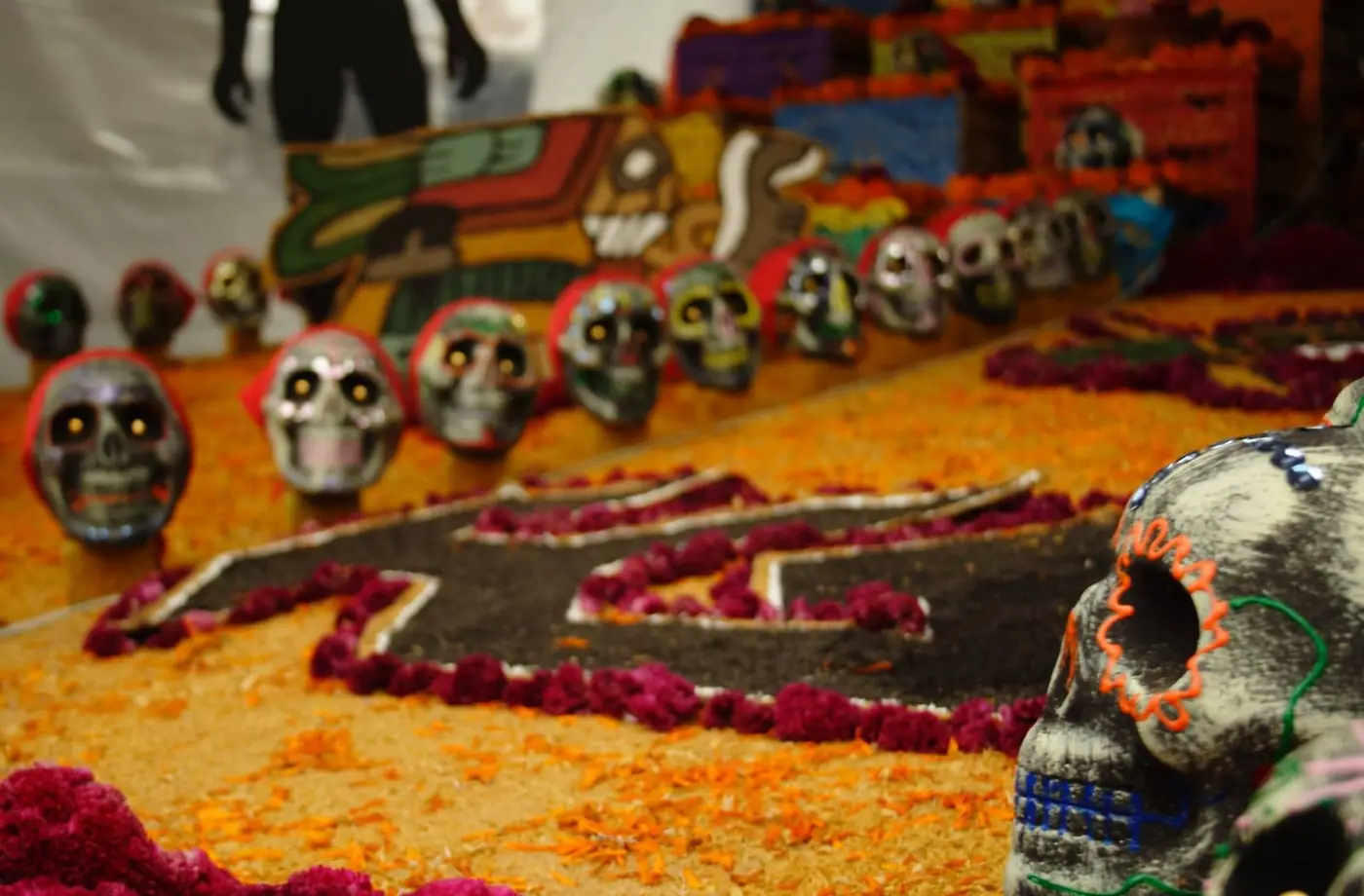
The bread, the sugar skulls and the sentences to say while standing in front of an altar each have their own logic, and each gets its own page here through the season.

<figure>
  <img src="/images/blog/optimized/day-of-the-dead-altar-objects-3-1400-e4416d2d.webp" alt="An ofrenda with sugar skulls and a path of marigold petals laid in front of it" loading="lazy" />
  <figcaption>The petals are a route, laid from the door to the table. Photo by Adrián Cerón, <a href="https://creativecommons.org/licenses/by-sa/4.0/">CC BY-SA 4.0</a>.</figcaption>
</figure>

Nine objects, four elements, one guest. That is the entire grammar of it, and it is the same in a museum installation and on a shelf in a one-room apartment.

*Hero photo by RubeHM, [CC BY-SA 4.0](https://creativecommons.org/licenses/by-sa/4.0/).*

[^unesco-ich]: [UNESCO, las fiestas indígenas dedicadas a los muertos](https://ich.unesco.org/es/RL/las-fiestas-indigenas-dedicadas-a-los-muertos-00054) - Lista Representativa del Patrimonio Cultural Inmaterial de la Humanidad, 2008
[^inali]: [INALI, Día de Muertos, Patrimonio Cultural Inmaterial de la Humanidad](https://www.inali.gob.mx/detalle/2018-10-31-18-10-36) - Instituto Nacional de Lenguas Indígenas
[^dem-ofrenda]: [Diccionario del español de México, ofrenda](https://dem.colmex.mx/ver/ofrenda) - El Colegio de México
[^dem-copal]: [Diccionario del español de México, copal](https://dem.colmex.mx/ver/copal) - El Colegio de México
[^dem-veladora]: [Diccionario del español de México, veladora](https://dem.colmex.mx/ver/veladora) - El Colegio de México
[^dem-petate]: [Diccionario del español de México, petate](https://dem.colmex.mx/ver/petate) - El Colegio de México

FAQ:
Q: What does ofrenda mean?
A: Offering. In Mexico it is the standard word for the Day of the Dead altar itself, so you build an ofrenda rather than a Day of the Dead altar.

Q: Why is there always water on the altar?
A: To quench the thirst of the souls after the journey, and because water represents the source of life. It is one of the few items considered essential on almost every ofrenda.

Q: What is the salt for?
A: Purification. A small dish of salt is placed so the body of the returning soul does not corrupt on the way there and back.

Q: What does copal do?
A: Copal is a tree resin burned as incense. Its smoke is understood to clear the space and to carry prayers, and its smell is one of the strongest markers of the season.

Q: What is papel picado for?
A: The cut tissue paper represents air, one of the four elements. Its movement is also taken as a sign that the souls have arrived and are passing through.

Q: Why put out the person's favorite food?
A: Because the ofrenda is an act of hospitality, not a display. Serving what someone actually liked is the difference between remembering a person and decorating for a holiday.

Q: What is pan de muerto and where does it come from?
A: A sweet bread baked for the season, usually round with strips of dough on top that are widely read as bones, and a knob at the center read as a skull.

Q: Can I visit or photograph someone's ofrenda?
A: Ask first, always. Public ofrendas in plazas and museums are made to be seen; a family one in a home or a cemetery is a memory space, and treating it as a photo backdrop lands badly.

Sources:
- UNESCO, las fiestas indígenas dedicadas a los muertos: https://ich.unesco.org/es/RL/las-fiestas-indigenas-dedicadas-a-los-muertos-00054
- INALI, Día de Muertos, Patrimonio Cultural Inmaterial de la Humanidad: https://www.inali.gob.mx/detalle/2018-10-31-18-10-36
- Diccionario del español de México, ofrenda: https://dem.colmex.mx/ver/ofrenda
- Diccionario del español de México, copal: https://dem.colmex.mx/ver/copal
- Diccionario del español de México, veladora: https://dem.colmex.mx/ver/veladora
- Diccionario del español de México, petate: https://dem.colmex.mx/ver/petate

Related words: mande, jefa, jefe, neta