---
title: "Can Foreigners Paint Their Face for Día de Muertos? The Honest, Non-Cringe Answer"
description: "Can foreigners wear Día de Muertos face paint? Learn when it is okay, what to avoid, and the Spanish to ask respectfully."
type: "article"
category: "manners"
url: "https://consalsa.app/blog/day-of-the-dead-face-paint"
canonical: "https://consalsa.app/blog/day-of-the-dead-face-paint"
published: "2026-10-27"
updated: "2026-10-27"
author: "Andrey the Nomad"
site: "ConSalsa.App"
license: "https://consalsa.app/terms#ip"
---
# Can Foreigners Paint Their Face for Día de Muertos? The Honest, Non-Cringe Answer
URL: https://consalsa.app/blog/day-of-the-dead-face-paint
Date: 2026-10-27
Updated: 2026-10-27
Category: manners
Keywords: day of the dead face paint foreigners, dia de muertos makeup etiquette, can foreigners paint face day of dead, catrina makeup respect
Summary: Can foreigners wear Día de Muertos face paint? Learn when it is okay, what to avoid, and the Spanish to ask respectfully.
Quick answer:
- Foreigners can wear Día de Muertos-style face paint in public festival contexts when it is done respectfully.
- The safest version highlights artistry, Catrina tradition, and public celebration, not shock, gore, or 'spooky Mexico.'
- Do not use private family altars, cemeteries, or mourning spaces as costume backdrops.
- Ask before photos, credit the artist, and avoid calling it Halloween makeup.
What you'll learn:
- When face paint is welcome and when it is better to skip it.
- How to compliment Catrina makeup in Mexican Spanish.
- What words to avoid if you do not want to sound like a tourist caricature.
- How to ask permission before photos at events or altars.
Don't sound gringo:
Don't call it 'sugar skull Halloween makeup.' Say maquillaje de Catrina or maquillaje de Día de Muertos, and compliment the artistry before you ask for a photo.
Body:
Yes, foreigners can wear Día de Muertos face paint in many public festival settings. The honest answer has a second half, though: it depends how you do it, where you do it, and whether you treat the look as Mexican artistry or as spooky decoration.
The phrase you want is usually maquillaje de Catrina or maquillaje de Día de Muertos, not "Halloween skull makeup." That one wording choice already changes the room.
## The etiquette map
| Context | Usually okay? | Better Spanish | Don't do this |
|---|---|---|---|
| Public parade | Yes | maquillaje de Catrina | gore jokes |
| Costume party | Usually | inspirado en Día de Muertos | fake accents |
| Family ofrenda | Ask first | ¿puedo tomar foto? | posing without permission |
| Cemetery visit | Be careful | lo digo con respeto | content-mode behavior |
Maquillaje means makeup, and disfraz means costume.[^maquillaje][^disfraz] Around Día de Muertos, those words are not automatically offensive. The risk is when the person wearing them acts like the tradition is a theme party with no memory behind it.
You are not trying to win permission from the internet. You are trying to behave well in the room.
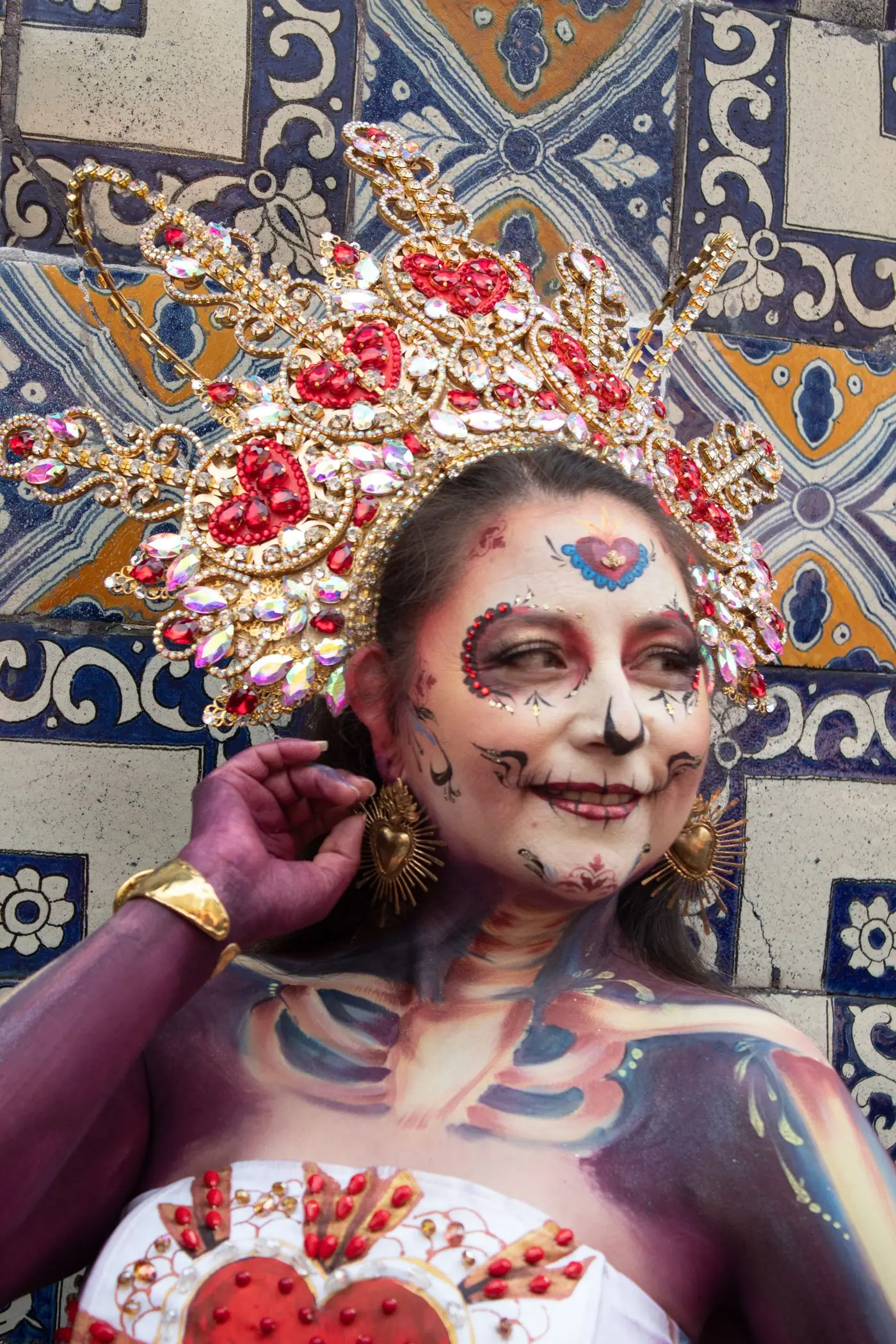
A polished Catrina portrait shows the artistry side of the question, not a horror costume.
## What makes it respectful
Good face paint looks intentional. It has craft, symmetry, flowers, color, and often an elegant Catrina influence. [La Catrina's image](/blog/who-is-la-catrina) is tied to Mexican printmaking, satire, and public culture, especially through José Guadalupe Posada and later visual traditions.[^posada] There is a male counterpart too, the [catrín](/blog/catrina-vs-catrin), if you want the full pair.
That does not mean every [skull face](/blog/what-do-sugar-skulls-mean) is automatically Catrina. If you are not sure, compliment the visible work instead of labeling it. Te quedó increíble el maquillaje is warmer than "nice skull."
Te quedó increíble el maquillaje.
Your makeup came out amazing.
¿Quién te lo hizo?
Who did it for you?
¿Puedo tomar una foto?
Can I take a photo?
## What makes it cringe
The bad version is not "foreigner has paint." The bad version is treating Día de Muertos like an exotic Halloween filter. Gore, drunk skeleton jokes, fake accents, sexy-dead captions, and posing on or near family memorials are the danger zone.
UNESCO describes the festivity as a living cultural practice connected to welcoming and honoring the dead.[^unesco] That is why your behavior matters more than your cheekbone shading. Public celebration and private remembrance can exist on the same weekend.
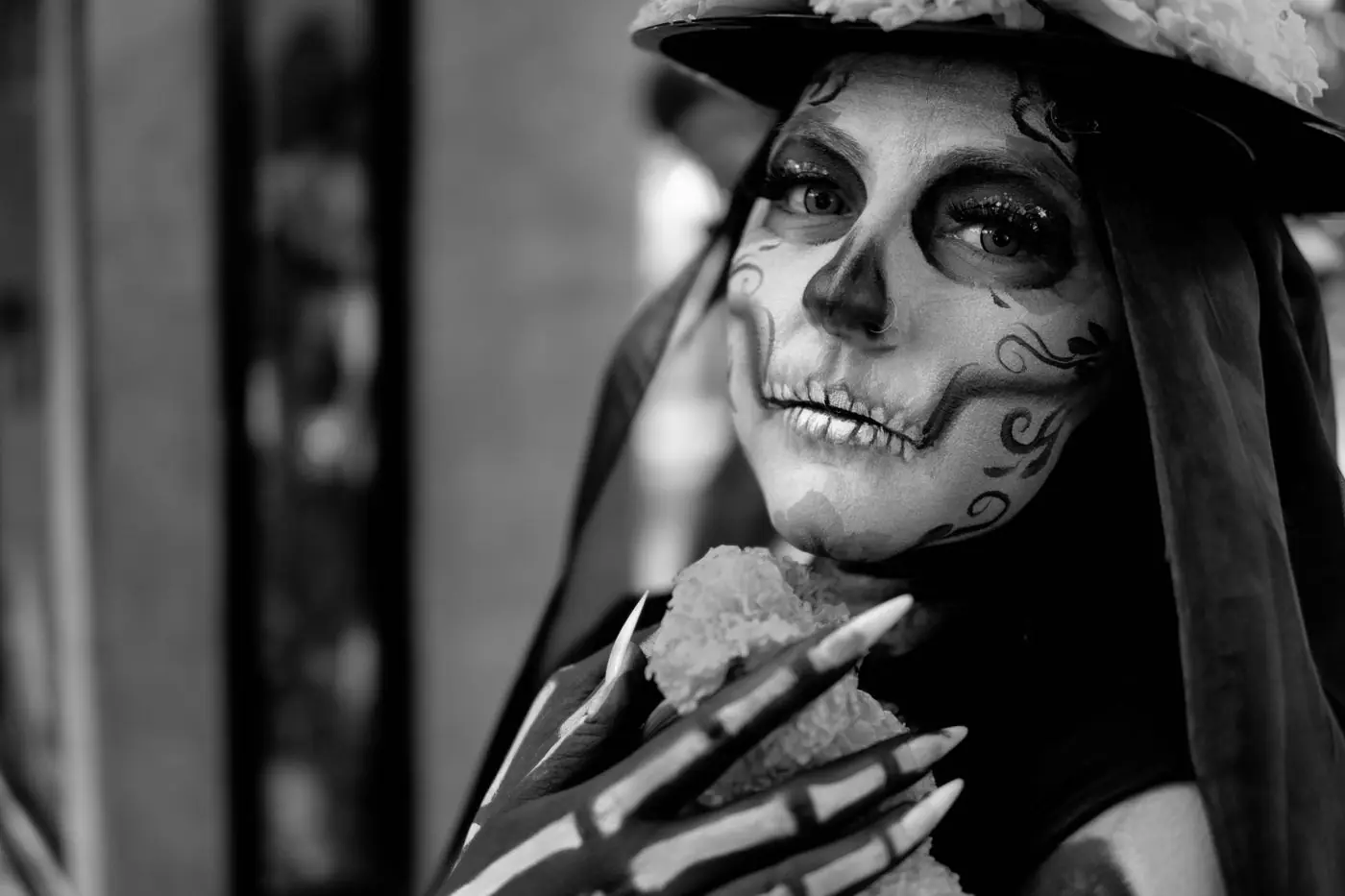
Close makeup detail helps readers understand why "compliment the work" is the safest move.
## The photo rule
If someone is clearly performing in a public parade, photos may be expected. Still, ask when you are close enough for an individual portrait. If there is an ofrenda, a grave, or a family photo in the frame, ask every time.
| You want to... | Say this | Tone |
|---|---|---|
| Ask for a photo | ¿Puedo tomar una foto? | neutral |
| Compliment | Qué bonito detalle | gentle |
| Credit artist | ¿A quién etiqueto? | modern and useful |
| Back off | Gracias, no pasa nada | respectful |
## If someone calls you out
Do not argue from your research notes. Say gracias, lo tomo en cuenta or no quiero faltar al respeto. That answer does not make you weak; it makes you someone who can be corrected without turning the night weird.
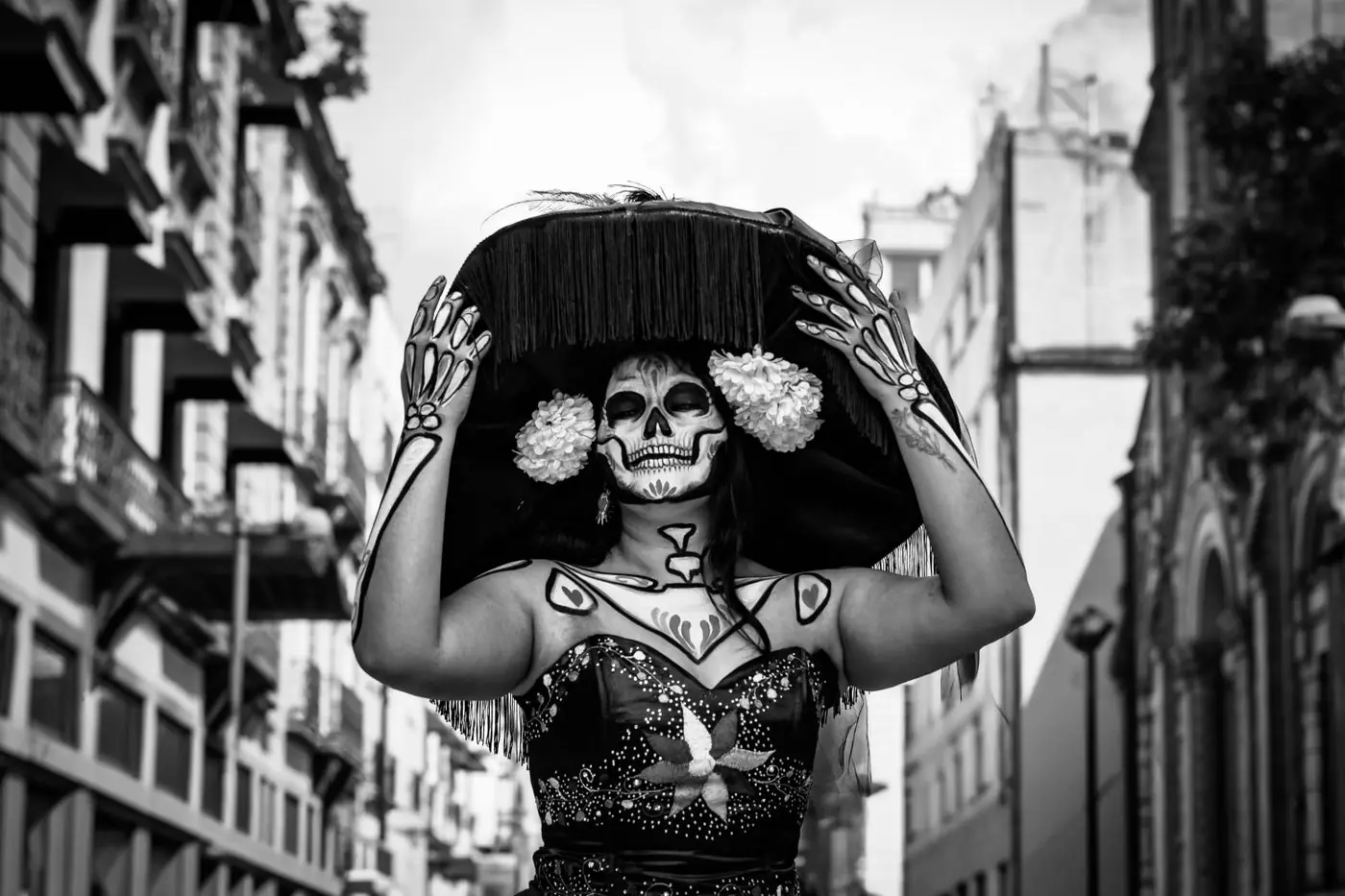
A public Catrina portrait fits festival context while avoiding private altar imagery.
The non-cringe answer is simple: if you wear the makeup, wear the humility too. Learn the words, respect the setting, and let the artistry be about Día de Muertos, not about proving you are the most festive foreigner in the crowd.
## If you are hiring someone to paint you
If a local artist is doing your maquillaje, ask what style they recommend instead of arriving with a random screenshot. ¿Qué diseño me recomiendas? sounds better than "make me authentic." You can also ask ¿cuánto tarda?, ¿cuánto cuesta?, and ¿te puedo etiquetar? That last one matters because artists deserve credit, not just exposure in the vague influencer sense.
A tasteful look does not need to be plain. It can be bright, dramatic, and theatrical. The line is whether you are honoring a public visual tradition or turning it into a scary mask. If your caption says maquillaje de Catrina, inspirado en Día de Muertos, or gracias al artista, you are already doing better than the person posting "spooky Mexico night."
## A quick mirror check
Before leaving, ask yourself three questions: would I take this same photo if someone's family altar were behind me? Am I using the word Halloween because I do not know better? Did I pay or credit the person who did the work? If one answer feels awkward, fix that before the street fixes it for you.
[^unesco]: [UNESCO, Indigenous festivity dedicated to the dead](https://ich.unesco.org/en/RL/indigenous-festivity-dedicated-to-the-dead-00054)
[^posada]: [Secretaría de Cultura, José Guadalupe Posada](https://www.gob.mx/cultura/prensa/euforia-internacional-por-jose-guadalupe-posada)
[^maquillaje]: [Diccionario de la lengua española, maquillaje](https://dle.rae.es/maquillaje)
[^disfraz]: [Diccionario de la lengua española, disfraz](https://dle.rae.es/disfraz)
FAQ:
Q: Can foreigners wear Day of the Dead face paint?
A: Yes, in public festival or costume contexts, if it is done with respect and not treated as a joke or horror look.
Q: Is Día de Muertos face paint cultural appropriation?
A: It depends on context, intent, and behavior. Public celebration is different from mocking, sexualizing, or using private grief as content.
Q: What should I call the makeup in Spanish?
A: Say maquillaje de Catrina or maquillaje de Día de Muertos.
Q: What should I avoid?
A: Avoid gore, cheap stereotypes, fake accents, sacred spaces as backdrops, and calling it Halloween makeup.
Q: Can I take photos with people in Catrina makeup?
A: Ask first: ¿puedo tomar una foto? If they say no or look uncomfortable, stop.
Q: How do I compliment the look?
A: Say te quedó increíble el maquillaje, qué bonito detalle, or se ve muy elegante.
Q: Is face paint okay at a cemetery?
A: Be much more careful. A cemetery visit may be a family remembrance, not a costume event.
Sources:
- UNESCO, Indigenous festivity dedicated to the dead: https://ich.unesco.org/en/RL/indigenous-festivity-dedicated-to-the-dead-00054
- Secretaría de Cultura, José Guadalupe Posada: https://www.gob.mx/cultura/prensa/euforia-internacional-por-jose-guadalupe-posada
- DLE, maquillaje: https://dle.rae.es/maquillaje
- DLE, disfraz: https://dle.rae.es/disfraz
Related words: mande, padre, chido, neta