---
title: "Día de Muertos: 5 Words Before You See Someone's Altar"
description: "Ofrenda, cempasúchil, pan de muerto, calaverita, catrina - what each word means plus the warm, non-sad tone Mexicans use, so you never treat it like Halloween."
type: "article"
category: "seasonal"
url: "https://consalsa.app/blog/dia-de-muertos-spanish"
canonical: "https://consalsa.app/blog/dia-de-muertos-spanish"
published: "2026-10-24"
updated: "2026-10-24"
author: "Andrey the Nomad"
site: "ConSalsa.App"
license: "https://consalsa.app/terms#ip"
---
# Día de Muertos: 5 Words Before You See Someone's Altar
URL: https://consalsa.app/blog/dia-de-muertos-spanish
Date: 2026-10-24
Updated: 2026-10-24
Category: seasonal
Keywords: dia de muertos meaning, ofrenda meaning in spanish, what is cempasuchil, pan de muerto meaning, calaverita meaning, catrina meaning, day of the dead spanish vocabulary
Summary: Ofrenda, cempasúchil, pan de muerto, calaverita, catrina - what each word means plus the warm, non-sad tone Mexicans use, so you never treat it like Halloween.
Quick answer:
- Día de Muertos is not a sad holiday - it's a warm reunion with people who died, treated as a visit, not a funeral.
- An ofrenda is the home altar families build with photos, food, and flowers to welcome the dead back for the night.
- Cempasúchil is the bright orange marigold whose smell and color are believed to guide souls home.
- Pan de muerto is the sweet orange-scented bread eaten only this season, and calaverita can mean a little sugar skull or a playful rhyme.
What you'll learn:
- Why Mexicans talk about Día de Muertos with affection, not grief, and how to match that tone.
- What each core word means - ofrenda, cempasúchil, pan de muerto, calaverita, catrina - in real use.
- How to ask about someone's altar or loved ones without making it heavy or awkward.
- The mistakes that mark you as a tourist, including treating it like Halloween.
Don't sound gringo:
Do not call it the Mexican Halloween or wish someone a happy spooky day. The two holidays sit next to each other on the calendar but mean opposite things. If you want to say something warm, ask quién está en tu ofrenda - who's on your altar - and let them tell you about their people.
Body:
Late October in CDMX. A coworker waves you over, turns her phone around, and shows you a photo of a little altar in her living room - candles, marigolds, a glass of something, and a picture of her grandfather. She's grinning at it.
And you feel that small tourist panic. What do you even say here?
I've watched a dozen people freeze in this exact moment and reach for the funeral face. Soft voice, "I'm so sorry." It lands wrong every single time.
So let me save you the mistake. **Día de Muertos is not the Mexican Halloween, and it is not a sad day.** It's the one night the dead come back for a visit, and the whole point is to welcome them. Their favorite food, their photo, candles, flowers - the way you'd set a place at the table for someone you miss.[^gob-muertos]
The mood is warm. A little festive. Sometimes it's flat-out funny.
So before the words, get the feeling right: this is a reunion, not a funeral. Once that clicks, the five words below mostly take care of themselves - including the exact thing to say to that coworker.
## The Día de Muertos word map
| Word | What it is | The feeling behind it |
|---|---|---|
| Ofrenda | The home altar for the dead | Love, hospitality, welcome |
| Cempasúchil | Bright orange marigold | The flower that guides souls home |
| Pan de muerto | Sweet orange-scented bread | Seasonal, comforting, shared |
| Calaverita | Sugar skull or joke rhyme | Playful, never grim |
| Catrina | Elegant skeleton in a big hat | Death dressed up, for everyone |
Look at the right column. **None of these words carry grief.** Even the skull is either sweet or a joke.
That's the part learners get wrong more than anything else. Once you stop expecting sadness, every conversation this week gets easier.
## Ofrenda: the altar that says welcome back
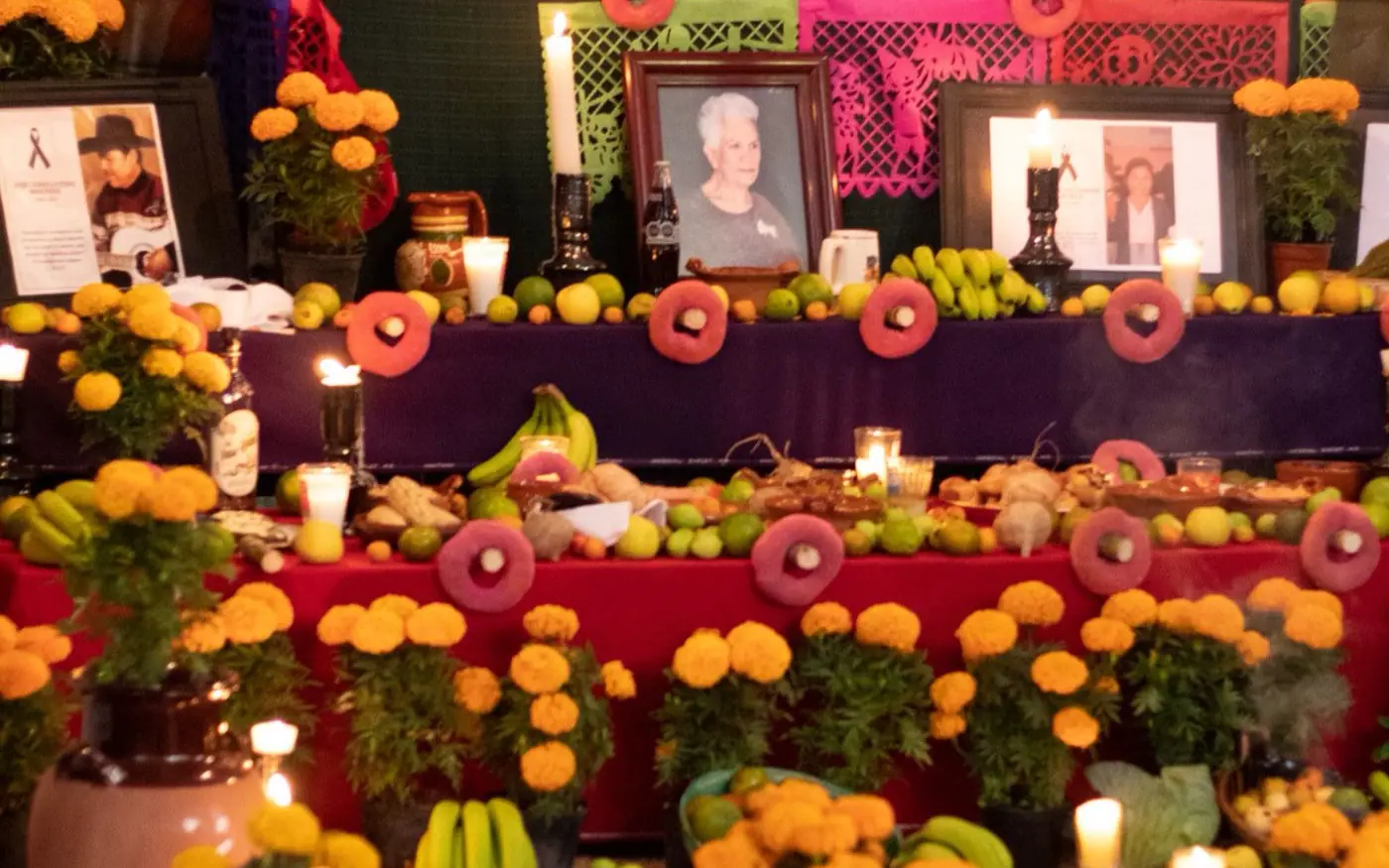
Back to that coworker's phone. What she showed you was an ofrenda - the altar a family builds at home or right on the grave. The word literally means offering, and that's exactly what it is: food and things laid out for the dead.[^dem-ofrenda]
There's a photo of the person, their favorite dish, a drink they liked, candles, and a trail of marigold petals so the soul can find its way back.
What gets visitors is how personal it is. If grandpa smoked, there's a pack of cigarettes on the altar. If he liked mezcal, somebody poured him a glass.
**An ofrenda is a portrait of one specific person, not a generic shrine.** Which is why asking about it is just about the kindest thing you can do.
¿Quién está en tu ofrenda este año?
Who's on your altar this year?
Mi abuela amaba el café, por eso le puse una taza.
My grandma loved coffee, that's why I put out a cup for her.
So when someone walks you through their ofrenda, lean in. Interest, not a sad face. A simple órale or qué bonita as they point things out does the job. That coworker from earlier? Ask her about her grandfather. She'll light up.
An ofrenda is a portrait of a real person - their photo, their food, their drink, all laid out to welcome them back. Photo by Alberto Lara on Pexels.
## Cempasúchil: the flower you smell before you see
Walk into any market this week and you'll smell it before you spot it - that heavy, peppery orange. That's cempasúchil, the Mexican marigold. The name is Nahuatl, older than the Spanish word for it.[^dem-cempasuchil]
Whole stalls disappear under the stuff. Then you see the petals scattered in lines from the sidewalk up to people's front doors.
The strong smell and the color are supposed to guide the souls back home. **It's not decoration - it's a map.** That's why people lay petal trails instead of just sticking a bunch in a vase.
Compré cempasúchil para hacer el camino a la ofrenda.
I bought marigolds to make the path to the altar.
El olor del cempasúchil me recuerda a mi infancia.
The smell of marigolds reminds me of my childhood.
## Pan de muerto: the bread with a season
If these days had a taste, it'd be pan de muerto - a round sweet bread scented with orange blossom, dusted in sugar, with little strips of dough shaped like bones on top.[^dem-pan]
The season is longer than people expect. Supermarkets put it out at the end of August, the bakeries follow through September, and by mid-November it has vanished again. Seasonal in the truest sense, like that one chido stretch of weather you wait for all year.
You eat it with coffee or hot chocolate, usually standing in the kitchen while everyone sets up the altar. Comfort food, tied to a memory. Show up at a friend's place with a couple of pieces and you've already got the right idea.
¿Ya probaste el pan de muerto de esa panadería? Está padrísimo.
Have you tried the pan de muerto from that bakery? It's amazing.
Traje pan de muerto para acompañar el café.
I brought pan de muerto to go with the coffee.
You'll hear padrísimo a lot about food this season - it just means really great, the natural way to say something is delicious.
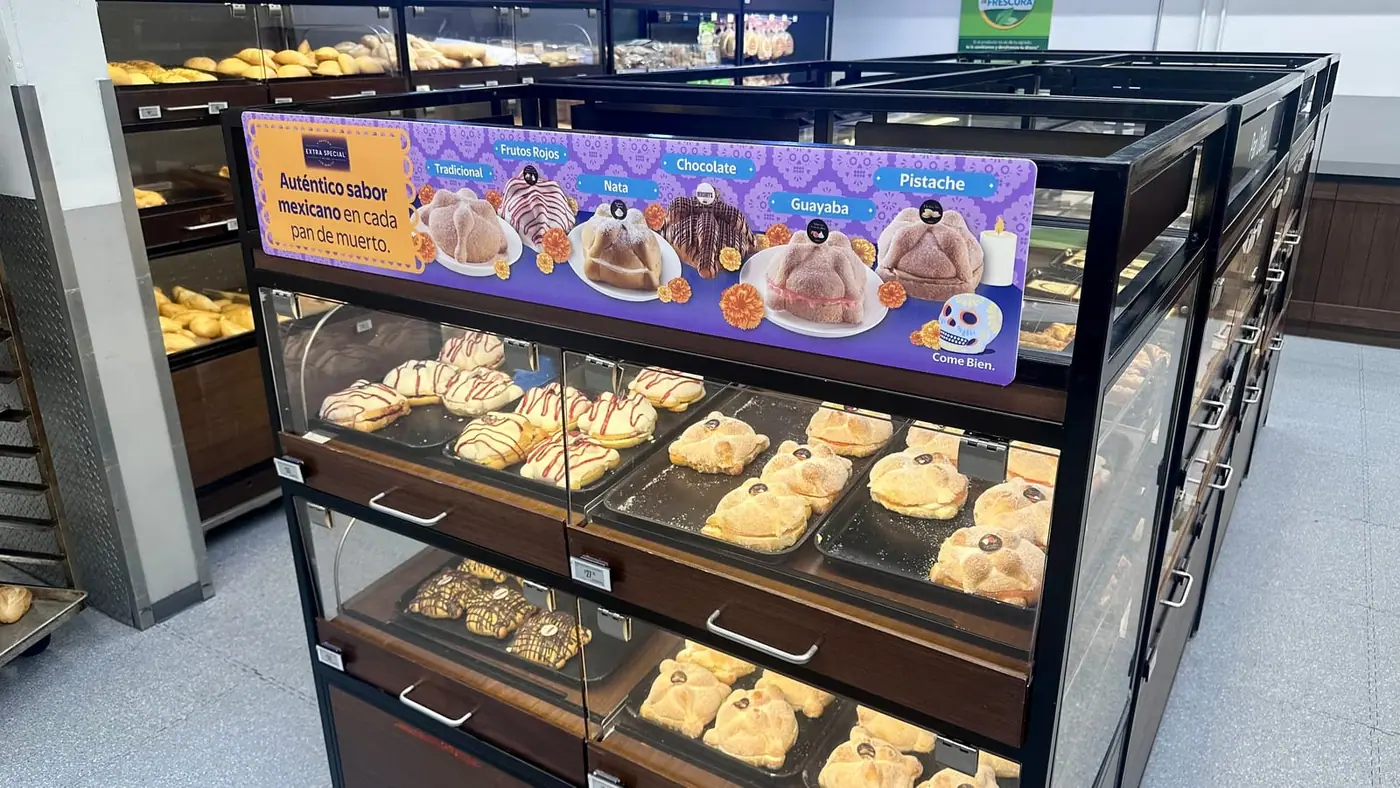
The version at a market stall will be plain sugar. The version in a supermarket case very often is not, and the sign above it will tell you the words: nata, chocolate, guayaba, pistache, frutos rojos. Which of them counts as the real one is a conversation you can start with almost anybody.
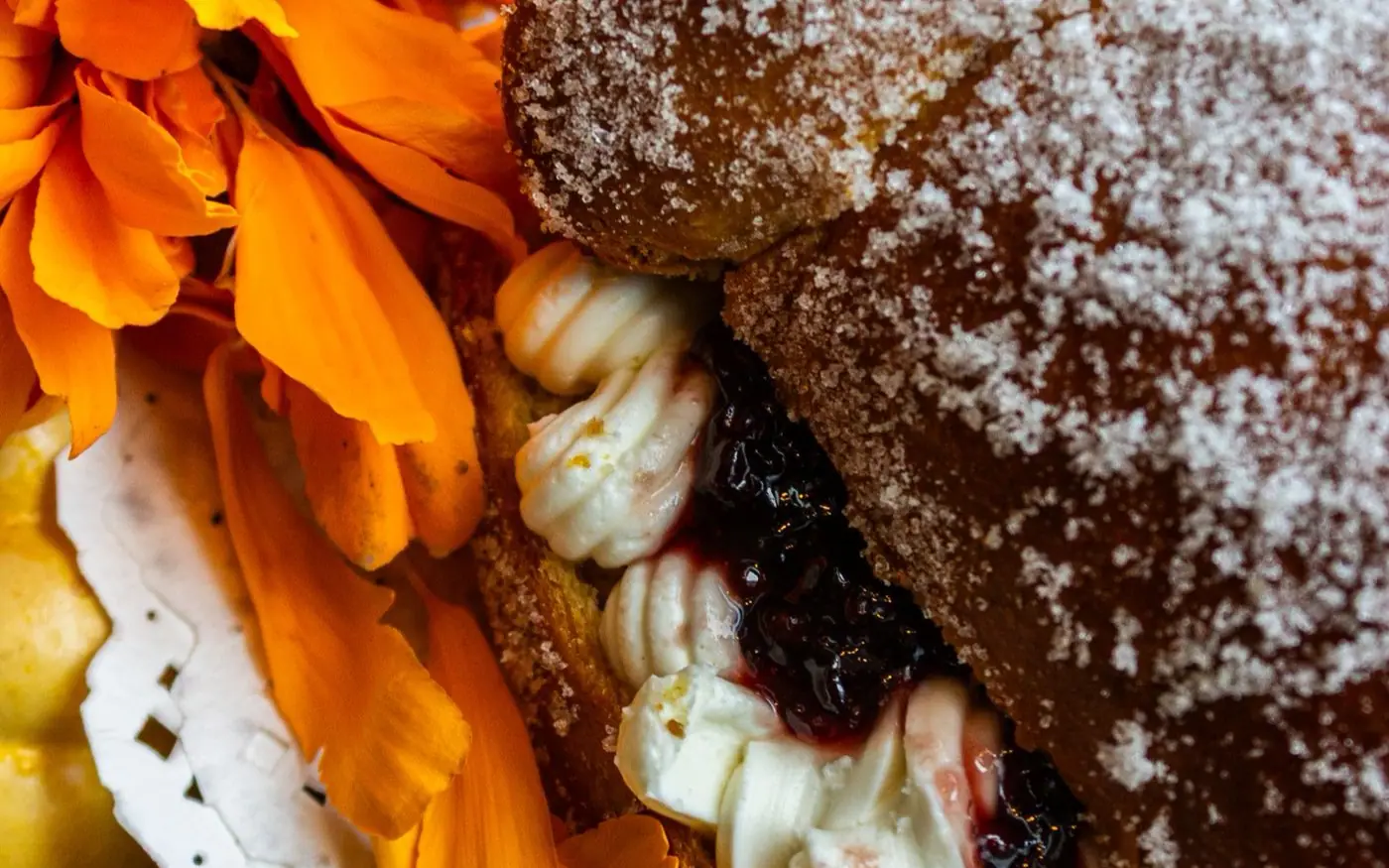
Six flavours on one sign, at the end of August. The filled versions are new and the argument about them is now part of the season. Photo by Andrey the Nomad for ConSalsa.App.Pan de muerto only shows up for a few weeks, scented with orange blossom and eaten with coffee while families build their altars. Photo by tartanribbonmx on Pexels.
## Calaverita and Catrina: where the humor lives
This is where the holiday shows its real personality. A calaverita is two things at once.
One is the little sugar or chocolate skull with a name written across the forehead. Kids eat them, people hand them out, and getting one with your own name on it is a joke, not a curse.[^rae-calavera]
The other is the calaverita literaria - a short rhyming poem that pokes fun at death, or at a living friend as if they'd already died and gone to meet it.
**That little poem is the clearest proof the holiday laughs at death instead of fearing it.** Newspapers run them about politicians. Coworkers write them about each other. The more affectionate the burn, the better.
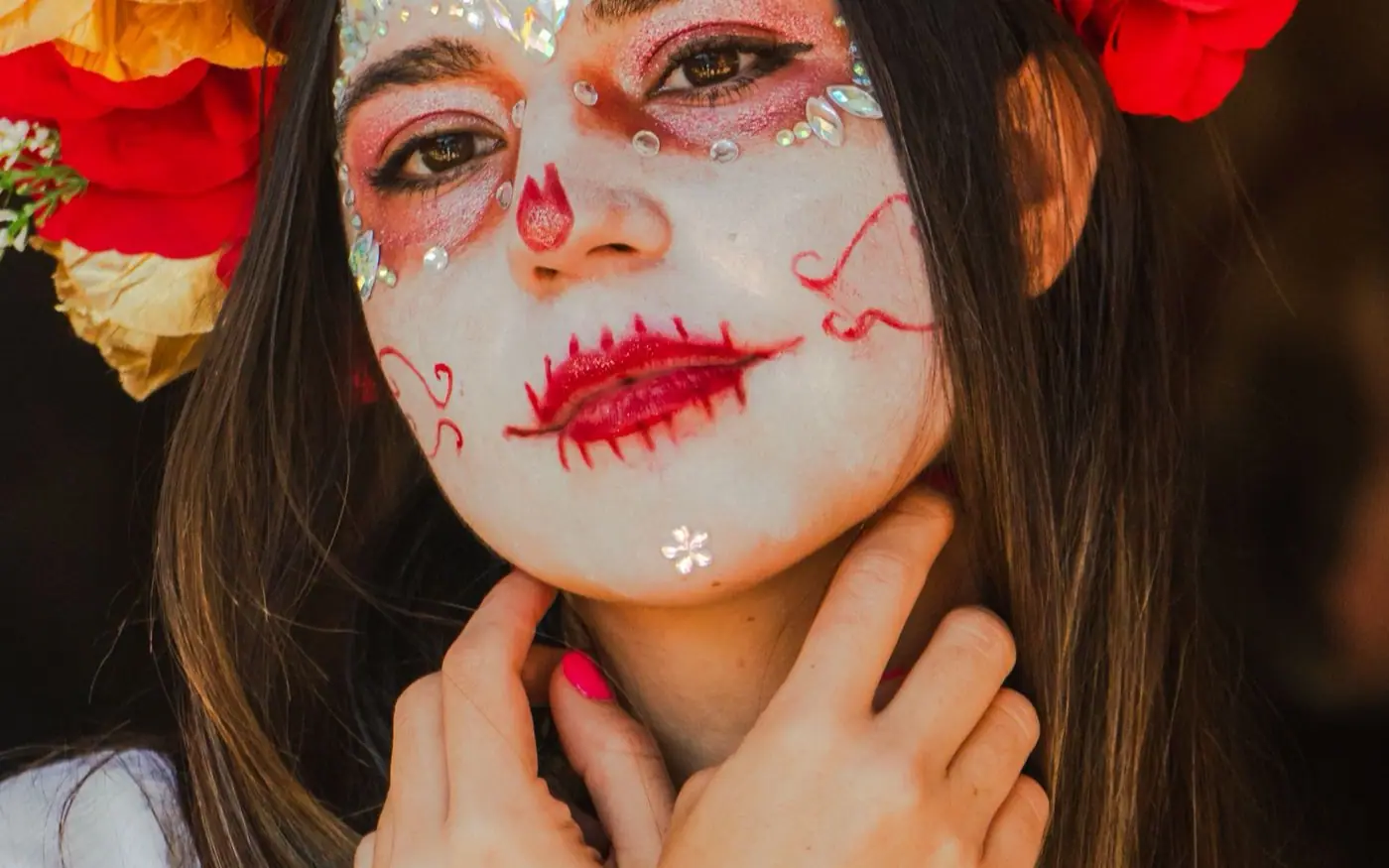
Then there's La Catrina, the tall skeleton woman in the giant feathered hat - the face you've already seen on tote bags and murals whether you knew it or not. She started as a drawing by José Guadalupe Posada and ended up the symbol of the whole thing.[^gob-muertos]
Her point is simple and a little cheeky: take away the fancy clothes and we're all the same skeleton underneath.
Me tocó una calaverita con mi nombre, ¡qué buena onda!
I got a sugar skull with my name on it, how fun!
Le escribí una calaverita al jefe y se rió muchísimo.
I wrote a calaverita rhyme about the boss and he laughed a lot.
If someone reads you their calaverita, laugh and say neta that's good. Take the joke. Do not go solemn on them - that kills the whole bit.
## Mistakes that mark you as a tourist
| You want to | Say or do this | Skip this |
|---|---|---|
| Greet the day | Feliz Día de Muertos | Happy spooky day / Mexican Halloween |
| Ask about loved ones | ¿Quién está en tu ofrenda? | Sorry for your loss energy |
| React to an altar | Qué bonita, cuéntame de ella | A sad, pitying face |
| Take the joke rhyme | Laugh, say está buenísima | Asking if it's disrespectful |
| Talk about death | Light, warm, matter-of-fact | Treating it as taboo |
It all comes down to tone. **The dead are being celebrated, not mourned, so your face and your words should match.**
Pity comes off as missing the point. Curiosity and a little warmth come off as someone who actually gets it.
La Catrina, the elegant skeleton - death dressed up, smiling, and meant to be enjoyed. Photo by Heber Vazquez on Pexels.
## Tone and safety: how to join in
You don't have to be Mexican or Catholic to take part. If a friend asks you to help set up their ofrenda or come along to a panteón (cemetery), that's a real invitation. Say yes. Ask questions. Bring cempasúchil or pan de muerto.
A few things to watch: don't turn it into a costume party, don't step on graves or photograph them like it's a tourist stop, and don't quiz people on whether they "really believe" the souls come back. That last one stings. It's somebody's family ritual, so treat it like one.[^unesco]
And if you want one line that never misses, go back to that coworker and her grandfather. Ask about their people. Órale, tell me about her - honestly, that's the whole holiday right there.
[^gob-muertos]: [Día de Muertos, una tradición viva](https://www.gob.mx/cultura/articulos/dia-de-muertos) — Gobierno de México
[^dem-ofrenda]: [Diccionario del español de México, ofrenda](https://dem.colmex.mx/ver/ofrenda) — El Colegio de México
[^dem-cempasuchil]: [Diccionario del español de México, cempasúchil](https://dem.colmex.mx/ver/cempasuchil) — El Colegio de México
[^dem-pan]: [Diccionario del español de México, pan de muerto](https://dem.colmex.mx/ver/pan) — El Colegio de México
[^rae-calavera]: [Diccionario de la lengua española, calavera](https://dle.rae.es/calavera) — Real Academia Española
[^unesco]: [Indigenous festivity dedicated to the dead](https://ich.unesco.org/en/RL/indigenous-festivity-dedicated-to-the-dead-00054) — UNESCO
FAQ:
Q: What does Día de Muertos mean?
A: It literally means Day of the Dead. It's a Mexican holiday on November 1 and 2 when families welcome the souls of relatives back for a visit, with altars, food, and flowers. The tone is loving and festive, not mournful.
Q: Is Día de Muertos the same as Halloween?
A: No. Halloween is about fright and costumes on October 31. Día de Muertos is about remembering and honoring the dead on November 1 and 2. They land close together but are completely different in meaning and mood.
Q: What is an ofrenda?
A: An ofrenda is the altar a family builds at home or on a grave to welcome the dead. It holds photos of the person, their favorite food and drink, candles, marigolds, and personal objects. The word literally means offering.
Q: What is cempasúchil?
A: Cempasúchil is the bright orange Mexican marigold used everywhere during Día de Muertos. Its strong smell and color are believed to guide souls back home, so petals get scattered in paths toward the altar.
Q: What is pan de muerto?
A: Pan de muerto is a round sweet bread flavored with orange blossom and sugar, decorated with bone-shaped strips of dough on top. It only shows up in bakeries around late October and early November, and people eat it with coffee or hot chocolate.
Q: What is a calaverita?
A: A calaverita can mean two things. One is a little sugar or chocolate skull, often with a name written on the forehead. The other is a calaverita literaria, a short funny rhyme that jokes about death or about a living friend as if they'd died.
Q: What is a catrina?
A: La Catrina is the elegant skeleton woman in a big feathered hat, originally a drawing by José Guadalupe Posada. She became the face of Día de Muertos and a symbol that death comes for everyone, rich or poor.
Q: How do you talk about Día de Muertos without sounding rude?
A: Match the warm, affectionate tone. Ask about people's altars and loved ones with genuine interest, not pity. Avoid calling it spooky or Mexican Halloween. Treating it as a celebration of memory, not a tragedy, is exactly right.
Sources:
- Diccionario del español de México, ofrenda: https://dem.colmex.mx/ver/ofrenda
- Diccionario del español de México, cempasúchil: https://dem.colmex.mx/ver/cempasuchil
- Diccionario de la lengua española, calavera: https://dle.rae.es/calavera
- Gobierno de México, Día de Muertos, una tradición viva: https://www.gob.mx/cultura/articulos/dia-de-muertos
- UNESCO, Indigenous festivity dedicated to the dead: https://ich.unesco.org/en/RL/indigenous-festivity-dedicated-to-the-dead-00054
- Diccionario del español de México, pan de muerto: https://dem.colmex.mx/ver/pan
Related words: padre, chido, neta, orale-pues