---
title: "Does Duolingo Teach Mexican Spanish? What the Owl Never Gets Around To"
description: "Duolingo teaches a Spanish designed to work everywhere, which makes it nobody's in particular. What the course covers, how its graduates actually test, and the half it leaves you."
type: "article"
category: "guides"
url: "https://consalsa.app/blog/duolingo-mexican-spanish"
canonical: "https://consalsa.app/blog/duolingo-mexican-spanish"
published: "2026-10-07"
updated: "2026-10-07"
author: "Andrey the Nomad"
site: "ConSalsa.App"
license: "https://consalsa.app/terms#ip"
---

# Does Duolingo Teach Mexican Spanish? What the Owl Never Gets Around To
URL: https://consalsa.app/blog/duolingo-mexican-spanish
Date: 2026-10-07
Updated: 2026-10-07
Category: guides
Keywords: does duolingo teach mexican spanish, what spanish does duolingo teach, duolingo latin american spanish, is duolingo good for mexico, duolingo spanish dialect, duolingo before moving to mexico
Summary: Duolingo teaches a Spanish designed to work everywhere, which makes it nobody's in particular. What the course covers, how its graduates actually test, and the half it leaves you.

Quick answer:
- Duolingo teaches Latin American Spanish rather than Mexican Spanish specifically, and its most visible dialect decision is teaching ustedes instead of Spain's vosotros.
- Duolingo's own linguists say to add music, movies, TV and social media from the country you care about, which is an admission the course alone does not localize you.
- An independent study of 225 Duolingo learners found reading at ACTFL Intermediate Low but listening only at Novice High, and Mexico is a listening problem.
- Nothing on the owl's path teaches the everyday Mexican courtesies: mande, provecho, and the diminutive habit that softens almost everything.

What you'll learn:
- The one dialect decision Duolingo has published a reason for, and what it does and does not cover.
- Where the course's graduates actually land on an independent proficiency test, and why the shape of that result matters here.
- Four everyday Mexican moves the course has no reason to include, with what each replaces.
- How to keep the app and close the gap, using the advice Duolingo's own team gives.

Don't sound gringo:
When you mishear someone, do not say que. Say mande. Every Mexican in the room will register it, and no app will ever prompt you to.

Body:

The short answer is no, and Duolingo has never claimed otherwise. The course teaches a Latin American Spanish assembled to be understood by as many people as possible, which is a reasonable thing to build and a strange thing to arrive in Mexico with.

## The one dialect decision they have published a reason for

Duolingo's Spanish course teaches <mark lang="es-MX">ustedes</mark> and skips Spain's <mark lang="es-MX">vosotros</mark>. Their team gives the reason directly: more dialects use <mark lang="es-MX">ustedes</mark>, and Spain understands it anyway.[^duo-vosotros]

That is a coverage decision, and for a course serving every Spanish learner on earth at once it is the right one. You get a form that works from Tijuana to Buenos Aires. Mexico just happens to be inside the net.

Look for a second published decision of that kind and you will not find much. No stated position on <mark lang="es-MX">carro</mark> versus <mark lang="es-MX">coche</mark>, no Mexico setting anywhere in the app. Spanish is the second most studied language on the platform and the one with the most committed learners on their own ranking,[^duo-report] so the neutrality is protecting a very large audience. It was never an oversight.

## Four everyday Mexican moves the course has no reason to include

None of these are slang. Ordinary courtesy, used by everyone, in offices as much as on the street - and a general Spanish course has nowhere to put it.

| What happens | What Duolingo hands you | What Mexico uses |
|---|---|---|
| Someone calls your name, or you mishear | <mark lang="es-MX">¿qué?</mark>, <mark lang="es-MX">¿cómo?</mark> | <a href="/words/mande">¿mande?</a> - listed in Mexico's national dictionary as a courtesy expression for answering someone who calls you |
| You walk past people eating | nothing | <a href="/words/provecho">provecho</a> - a set courtesy for wishing someone enjoyment of what they are eating |
| You want to say you were chatting | <mark lang="es-MX">hablar</mark>, <mark lang="es-MX">conversar</mark> | <mark lang="es-MX">platicar</mark> - the ordinary Mexican verb for two people talking |
| You are softening a request or a time | the plain noun | the diminutive: <a href="/words/ahorita">ahorita</a>, <mark lang="es-MX">un ratito</mark>, <mark lang="es-MX">tantito</mark> |

<mark lang="es-MX">Mande</mark> is the one that gives people away fastest. The Colegio de México dictionary defines it flatly, as the courtesy expression you answer with when somebody calls you or you did not catch something.[^dem-mande] <mark lang="es-MX">Platicar</mark> sits in there as an ordinary entry, no curiosity label attached.[^dem-platicar] <mark lang="es-MX">Provecho</mark> is defined as the set phrase for wishing somebody enjoyment of their food,[^dem-provecho] and in practice it travels down an office corridor at lunchtime whether or not you know the people eating.

## Where the course's graduates actually land

An independent team tested 225 US-based adults who had finished beginning-level Duolingo courses in Spanish or French and had used nothing else. They came out at ACTFL Intermediate Low in reading and Novice High in listening, roughly level with university students at the end of a fourth semester.[^duo-efficacy]

Two semesters of university for free is a real result. That should be said before the rest of this.

Then look at the shape of it. **Reading ran ahead of listening by a full band.** That is the exact wrong shape for Mexico, where the thing you have to survive is a person speaking at normal speed with three <mark lang="es-MX">diminutivos</mark> and a <mark lang="es-MX">güey</mark> in the middle of the sentence. Menus will be fine. The taquero will not be.

There is a separate piece on [why Mexican Spanish sounds so fast](/blog/why-mexican-spanish-sounds-fast) if that gap is the one you are standing in.

<div id="midpost-newsletter-slot"></div>

<figure>
  <img src="/images/blog/optimized/pexels-julio-lopez-cdmx-cafe-bench-1400-8351369d.webp" alt="A group of people sitting and talking on a bench outside a café in Mexico City." loading="lazy" />
  <figcaption>Nobody at this table is speaking at course audio speed. Photo by <a href="https://www.pexels.com/photo/a-group-of-people-sitting-on-a-bench-in-front-of-a-tree-28280847/" target="_blank" rel="noopener noreferrer">Julio Lopez on Pexels</a>.</figcaption>
</figure>

## What the app is good at, and what it is not

<div class="do-dont">
  <div class="dd-col dd-do"><p class="dd-title">Genuinely good at this</p><ul>
    <li>A first few hundred words, cheaply and without a teacher</li>
    <li>Present tense until it stops being a decision</li>
    <li>Reading, which is where its graduates score highest</li>
    <li>Keeping a daily habit alive on days you would otherwise do nothing</li>
  </ul></div>
  <div class="dd-col dd-dont"><p class="dd-title">Not built for this</p><ul>
    <li>Any one country's courtesy layer</li>
    <li>Speech at the speed people actually use</li>
    <li>Knowing when <b lang="es-MX">usted</b> is required and when it is distant</li>
    <li>Anything a dictionary marks as <b>popular</b> or regional</li>
  </ul></div>
</div>

The <mark lang="es-MX">usted</mark> line matters more than it looks. A course can teach you the conjugation in ten minutes; picking the right one in a room is a different skill, and there is a [whole piece on how Mexicans actually split them](/blog/tu-vs-usted-mexico).

## Their own team tells you what to do next

The Duolingo linguists' guide to Spanish dialects ends by telling readers to keep doing lessons for the foundation and then add the music, films, TV and social accounts of the country they care about.[^duo-dialects]

Read that again as a product statement. The people who built the course are telling you the course gives you a foundation and the country comes from somewhere else.

<figure>
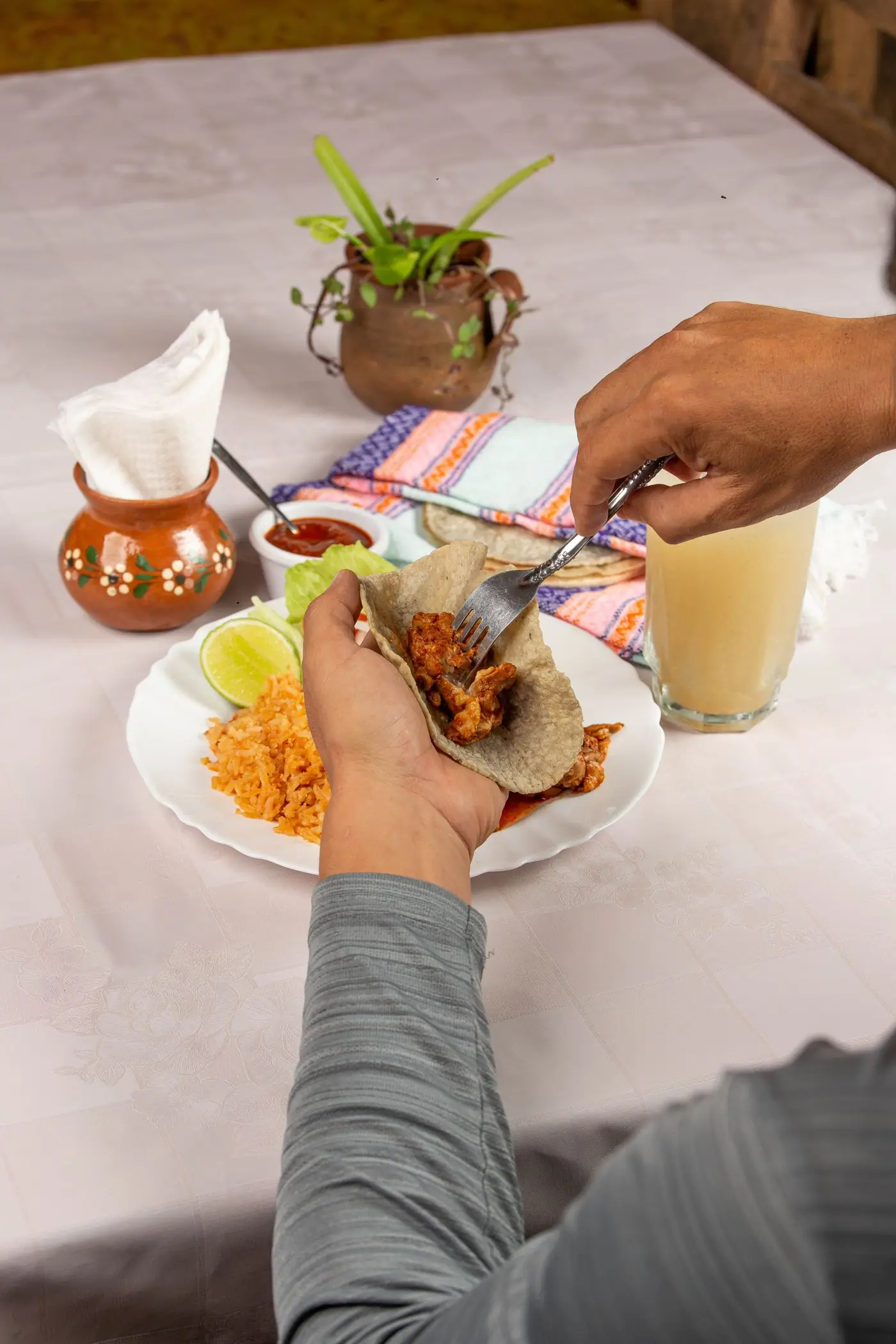
  <img src="/images/blog/optimized/pexels-jonathan-reynaga-taco-plate-table-1400-aae16a48.webp" alt="A person eating tacos with rice and lime at a table in Mexico." loading="lazy" />
  <figcaption>The moment somebody walks past this table, a word is expected. Photo by <a href="https://www.pexels.com/photo/hands-of-a-person-eating-mexican-food-at-a-table-17429508/" target="_blank" rel="noopener noreferrer">Jonathan Reynaga on Pexels</a>.</figcaption>
</figure>

The corpus behind the Colegio de México dictionary was built from 996 texts sorted into fourteen genres, and those genres include colloquial speech, recorded conversations by region, and the slang of young people.[^lara-cemc] A national dictionary counted all of that as the language. A global course cannot, because it would have to choose one country's version of that and give up all the others.

<div class="note-card is-tip">
  <span class="note-label">Cheapest possible fix</span>
  <p>Keep the streak. Change the input. Twenty minutes of Mexican YouTube a day will do more than a second app, because listening is the side the research found lagging. If you want the wider comparison of tools, there is <a href="/blog/mexican-spanish-apps">a piece on which apps do what</a>, and one on <a href="/blog/spanish-school-vs-tutor">whether to buy a school, a tutor, or a plane ticket</a>.</p>
</div>

## So: keep it or drop it

Keep it, if you are near the beginning. Getting to a few hundred words for free is not nothing, and arriving in Mexico with the present tense already automatic changes what your first month is worth.

Drop the expectation, though. The owl is teaching a Spanish that belongs to no country, on purpose, and it has published the reasons. Mexico is a country. That is the whole gap, and more lessons will not close it. Mexican voices will.

<figure>
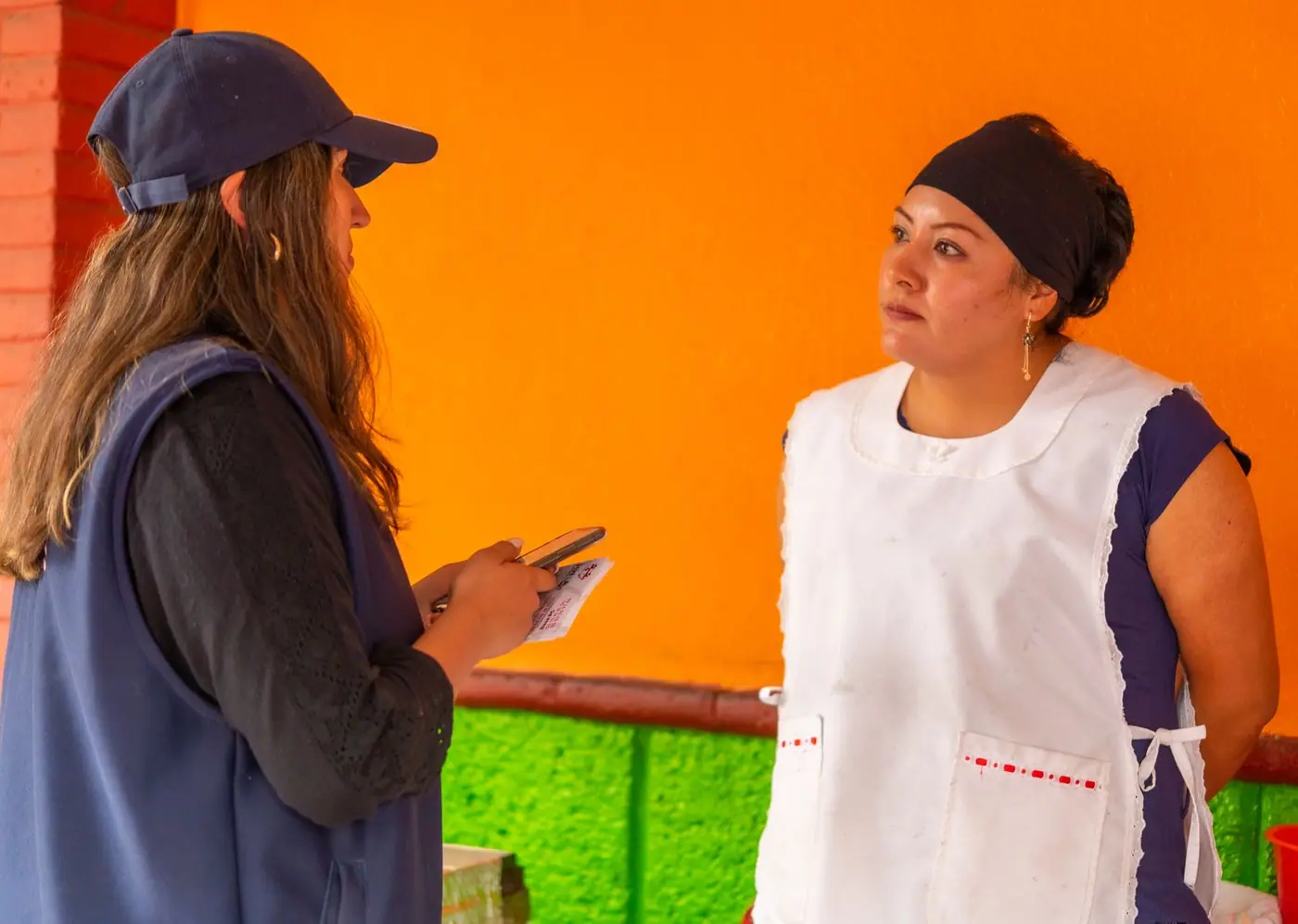
  <img src="/images/blog/optimized/pexels-israwmx-cdmx-two-women-talking-1400-96d85c32.webp" alt="Two women standing and talking in front of a brightly painted wall in Mexico City." loading="lazy" />
  <figcaption>This is the exam. Photo by <a href="https://www.pexels.com/photo/women-standing-and-talking-16837810/" target="_blank" rel="noopener noreferrer">Israwmx on Pexels</a>.</figcaption>
</figure>

[^duo-vosotros]: [Dear Duolingo: What is "vosotros" and when do I use it?](https://blog.duolingo.com/what-is-spanish-vosotros/) - Cindy Blanco and Olivia Thayer, Duolingo Blog
[^duo-dialects]: [How different are Spanish dialects around the world?](https://blog.duolingo.com/spanish-dialects/) - Elisa Camps Troncoso, James Leow, Cindy Blanco and Olivia Thayer, Duolingo Blog
[^duo-efficacy]: [Evaluating the reading and listening outcomes of beginning-level Duolingo courses](https://experts.nau.edu/en/publications/evaluating-the-reading-and-listening-outcomes-of-beginning-level-/) - Jiang, Rollinson, Plonsky, Gustafson and Pajak, Foreign Language Annals 54(4), 2021
[^duo-report]: [2025 Duolingo Language Report](https://blog.duolingo.com/2025-duolingo-language-report/) - Duolingo
[^dem-mande]: [Diccionario del español de México, ¡mande!](https://dem.colmex.mx/ver/mande) - El Colegio de México
[^dem-platicar]: [Diccionario del español de México, platicar](https://dem.colmex.mx/ver/platicar) - El Colegio de México
[^dem-provecho]: [Diccionario del español de México, provecho](https://dem.colmex.mx/ver/provecho) - El Colegio de México
[^lara-cemc]: [El vocabulario fundamental del español de México](https://dem.colmex.mx/Vocabulario/Fundamental) - Luis Fernando Lara, El Colegio de México

FAQ:
Q: Does Duolingo teach Mexican Spanish?
A: Not specifically. The course teaches a broadly Latin American Spanish, and Duolingo has never advertised it as Mexican. The clearest published dialect choice is ustedes over vosotros, made for reach rather than for any one country.

Q: Will Duolingo Spanish work in Mexico?
A: It works. You will be understood everywhere, and the tenses and structures you get are the ones Mexico uses. What you will not have is the courtesy layer and the slang, which is most of what makes a conversation feel normal.

Q: Is the Duolingo Spanish accent Mexican?
A: The audio is a generic Latin American register rather than a Mexico City one, and it is slower and cleaner than anything you will hear at a counter. That gap shows up as soon as you land.

Q: How good is your Spanish after finishing the Duolingo course?
A: A 2021 study of 225 US-based learners who used Duolingo as their only tool put them at ACTFL Intermediate Low in reading and Novice High in listening, comparable to university students after four semesters.

Q: Why does Duolingo not teach vosotros?
A: Duolingo's team has said plainly that more dialects use ustedes, and that ustedes is understood in Spain too. It is a coverage decision, not a claim about which Spanish is better.

Q: Should I use Duolingo before moving to Mexico?
A: Yes, if you are starting near zero. It is a cheap way to arrive with a few hundred words and the present tense. Just do not expect it to prepare your ear.

Q: What does Duolingo not teach you about Mexican Spanish?
A: The reply to being called, the phrase you say walking past someone eating, the verb Mexicans actually use for chatting, and the diminutive habit that makes a request sound friendly rather than blunt.

Q: Is there a better app for Mexican Spanish?
A: No app is built for one country's Spanish, because the market is not there. The realistic fix is to keep the app for vocabulary and get your input from Mexican media and Mexican people.

Sources:
- Dear Duolingo: What is vosotros and when do I use it? - Cindy Blanco and Olivia Thayer, Duolingo Blog: https://blog.duolingo.com/what-is-spanish-vosotros/
- How different are Spanish dialects around the world? - Camps Troncoso, Leow, Blanco and Thayer, Duolingo Blog: https://blog.duolingo.com/spanish-dialects/
- Evaluating the reading and listening outcomes of beginning-level Duolingo courses - Jiang, Rollinson, Plonsky, Gustafson and Pajak, Foreign Language Annals 54(4), 2021: https://experts.nau.edu/en/publications/evaluating-the-reading-and-listening-outcomes-of-beginning-level-/
- 2025 Duolingo Language Report: https://blog.duolingo.com/2025-duolingo-language-report/
- Diccionario del espanol de Mexico, mande - El Colegio de Mexico: https://dem.colmex.mx/ver/mande
- Diccionario del espanol de Mexico, platicar - El Colegio de Mexico: https://dem.colmex.mx/ver/platicar
- Diccionario del espanol de Mexico, provecho - El Colegio de Mexico: https://dem.colmex.mx/ver/provecho
- El vocabulario fundamental del espanol de Mexico - Luis Fernando Lara, El Colegio de Mexico: https://dem.colmex.mx/Vocabulario/Fundamental

Related words: mande, provecho, padre, ahorita