---
title: "How to Flirt in Mexican Spanish Without Sounding Like You Googled Pickup Lines"
description: "Learn Mexican Spanish flirting that feels playful, normal, and human: te late, qué plan, se arma, me caes bien, and safer compliments."
type: "article"
category: "dating"
url: "https://consalsa.app/blog/flirting-mexican-spanish"
canonical: "https://consalsa.app/blog/flirting-mexican-spanish"
published: "2026-06-15"
updated: "2026-06-15"
author: "Andrey the Nomad"
site: "ConSalsa.App"
license: "https://consalsa.app/about"
---

# How to Flirt in Mexican Spanish Without Sounding Like You Googled Pickup Lines
URL: https://consalsa.app/blog/flirting-mexican-spanish
Date: 2026-06-15
Updated: 2026-06-15
Category: dating
Keywords: mexican spanish flirting, flirting in mexican spanish, mexican dating phrases, te late meaning, mexican spanish pickup lines
Summary: Learn Mexican Spanish flirting that feels playful, normal, and human: te late, qué plan, se arma, me caes bien, and safer compliments.

Quick answer:
- The problem is almost never your accent. It is the switch from normal person to translated pickup line.
- Mexican flirting runs on low-stakes invitations, not declarations: te late, ¿qué plan?, se arma, ¿caes?
- Compliment something specific and small. Intensity reads as performance; detail reads as attention.
- Give an exit with every invitation and you will get honest answers instead of polite maybes.

What you'll learn:
- Why the trouble is the translated pickup line, not your accent.
- The low-stakes invitations Mexican flirting actually runs on.
- Why a small specific compliment beats an intense one.
- The exit clause that turns polite maybes into honest answers.

Don't sound gringo:
Do not translate pickup-line English into Spanish. In Mexico, te late, me caes bien, and te ves muy bien usually beat a dramatic confession from nowhere.

Body:

The flirting mistake is rarely the accent. It is the sudden switch from normal person to translated pickup artist. Mexican flirting usually starts in the middle: one playful question, one soft invite, one compliment that does not trap the other person. If you can keep <mark lang="es-MX">te late</mark>, <mark lang="es-MX">qué plan</mark>, and <mark lang="es-MX">me caes bien</mark> small, you already sound more natural than the guy reciting lines from a forum.

The accent is rarely the problem. What gives people away is the switch - somebody talking normally, then suddenly delivering a sentence they clearly translated in advance. Mexican flirting is built out of ordinary conversation with a small invitation slipped inside it, not out of separate material kept for the purpose.[^rae-plan][^rae-quedar]

## Five moves that actually sound human

Think of these as doors, not declarations. Each one lets the other person answer without being cornered.

| Phrase | What it does | Best read |
|---|---|---|
| Te late un café? | Soft invite | Good first move |
| Qué plan traes? | Casual opener | Good when you already chat |
| Se arma otro día? | Playful follow-up | Good after a missed plan |
| Me caes muy bien | Warmth | Not automatically romantic |
| Te ves muy bien | Compliment | Safer than a body comment |

What the good column has in common is that none of it is a line. They are ordinary sentences that happen to contain an invitation, which is why they survive being said out loud by somebody nervous. A line has to be delivered; a question only has to be asked.[^rae-cita]

Notice that four of the five are questions, and the fifth is a compliment small enough to be shrugged off. Mexican flirting front-loads very little. The move is to propose something tiny and let the other person decide how much it means, rather than announcing how much it means and hoping they agree.

<div class="do-dont">
  <div class="dd-col dd-do"><p class="dd-title">Suena a persona</p><ul>
    <li><b lang="es-MX">¿Te late un café?</b> — cheap to accept, cheap to decline</li>
    <li><b lang="es-MX">Me gustó cómo contaste eso</b> — attention, not assessment</li>
    <li><b lang="es-MX">¿Y tú qué haces por acá?</b> — a real question</li>
    <li>Saying the small true thing instead of the clever one</li>
  </ul></div>
  <div class="dd-col dd-dont"><p class="dd-title">Suena a guion traducido</p><ul>
    <li>Any line you would not say in your own language</li>
    <li><b lang="es-MX">Piropos</b> shouted at someone walking past</li>
    <li>Switching register mid-conversation into somebody else</li>
    <li>Complimenting the body before the person has spoken</li>
  </ul></div>
</div>

## The bar test

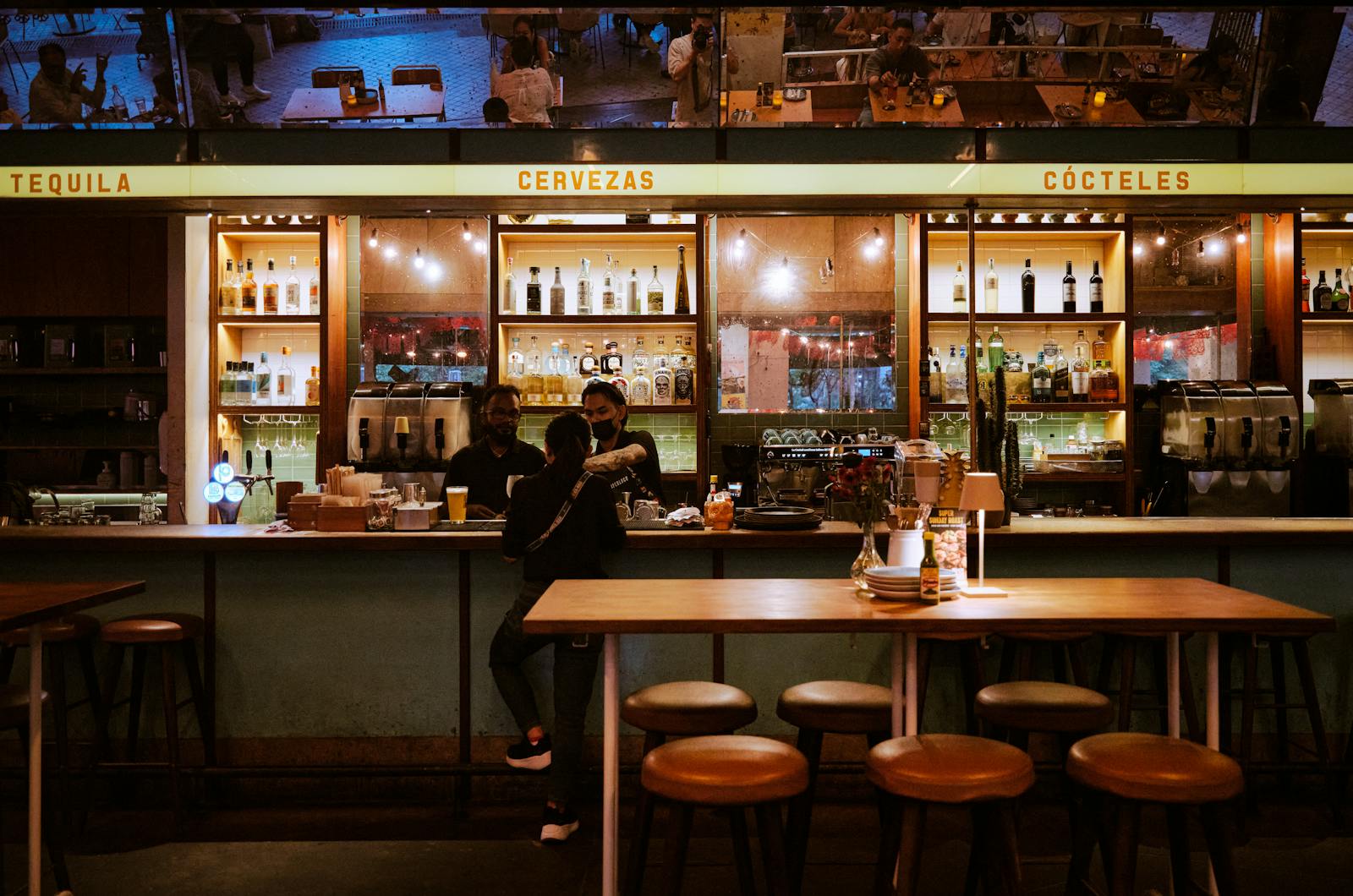
Picture a noisy bar in Roma. If the sentence would make the other person glance at the exit, it is too much. <mark lang="es-MX">Te ves muy bien</mark> is one breath. <mark lang="es-MX">quiero conquistarte</mark> brings a costume. The useful flirt is specific enough to be noticed and light enough to survive a no.

The bar test is simple: could you say this to somebody you were not flirting with? If the answer is yes, it is safe to try. Almost everything that works here passes that test, which is also why it survives being said by somebody whose Spanish is still landing a little awkwardly.[^dem-onda]

<ul class="examples">
  <li class="example">
    <div class="es" lang="es-MX">Me late verte otro día, ¿te late un café?</div>
    <div class="en" lang="en">I am into seeing you another day. Are you up for coffee?</div>
  </li>
  <li class="example">
    <div class="es" lang="es-MX">Me caes muy bien, la verdad.</div>
    <div class="en" lang="en">I really like your vibe, honestly.</div>
  </li>
  <li class="example">
    <div class="es" lang="es-MX">Jajaja va, entonces se arma.</div>
    <div class="en" lang="en">Haha okay, then it is happening.</div>
  </li>
</ul>

<figure>
  <img src="/images/blog/mexican-bar-nightlife-cozy.jpg" alt="A bar invite works better when the pressure stays low." loading="lazy" />
  <figcaption>A bar invite works better when the pressure stays low.</figcaption>
</figure>

<div id="midpost-newsletter-slot"></div>

## The hub rule

Use this article as the hub: start with a small signal, then choose the deeper move. If the issue is timing, use the <mark lang="es-MX">ahorita</mark> and <mark lang="es-MX">tranqui</mark> posts. If the issue is attraction, use compliments. If the issue is silence, use the left-on-read rule. Flirting is not one sentence; it is a sequence of low-risk turns.

The exit is what makes the invitation work. <mark lang="es-MX">Si no se arma, todo bien</mark> costs you nothing and buys an honest answer, because it lets somebody decline without manufacturing a reason first. Invitations sent without an exit collect polite maybes instead.[^timeout-first-date-bars]

## Normal vs too much

| Situation | Use this | Why it works |
|---|---|---|
| Me late seguir platicando | Natural | Shows interest without pressure |
| Eres el amor de mi vida | Too much | Funny only as a clear joke |
| Te ves muy bien hoy | Natural | Compliment with a clean landing |
| Dame tu número | Risky | Ask softer: me pasas tu Insta? |

Use these as rehearsal lines, not robot lines. The point is to have something ready before your brain opens twelve browser tabs of doubt.

<figure>
  <img src="/images/blog/cdmx-night-street-people.jpg" alt="The follow-up matters more than the perfect line." loading="lazy" />
  <figcaption>The follow-up matters more than the perfect line.</figcaption>
</figure>

## Openers that sound like you

Short lines. The invitation does more work than any clever sentence will.

<ul class="examples">
  <li class="example">
    <div class="es" lang="es-MX">Me late verte otro día, ¿te late un café?</div>
    <div class="en" lang="en">I am into seeing you another day. Are you up for coffee?</div>
  </li>
  <li class="example">
    <div class="es" lang="es-MX">Me caes muy bien, la verdad.</div>
    <div class="en" lang="en">I really like your vibe, honestly.</div>
  </li>
  <li class="example">
    <div class="es" lang="es-MX">Jajaja va, entonces se arma.</div>
    <div class="en" lang="en">Haha okay, then it is happening.</div>
  </li>
  <li class="example">
    <div class="es" lang="es-MX">Sin presión, pero sí me late.</div>
    <div class="en" lang="en">No pressure, but I am into it.</div>
  </li>
</ul>

## Small and true beats clever

A good flirt gives the other person room to lean in. That is what makes it feel Mexican in the social sense: warm, quick, and aware of the room.

Small and true beats clever every time. A specific remark about a jacket does more work than a rehearsed line - partly because it is better, and mostly because you can deliver it without sounding like you are reading from something.[^spanishandgo-greetings]

[^rae-plan]: [Diccionario de la lengua española, plan](https://dle.rae.es/plan) - The RAE entry for plan includes both intention/project and a colloquial romantic or casual relation sense, which is why plan can feel innocent and loaded at once.
[^rae-quedar]: [Diccionario de la lengua española, quedar](https://dle.rae.es/quedar) - The RAE entry for quedar includes agreeing on something and arranging a meeting, the backbone of many dating texts.
[^rae-cita]: [Diccionario de la lengua española, cita](https://dle.rae.es/cita) - The RAE entry for cita covers an agreed time and place to meet, plus a meeting or encounter, which maps neatly to date logistics.
[^dem-onda]: [Diccionario del español de México, onda](https://dem.colmex.mx/ver/onda) - The Diccionario del español de México gives onda popular senses around attitude, vibe, greeting, and showing romantic or sexual interest.
[^timeout-first-date-bars]: [Time Out México, bares para una primera cita en CDMX](https://www.timeoutmexico.mx/ciudad-de-mexico/antros-bares/bares-para-una-primera-cita-cdmx) - Time Out México frames CDMX first dates as a real local genre with bars chosen for conversation, mood, and low-pressure movement.
[^spanishandgo-greetings]: [Spanish and Go, greetings and goodbyes in Spanish](https://spanishandgo.com/learn/greetings-and-goodbyes-in-spanish/) - Spanish and Go notes qué onda as a Mexican informal greeting, useful for separating friendliness from flirting.

FAQ:
Q: How do Mexicans actually flirt?
A: Mostly by proposing small, easy things and paying attention. ¿Te late un café? does more than any line, because it is low cost to accept and low cost to decline.

Q: What flirting mistakes do foreigners make?
A: Translating a script. People switch registers mid-conversation into something they would never say in English either, and the sudden change is far more noticeable than any grammar error.

Q: Is it better to be direct or subtle in Mexico?
A: Direct about the plan, soft about the feelings. A specific invitation with a warm delivery is the local combination - the reverse tends to land badly.

Q: What does se arma mean?
A: It is on, it is happening. ¿Se arma? proposes something without anyone having to be the person who asked, which is why group chats run on it.

Q: Should I use pickup lines or piropos?
A: No. Street piropos in particular are widely disliked and increasingly read as harassment rather than charm. Ordinary conversation outperforms every line you could learn.

Q: How do I flirt if my Spanish is still basic?
A: Lean on invitations rather than wordplay. ¿Te late un café? needs four words and works perfectly, where a joke needs fluency and timing to land.

Q: How do I know if it is working?
A: They add a detail you did not ask for - a day, a place, a suggestion of their own. Unprompted specifics are the strongest signal in Mexican Spanish.

Q: Is it okay to flirt in English if my Spanish fails?
A: Yes, and switching is normal in CDMX. Asking ¿te molesta si te digo esto en inglés? first turns the language gap into a small shared joke rather than a wall.

Sources:
- Diccionario de la lengua española, plan: https://dle.rae.es/plan
- Diccionario de la lengua española, quedar: https://dle.rae.es/quedar
- Diccionario de la lengua española, cita: https://dle.rae.es/cita
- Diccionario del español de México, onda: https://dem.colmex.mx/ver/onda
- Time Out México, bares para una primera cita en CDMX: https://www.timeoutmexico.mx/ciudad-de-mexico/antros-bares/bares-para-una-primera-cita-cdmx
- Spanish and Go, greetings and goodbyes in Spanish: https://spanishandgo.com/learn/greetings-and-goodbyes-in-spanish/

Related words: que-onda, sale, guey, chido