---
title: "Nobody Pumps Their Own Gas in Mexico: Gasolinera Spanish"
description: "At a Mexican gas station an attendant fills your tank and you tip. Learn what to say: lleno por favor, quinientos de magna, que empiece en ceros."
type: "article"
category: "getting_around"
url: "https://consalsa.app/blog/gasolinera-spanish"
canonical: "https://consalsa.app/blog/gasolinera-spanish"
published: "2026-08-27"
updated: "2026-08-27"
author: "Andrey the Nomad"
site: "ConSalsa.App"
license: "https://consalsa.app/about"
---

# Nobody Pumps Their Own Gas in Mexico: Gasolinera Spanish
URL: https://consalsa.app/blog/gasolinera-spanish
Date: 2026-08-27
Updated: 2026-08-27
Category: getting_around
Keywords: gas station spanish mexico, gasolinera spanish, how to buy gas in mexico, magna vs premium gasolina, tipping gas station attendant mexico, driving in mexico spanish phrases
Summary: At a Mexican gas station an attendant fills your tank and you tip. Learn what to say: lleno por favor, quinientos de magna, que empiece en ceros.

Quick answer:
- Mexican gas stations are full service. An attendant called a despachador fills the tank while you stay in the car, and you tip them a few coins in cash.
- Say lleno, por favor for a full tank, or name an amount in pesos: quinientos de magna.
- Magna is the regular grade at 87 octane, premium is the higher one at 91, and diésel is diésel.
- Ask que empiece en ceros so the pump is reset before it starts, then pay with efectivo or tarjeta.

What you'll learn:
- How to ask for a full tank, a peso amount, or a set number of liters without hesitating.
- Which fuel to ask for by name, and why Mexicans mostly buy gas by price, not by volume.
- How the payment moment works, including the reset-to-zero convention and the receipt.
- What the attendant offers you at the window, and how to say no without sounding cold.

Don't sound gringo:
Don't ask where to find gas using the word gas. In Mexico, el gas is the cooking fuel that arrives in a cylinder on a truck. The stuff for your car is gasolina, and the place is a gasolinera.

Body:

I pulled into a <mark lang="es-MX">gasolinera</mark> on the road out of Querétaro with my hand on the door handle before the car had finished rolling. A guy in a red polo waved me back in, smiling, the way a hotel bellhop waves you off your own suitcase. Sit down. This part is his job.

At a Mexican gas station you do not get out of the car. An attendant fills the tank, cleans your windshield if you let him, and you hand him a few coins. The Spanish you need is four short pieces: how much, which fuel, how you are paying, and thank you.

That is the whole thing. About three minutes, and almost none of it is grammar.

His job has a name: <mark lang="es-MX">despachador</mark>, the person who serves you directly and hands over the goods.[^dem-despachador] He works the pump, takes your money, and lives partly on tips. **Self-service is simply not a thing here**, so the instinct you brought from home is the first thing to unlearn.

## Say how much you want

The attendant will arrive at your window and ask something like <mark lang="es-MX">¿cuánto le pongo?</mark> or just <mark lang="es-MX">¿qué le sirvo?</mark> You answer with an amount and a fuel.

| What you want | Say this |
|---|---|
| Fill it up | Lleno, por favor |
| Fill it with regular | Lleno de magna, por favor |
| 300 pesos of regular | Trescientos de magna |
| 500 pesos of regular | Quinientos de magna |
| 200 pesos of premium | Doscientos de premium |
| 20 liters of regular | Veinte litros de magna |
| Half a tank | Medio tanque, por favor |

Here is the part that surprises most people from the US: **Mexicans mostly buy gas by peso amount, not by volume**. <mark lang="es-MX">Quinientos de magna</mark> is a completely normal sentence. Nobody is going to ask you how many liters that is.

If you want the tank full, <mark lang="es-MX">lleno</mark> alone does the job. Add <mark lang="es-MX">por favor</mark> and you sound like a person who has done this before.

<ul class="examples">
  <li class="example">
    <div class="es" lang="es-MX">Buenas. Lleno de magna, por favor.</div>
    <div class="en" lang="en">Hi. Fill it with regular, please.</div>
  </li>
  <li class="example">
    <div class="es" lang="es-MX">Quinientos de magna, por favor.</div>
    <div class="en" lang="en">Five hundred pesos of regular, please.</div>
  </li>
  <li class="example">
    <div class="es" lang="es-MX">Nada más doscientos, para llegar.</div>
    <div class="en" lang="en">Just two hundred, enough to get there.</div>
  </li>
</ul>

Some rough math so those numbers mean something. **As of mid-2026, <mark lang="es-MX">magna</mark> averages around 23.7 pesos a litre nationally**, so 500 pesos buys you a bit over 21 litres, and a few hundred pesos does not fill most tanks. Prices move week to week and vary by station and by state, so check Profeco's fuel price monitor before a long drive, or just read the board on the way in.[^profeco-combustibles]

## Magna, premium, diésel: which one to ask for

Three fuels, three names. You only need to know which one is yours.

| Fuel | Ask for it as | What it is |
|---|---|---|
| Regular | Magna | 87 octane, the default for most cars |
| Higher grade | Premium | 91 octane, for high-compression and turbo engines |
| Diesel | Diésel | Diesel, priced and pumped separately |

Pemex lists <mark lang="es-MX">magna</mark> at 87 octane and <mark lang="es-MX">premium</mark> at 91.[^pemex-combustible] Unless your rental agreement or the sticker inside the fuel door says otherwise, <mark lang="es-MX">magna</mark> is almost certainly what you want.

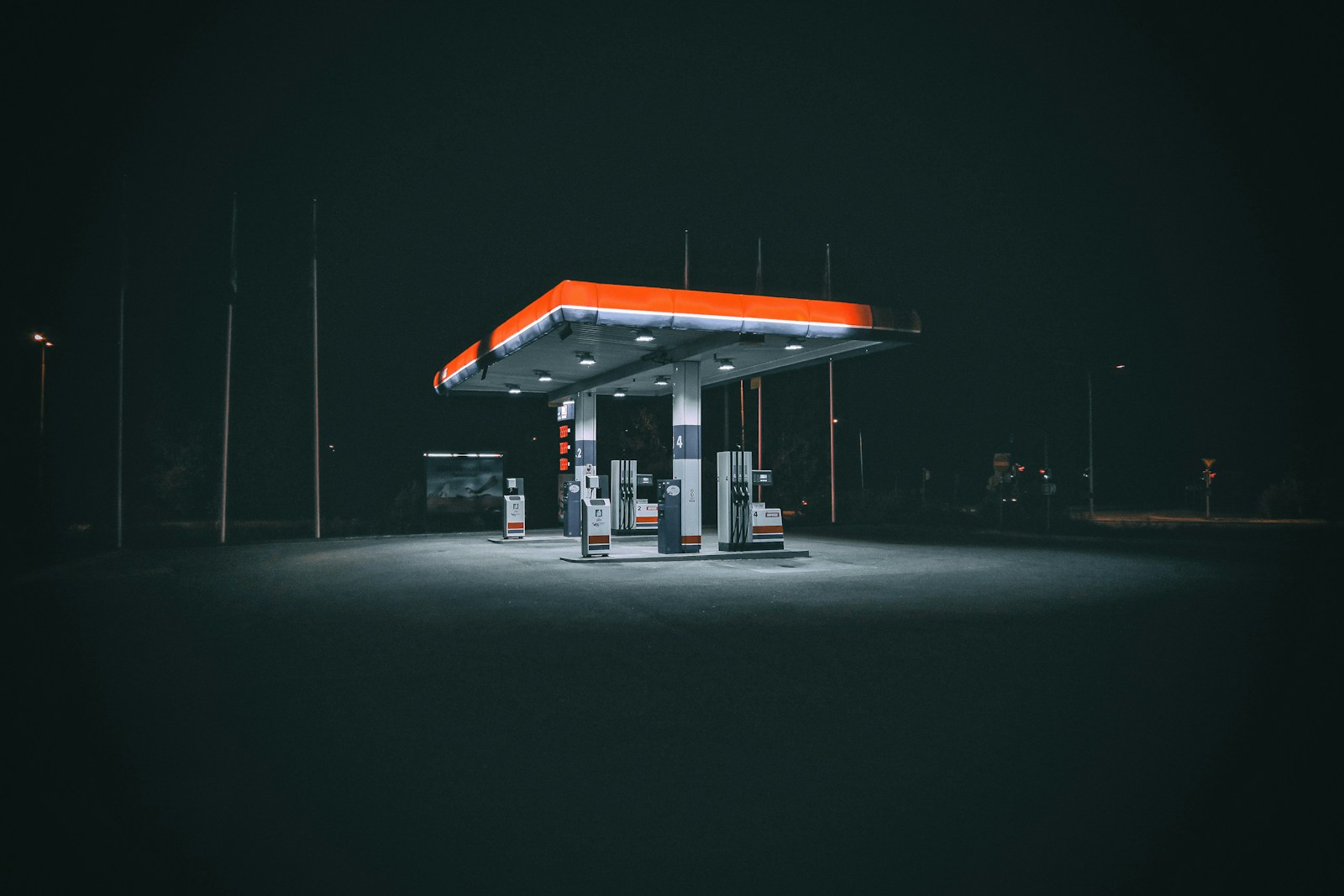
On most forecourts the color coding helps: **magna is the green one, premium is the red one, diésel usually black**. That convention holds widely, but it is a habit, not a law, and non-Pemex brands do their own branding. Read the label on the pump instead of trusting the color, especially at night.

One more thing worth saying out loud, because it is expensive to get wrong: putting <mark lang="es-MX">magna</mark> into a diesel car ruins your day and possibly the engine. If you are not sure what you are driving, say so.

<ul class="examples">
  <li class="example">
    <div class="es" lang="es-MX">Es rentado, no sé si es diésel. ¿Me ayuda a checar?</div>
    <div class="en" lang="en">It's a rental, I don't know if it's diesel. Can you help me check?</div>
  </li>
</ul>

<figure>
  <img src="/images/blog/gasolinera-spanish-1.jpg" alt="A brightly lit petrol station forecourt at night, with pump islands glowing under a wide canopy." loading="lazy" />
  <figcaption>The forecourt at night is where the color coding on the pumps stops helping. Read the label. Photo by <a href="https://unsplash.com/photos/OnmOFmwTlP0" target="_blank" rel="noopener noreferrer">Hans Eiskonen on Unsplash</a>.</figcaption>
</figure>

## Paying, and the zeros

Before the fuel starts flowing, there is a small ritual that locals do automatically and visitors usually miss.

You look at the pump display, and you want it showing zero. The phrase is:

<ul class="examples">
  <li class="example">
    <div class="es" lang="es-MX">Que empiece en ceros, por favor.</div>
    <div class="en" lang="en">Let it start at zeros, please.</div>
  </li>
  <li class="example">
    <div class="es" lang="es-MX">¿Está en ceros?</div>
    <div class="en" lang="en">Is it at zero?</div>
  </li>
</ul>

This is not paranoia and it is not rude. Mexican measurement rules require the pump indicator to be at zero before dispensing starts, and consumer coverage of the topic tells drivers to check exactly that.[^eluniversal-litros] Attendants hear the phrase constantly. Most will reset it and say <mark lang="es-MX">en ceros</mark> before you finish asking.

Payment comes at the end. The attendant asks <mark lang="es-MX">¿efectivo o tarjeta?</mark> and you answer in two words.

| They ask | You say |
|---|---|
| ¿Efectivo o tarjeta? | Con tarjeta / En efectivo |
| ¿Le doy ticket? | Sí, por favor / No, gracias |
| ¿Necesita factura? | No, gracias |
| ¿Con cuánto? | Con quinientos |

<mark lang="es-MX">Ticket</mark> is the receipt. <mark lang="es-MX">Factura</mark> is the formal tax invoice, which you only need if you are expensing the trip in Mexico. Say no and move on.

If something feels wrong with the amount, the federal consumer protection agency, Profeco, is the office that handles fuel measurement complaints and runs the verification operations behind the <mark lang="es-MX">litros completos</mark> campaigns, immobilizing pumps and closing stations that come up short.[^profeco] In practice, most stops are uneventful.

<div id="midpost-newsletter-slot"></div>

## The tip

Yes, you tip. The <mark lang="es-MX">propina</mark> is part of how the job pays, and skipping it reads as slightly cold rather than neutral.[^rae-propina]

Amounts are small and move over time. **Somewhere around five to twenty pesos in coins is the usual range**, closer to the top of it if the attendant cleaned your windshield, checked the oil, or worked in the rain. Treat that as an approximation, not a rule, and adjust up as prices climb.

The practical trap: **you pay for fuel with a card, but you tip with cash**. The portable terminal does not do tips. Keep loose coins in the door pocket before you need them.

<ul class="examples">
  <li class="example">
    <div class="es" lang="es-MX">Y esto para usted.</div>
    <div class="en" lang="en">And this is for you.</div>
  </li>
  <li class="example">
    <div class="es" lang="es-MX">Quédese con el cambio.</div>
    <div class="en" lang="en">Keep the change.</div>
  </li>
  <li class="example">
    <div class="es" lang="es-MX">Gracias, muy amable.</div>
    <div class="en" lang="en">Thanks, that's very kind of you.</div>
  </li>
</ul>

<mark lang="es-MX">Muy amable</mark> is worth learning on its own. It closes the interaction warmly in two words and works at counters, taxis, and doorways all over the country.

<figure>
  <img src="/images/blog/gasolinera-spanish-2.jpg" alt="An empty two-lane highway running straight toward dry hills under an open sky." loading="lazy" />
  <figcaption>On long empty stretches, fill up earlier than you think you need to. Photo by <a href="https://unsplash.com/photos/QhYB_g_7C5I" target="_blank" rel="noopener noreferrer">Jonathan Adeline on Unsplash</a>.</figcaption>
</figure>

## The extras, and how to say no

While the tank fills, the attendant will offer things. This is normal service, not a hustle, and the offers come fast.

| They ask | They mean | Yes | No |
|---|---|---|---|
| ¿Le limpio el parabrisas? | Clean the windshield? | Sí, por favor | No gracias, así está bien |
| ¿Le reviso el aceite? | Check the oil? | Sí, porfa | Ahorita no, gracias |
| ¿Le checo las llantas? | Check the tires? | Sí, por favor | Están bien, gracias |
| ¿Le pongo agua? | Top up the water? | Sí, gracias | No, está bien |
| ¿Anticongelante? | Coolant? | Sí, por favor | No, gracias |

The all-purpose decline is **<mark lang="es-MX">no gracias, así está bien</mark>**. It means no thanks, it's fine as it is, and it lands softly. The blunt version, <mark lang="es-MX">nada más la gasolina</mark>, is also perfectly polite when you are in a hurry.

If you do want the windshield done, say so early. Once the pump clicks off, the moment has passed and the attendant is already walking toward the next car.

<ul class="examples">
  <li class="example">
    <div class="es" lang="es-MX">Sí, el parabrisas por favor. El aceite no, gracias.</div>
    <div class="en" lang="en">Yes, the windshield please. Not the oil, thanks.</div>
  </li>
  <li class="example">
    <div class="es" lang="es-MX">Nada más la gasolina, gracias.</div>
    <div class="en" lang="en">Just the gas, thanks.</div>
  </li>
</ul>

A useful detail: <mark lang="es-MX">llanta</mark> is the word for tire in Mexico, not <mark lang="es-MX">neumático</mark>, which is what your textbook probably taught you. And the little air-and-water station off to the side is <mark lang="es-MX">el aire</mark>.

<figure>
  <img src="/images/blog/gasolinera-spanish-3.jpg" alt="A dry roadside with tall cactus and low scrub stretching out under a wide pale sky." loading="lazy" />
  <figcaption>Cash matters more the farther you get from a city. Not every small station takes cards. Photo by <a href="https://unsplash.com/photos/3B6lQSb8aTU" target="_blank" rel="noopener noreferrer">Daniel De Los Santos on Unsplash</a>.</figcaption>
</figure>

## Pemex, and the brands that came after

Pemex is Petróleos Mexicanos, the state oil company, and it is still the green-and-red name you will see most often on the highway.[^pemex-acerca] For decades it was the only one.

That changed. Fuel retail opened up, and now you will pass stations under other brands too, some international and some Mexican chains. Permits and oversight for fuel retail sit with the federal energy regulator, currently the Comisión Nacional de Energía.[^cne]

For your purposes at the window, none of this changes the script. **The vocabulary is the same at every brand**: <mark lang="es-MX">lleno</mark>, <mark lang="es-MX">magna</mark>, <mark lang="es-MX">premium</mark>, <mark lang="es-MX">ceros</mark>, <mark lang="es-MX">efectivo</mark>, <mark lang="es-MX">tarjeta</mark>, <mark lang="es-MX">propina</mark>. Only the logo on the canopy is different.

## The whole stop, start to finish

Here is the entire interaction, from pulling in to pulling out.

<ul class="examples">
  <li class="example">
    <div class="es" lang="es-MX">Buenas tardes. Lleno de magna, por favor.</div>
    <div class="en" lang="en">Good afternoon. Fill it with regular, please.</div>
  </li>
  <li class="example">
    <div class="es" lang="es-MX">Que empiece en ceros, porfa.</div>
    <div class="en" lang="en">Let it start at zeros, please.</div>
  </li>
  <li class="example">
    <div class="es" lang="es-MX">El parabrisas sí, el aceite no, gracias.</div>
    <div class="en" lang="en">The windshield yes, the oil no, thanks.</div>
  </li>
  <li class="example">
    <div class="es" lang="es-MX">Con tarjeta, por favor.</div>
    <div class="en" lang="en">By card, please.</div>
  </li>
  <li class="example">
    <div class="es" lang="es-MX">Y esto para usted. Gracias, muy amable.</div>
    <div class="en" lang="en">And this is for you. Thanks, that's very kind.</div>
  </li>
</ul>

Two of those sentences are about fuel. The other three are about being a normal person at a window, which is most of what Spanish in Mexico actually is.

The word [va](/words/va) is the tiny confirmation you will hear back through all of it. So is [sale](/words/sale), and [órale](/words/orale) when the attendant is in a good mood. You do not have to say them yet. Just recognize them, nod, and drive off with a full tank and one less thing to be nervous about.

[^pemex-combustible]: [Lo que necesitas saber al cargar combustible](https://www.pemex.com/negocio/gasolineras/pemex-te-lleva/en-tu-camino/Paginas/002.aspx) — Pemex
[^pemex-acerca]: [Quiénes somos](https://www.pemex.com/acerca/Paginas/default.aspx) — Pemex
[^cne]: [Comisión Nacional de Energía](https://www.gob.mx/cne) — Gobierno de México
[^profeco]: [Incrementa Profeco operativos de verificación a gasolineras](https://www.gob.mx/profeco/prensa/incrementa-profeco-operativos-de-verificacion-a-gasolineras) — Procuraduría Federal del Consumidor
[^profeco-combustibles]: [Quién es quién en el precio de la gasolina](https://combustibles.profeco.gob.mx/) — Procuraduría Federal del Consumidor
[^eluniversal-litros]: [Cómo saber si una gasolinera vende litros de a litro](https://www.eluniversal.com.mx/autopistas/como-saber-si-una-gasolinera-vende-litros-de-a-litro/) — El Universal
[^rae-propina]: [Diccionario de la lengua española, propina](https://dle.rae.es/propina) — Real Academia Española
[^dem-despachador]: [Diccionario del español de México, despachador](https://dem.colmex.mx/ver/despachador) — El Colegio de México

FAQ:
Q: Do you pump your own gas in Mexico?
A: No. Mexican gas stations are full service. An attendant, the despachador, pumps the fuel for you while you wait in the car. Self-service is not the norm anywhere in the country.

Q: How do you say fill it up in Mexican Spanish?
A: Say lleno, por favor. If you want to name the fuel, say lleno de magna, por favor or lleno de premium, por favor.

Q: How do you ask for a specific amount of gas in Mexico?
A: Name the peso amount plus the fuel: quinientos de magna means 500 pesos of regular. You can also ask by volume, like veinte litros de magna, but pesos are more common.

Q: What is the difference between magna and premium?
A: Magna is the regular grade at 87 octane and premium is the higher grade at 91 octane. Most ordinary cars run fine on magna; check your owner's manual or the sticker inside the fuel door.

Q: What does que empiece en ceros mean?
A: It means let it start at zeros. You are asking the attendant to reset the pump display to zero before filling, so you can see that you are only paying for your own fuel.

Q: How much does gas cost in Mexico?
A: As of mid-2026 Magna, the regular grade, averages around 23.7 pesos a litre nationally, with premium and diésel higher. Prices move week to week and vary by station, so check Profeco's fuel price monitor or read the board on the way in.

Q: Do you tip gas station attendants in Mexico?
A: Yes, tipping is normal and expected. Small coins are the custom, and the amount goes up if they clean your windshield or check the oil. Keep coins in the car, since a card payment does not include the tip.

Q: How do I say no to the windshield or the oil check?
A: Say no gracias, así está bien or nada más la gasolina, gracias. Both are polite and completely normal answers.

Q: Is Pemex the only gas station brand in Mexico?
A: No. Pemex is the state oil company and still the most visible brand, but other brands operate stations across the country and the sector is regulated by the federal energy regulator.

Q: Can I pay for gas with a card in Mexico?
A: Usually yes. Say con tarjeta and the attendant brings a portable terminal to your window. Smaller highway stations can be cash only, so it helps to carry pesos.

Sources:
- Pemex, Lo que necesitas saber al cargar combustible: https://www.pemex.com/negocio/gasolineras/pemex-te-lleva/en-tu-camino/Paginas/002.aspx
- Pemex, Quiénes somos: https://www.pemex.com/acerca/Paginas/default.aspx
- Comisión Nacional de Energía: https://www.gob.mx/cne
- Profeco, Incrementa Profeco operativos de verificación a gasolineras: https://www.gob.mx/profeco/prensa/incrementa-profeco-operativos-de-verificacion-a-gasolineras
- Profeco, Quién es quién en el precio de la gasolina: https://combustibles.profeco.gob.mx/
- El Universal, Cómo saber si una gasolinera vende litros de a litro: https://www.eluniversal.com.mx/autopistas/como-saber-si-una-gasolinera-vende-litros-de-a-litro/
- Diccionario del español de México, despachador: https://dem.colmex.mx/ver/despachador
- Diccionario de la lengua española, propina: https://dle.rae.es/propina

Related words: sale, va, orale, lana