---
title: "What Lucha Libre Crowds Are Really Yelling: Chants, Insults, and Arena Spanish"
description: "Learn lucha libre chants and crowd Spanish, from técnico and rudo to safe reactions, insults to avoid, and what people yell in the arena."
type: "article"
category: "guides"
url: "https://consalsa.app/blog/lucha-libre-chants"
canonical: "https://consalsa.app/blog/lucha-libre-chants"
published: "2026-09-22"
updated: "2026-09-22"
author: "Andrey the Nomad"
site: "ConSalsa.App"
license: "https://consalsa.app/terms#ip"
---

# What Lucha Libre Crowds Are Really Yelling: Chants, Insults, and Arena Spanish
URL: https://consalsa.app/blog/lucha-libre-chants
Date: 2026-09-22
Updated: 2026-09-22
Category: guides
Keywords: lucha libre chants meaning, lucha libre spanish, mexican wrestling chants, lucha libre crowd words
Summary: Learn lucha libre chants and crowd Spanish, from técnico and rudo to safe reactions, insults to avoid, and what people yell in the arena.

Quick answer:
- Lucha libre means free wrestling and refers to Mexico's masked wrestling tradition.
- Crowds yell support, insults, jokes, and rhythm chants at técnicos and rudos.
- Técnico is the heroic side; rudo is the rule-bending villain side.
- As a visitor, join simple cheers before repeating harsh insults.

What you'll learn:
- What lucha libre crowds yell and why the arena feels interactive.
- The difference between técnico, rudo, máscara, caída, and llave.
- Which chants are safe for learners and which ones need caution.
- How to enjoy the show without turning the crowd into your Spanish lab.

Don't sound gringo:
Do not shout a chant you only half understand because the row in front of you did. Arena Spanish carries insults that land very differently coming from a visitor. Clap the rhythm, learn the words, and join on the next fall.

Body:

Walk into Arena México and the first thing that hits you is not the wrestling. It is the noise, and the noise has structure. The crowd is not reacting to the match so much as performing the other half of it.

Most of what people yell is short, rhythmic, and repeated. Learn maybe fifteen words and the whole room stops being a wall of sound and turns into something you can follow.

## The arena is an instrument, and the crowd plays it

Mexico City recognizes this officially. In July 2018 the city declared <mark lang="es-MX">lucha libre</mark> Intangible Cultural Heritage, and the decree specifically names the "knowledge, beliefs, practices, techniques and systems of representation" around it — not just the athletes, the whole apparatus, audience included.[^cultura-cdmx] The declaration described it as a theatre of life with fabulous characters.[^jornada-lucha]

That is the frame worth holding. The crowd has a script too.

| Spanish | What it means | When it fires |
|---|---|---|
| <mark lang="es-MX">rudo</mark> | the rule-breaking side | booed, loudly, on purpose |
| <mark lang="es-MX">técnico</mark> | the clean-fighting side | cheered, or booed for being boring |
| <mark lang="es-MX">llave</mark> | a hold or submission | when someone gets locked up |
| <mark lang="es-MX">caída</mark> | a fall, one round of the match | at the end of each one |
| <mark lang="es-MX">máscara</mark> | the mask | any time it is nearly pulled off |
| <mark lang="es-MX">la porra</mark> | the chant, and the people chanting | continuously |

Six words and you can follow a whole card. The one doing the most work is <mark lang="es-MX">la porra</mark>, which is where the noise comes from and, confusingly, also what the noise is called.[^dem-porra]

<figure>
  <img src="/images/blog/optimized/lucha-libre-chants-1-1400-9e598f05.webp" alt="The lit ring at Arena Mexico with the crowd around it" loading="lazy" />
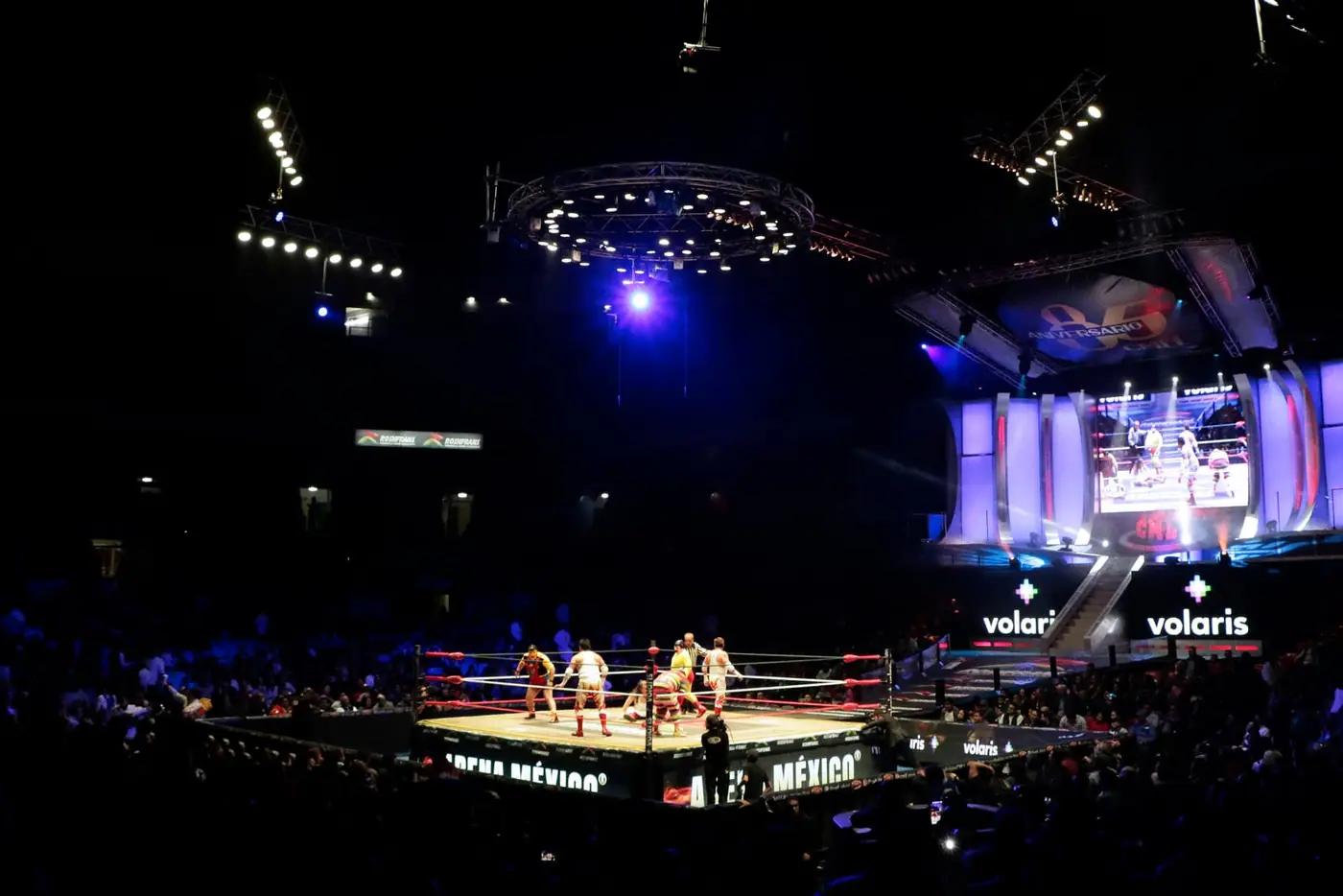
  <figcaption>Arena Mexico, and the other half of the show: everyone in the seats. Photo by Secretaría de Cultura Ciudad de México, <a href="https://creativecommons.org/licenses/by/2.0/">CC BY 2.0</a>.</figcaption>
</figure>

## The crowd has its own job title

<mark lang="es-MX">La porra</mark> is the word that covers all of this, and it does double duty: the dictionary defines it as the shout used to urge on or rally a person, a political side, or a sports team — and it is also the name for the people doing the shouting. A <mark lang="es-MX">porra</mark> is a chant and a chanting section at the same time.

Which tells you something about how the arena works. There is no separate word for spectator-who-participates, because that is just what a spectator is.

<ul class="examples">
  <li class="example">
    <div class="es" lang="es-MX">Nos sentamos cerca de la porra.</div>
    <div class="en" lang="en">We sat near the loud section.</div>
  </li>
  <li class="example">
    <div class="es" lang="es-MX">Se le fue la máscara en la segunda caída.</div>
    <div class="en" lang="en">His mask came off in the second fall.</div>
  </li>
  <li class="example">
    <div class="es" lang="es-MX">Qué llave tan fea, neta.</div>
    <div class="en" lang="en">That was an ugly hold, seriously.</div>
  </li>
</ul>

The practical consequence: where you sit changes what evening you have. Ringside is the show. Up in the cheap seats with the <mark lang="es-MX">porra</mark> is the other show, and it is louder, funnier and much better Spanish practice.

<div id="midpost-newsletter-slot"></div>

## The crowd noise has a heat scale

Not all of it is the same thing. Some is rhythm, some is teasing, some is genuine abuse, and the gap between them is where visitors get into trouble.

<ul class="meter-list">
  <li class="meter-head"><span>what you hear</span><span>how hard it lands</span><span></span></li>
  <li data-tone="soft" style="--fill:15%"><span class="meter-es" lang="es-MX">¡Otro, otro!<span class="meter-en" lang="en">Again, again!</span></span><span class="meter-track"><span class="meter-fill"></span></span><span class="meter-val">safe</span></li>
  <li data-tone="soft" style="--fill:28%"><span class="meter-es" lang="es-MX">¡Échale!<span class="meter-en" lang="en">Come on, go for it!</span></span><span class="meter-track"><span class="meter-fill"></span></span><span class="meter-val">safe</span></li>
  <li data-tone="mid" style="--fill:45%"><span class="meter-es" lang="es-MX">¡Rudos! ¡Rudos!<span class="meter-en" lang="en">Rudos! Rudos!</span></span><span class="meter-track"><span class="meter-fill"></span></span><span class="meter-val">partisan</span></li>
  <li data-tone="firm" style="--fill:70%"><span class="meter-es" lang="es-MX">¡Ya, chécate el reglamento!<span class="meter-en" lang="en">Go read the rulebook!</span></span><span class="meter-track"><span class="meter-fill"></span></span><span class="meter-val">jeering</span></li>
  <li data-tone="blunt" style="--fill:95%"><span class="meter-es" lang="es-MX">the insult chants<span class="meter-en" lang="en">you will know them when you hear them</span></span><span class="meter-track"><span class="meter-fill"></span></span><span class="meter-val">not yours</span></li>
</ul>

The bottom rung is real and it is loud. Some of what a Mexican arena chants in unison is homophobic, some of it is about somebody's mother, and none of it improves by being repeated in an American accent.

<div class="note-card is-safety">
  <span class="note-label">The line worth holding</span>
  <p>A local shouting an insult at a <span lang="es-MX">rudo</span> is inside a tradition they grew up in and can read the edges of. A visitor shouting the same word is doing something else, and the row around you will hear the difference immediately. Chant the rhythm. Skip the slurs. Nobody will think less of you for clapping instead.</p>
</div>

## Reading the match by the fall

Traditional matches run <mark lang="es-MX">dos de tres caídas</mark>, best of three falls, which is why the noise comes in waves instead of building steadily. The first <mark lang="es-MX">caída</mark> sets the story, the second usually reverses it, the third settles it. If the arena suddenly triples in volume, count the falls before you look for what you missed.

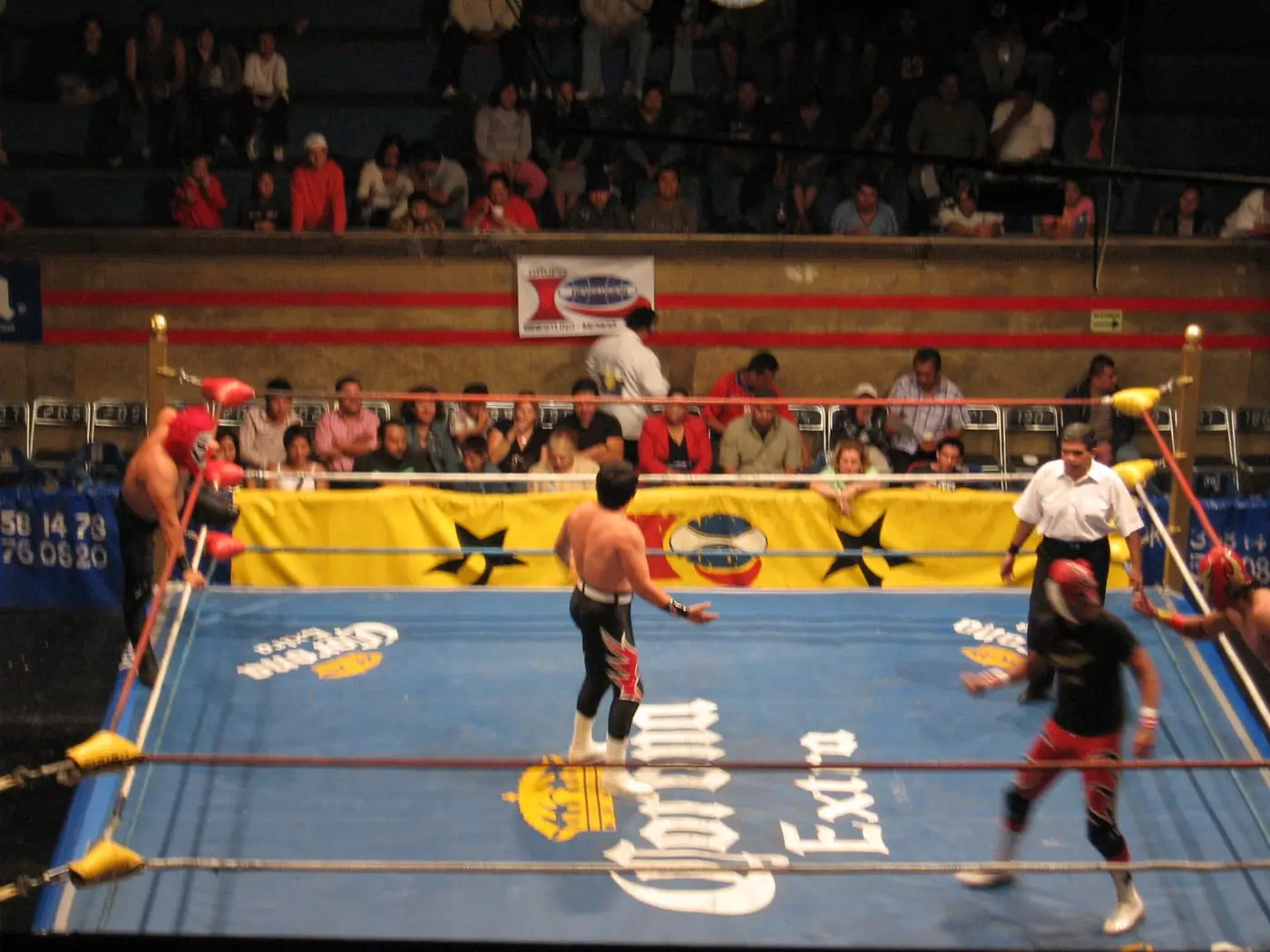
The mask carries its own weight. A <mark lang="es-MX">máscara</mark> is not a costume — the dictionary sense is a covering worn to hide the face or represent a mythic character,[^dem-mascara] and in lucha it functions as identity. The very biggest matches are wagers: <mark lang="es-MX">máscara contra máscara</mark>, or <mark lang="es-MX">máscara contra cabellera</mark>, mask against hair. The loser is unmasked or shaved on the spot, once, permanently.

<figure>
  <img src="/images/blog/optimized/lucha-libre-chants-2-1400-b3c37fca.webp" alt="Spectators packed into the stands behind a lucha libre ring" loading="lazy" />
  <figcaption>Where you sit changes the evening. Near the porra is the louder show. Photo by Syced, <a href="https://creativecommons.org/publicdomain/zero/1.0/">CC0</a>.</figcaption>
</figure>

## Sounding like a fan instead of a tourist

<div class="do-dont">
  <div class="dd-col dd-do">
    <p class="dd-title">Lands fine</p>
    <ul>
      <li><b lang="es-MX">¡Otro!</b> after anything spectacular.</li>
      <li><b lang="es-MX">¿A quién le vas, técnicos o rudos?</b> to the person next to you.</li>
      <li><b lang="es-MX">¡Qué llave!</b> when someone gets locked up properly.</li>
      <li>Clapping the rhythm of a chant you do not know the words to.</li>
    </ul>
  </div>
  <div class="dd-col dd-dont">
    <p class="dd-title">Lands badly</p>
    <ul>
      <li>Repeating an insult chant because it was catchy.</li>
      <li>Explaining to a Mexican that the outcome is scripted.</li>
      <li>Filming the row behind you instead of the ring.</li>
      <li>Calling it <b>Mexican WWE</b> out loud.</li>
    </ul>
  </div>
</div>

That third one about the outcome deserves a note. Everybody knows. It is theatre, declared as theatre by the city itself,[^indeporte-lucha] and pointing it out lands roughly like telling an opera audience the soprano is not really dying.

<figure>
  <img src="/images/blog/optimized/lucha-libre-chants-3-1400-27834703.webp" alt="A masked luchador raising his arms as the referee signals, crowd close behind" loading="lazy" />
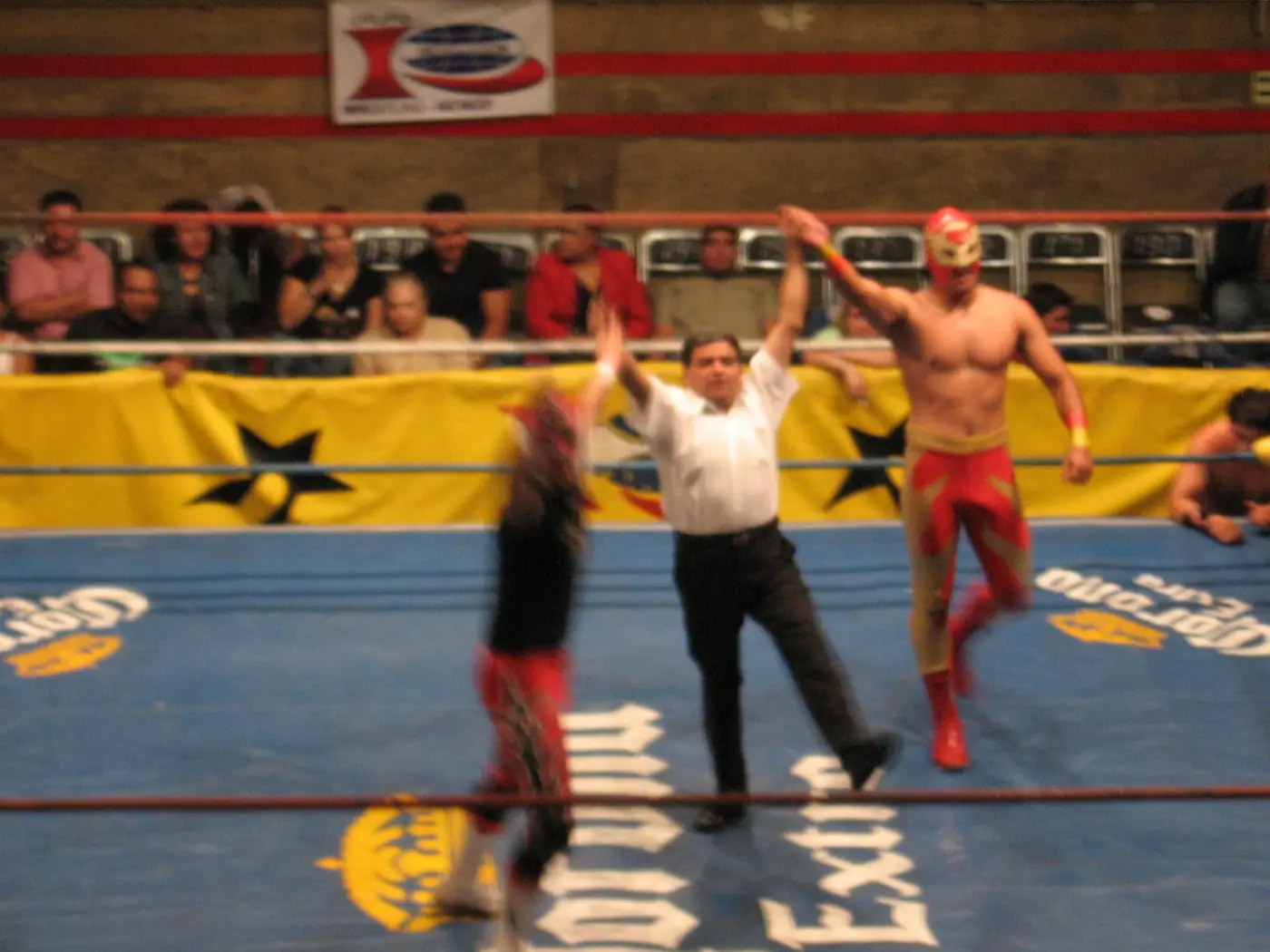
  <figcaption>The noise arrives in waves because the match is scored in falls, not minutes. Photo by Syced, <a href="https://creativecommons.org/publicdomain/zero/1.0/">CC0</a>.</figcaption>
</figure>

Go once and you will spend the first match watching the ring. Go twice and you will spend it watching the crowd, which is where most of the Spanish is anyway.

*Hero photo by Syced, [CC0](https://creativecommons.org/publicdomain/zero/1.0/).*

[^cultura-cdmx]: [Secretaría de Cultura CDMX, declaratoria de la lucha libre como Patrimonio Cultural Intangible](https://www.cultura.cdmx.gob.mx/comunicacion/nota/0667-18) - Gobierno de la Ciudad de México, julio de 2018
[^jornada-lucha]: [La Jornada, declaran a la lucha libre patrimonio cultural intangible de CDMX](https://www.jornada.com.mx/2018/07/22/cultura/a05n2cul)
[^indeporte-lucha]: [INDEPORTE CDMX, declaratoria de la lucha libre](https://indeporte.cdmx.gob.mx/comunicacion/nota/declaran-la-lucha-libre-como-patrimonio-cultural-intangible-en-la-cdmx)
[^dem-porra]: [Diccionario del español de México, porra](https://dem.colmex.mx/ver/porra) - El Colegio de México
[^dem-mascara]: [Diccionario del español de México, máscara](https://dem.colmex.mx/ver/mascara) - El Colegio de México

FAQ:
Q: What does lucha libre mean?
A: Free wrestling. In Mexico it refers to the masked wrestling tradition specifically, with its own style, its own rules and its own crowd culture.

Q: What do crowds actually shout?
A: A mix of rhythm chants, encouragement for the técnicos, abuse for the rudos, and a great deal of improvised commentary. Much of it is call-and-response, so you can join by copying the second half.

Q: Is the crowd language rude?
A: Frequently, yes. Arena chanting includes insults that would be unacceptable almost anywhere else in Mexican public life, and it is understood as part of the performance.

Q: Should I join in with the insults?
A: Start with the cheers. The chants are affectionate ritual for people who grew up with them, and a visitor repeating the harshest ones without the timing tends to land badly rather than as belonging.

Q: What is a safe thing to yell?
A: Vamos, eso, órale, and the arena-wide otra, otra when something is worth repeating. All of them are enthusiastic without being aimed at anyone.

Q: Can I take children?
A: Yes, and families do - it is a normal family outing. Be aware that the chanting around you will not moderate itself for the presence of children.

Q: What does the crowd yell when a wrestler cheats?
A: Complaints at the referee more than the wrestler. Rudos cheating is the expected story, so the outrage is theatrical and directed at the official who failed to see it.

Q: Is it okay to photograph the wrestlers?
A: In the arena generally yes, but never try to remove or touch a mask, and do not photograph a masked wrestler outside the arena. The mask is the identity, and that is taken seriously.

Sources:
- Secretaría de Cultura CDMX, declaratoria de la lucha libre como Patrimonio Cultural Intangible: https://www.cultura.cdmx.gob.mx/comunicacion/nota/0667-18
- La Jornada, declaran a la lucha libre patrimonio cultural intangible de CDMX: https://www.jornada.com.mx/2018/07/22/cultura/a05n2cul
- INDEPORTE CDMX, declaratoria de la lucha libre: https://indeporte.cdmx.gob.mx/comunicacion/nota/declaran-la-lucha-libre-como-patrimonio-cultural-intangible-en-la-cdmx
- Diccionario del español de México, porra: https://dem.colmex.mx/ver/porra
- Diccionario del español de México, máscara: https://dem.colmex.mx/ver/mascara

Related words: cabron, no-mames, a-huevo, orale