---
title: "Regreso a Clases: Mexican School Slang Your Textbook Skipped"
description: "Learn Mexican school slang for regreso a clases, tareas, maestros, compañeros, acordeones, and surviving class without sounding stiff."
type: "article"
category: "slang"
url: "https://consalsa.app/blog/mexican-school-slang"
canonical: "https://consalsa.app/blog/mexican-school-slang"
published: "2026-08-26"
updated: "2026-08-26"
author: "Andrey the Nomad"
site: "ConSalsa.App"
license: "https://consalsa.app/about"
---
# Regreso a Clases: Mexican School Slang Your Textbook Skipped
URL: https://consalsa.app/blog/mexican-school-slang
Date: 2026-08-26
Updated: 2026-08-26
Category: slang
Keywords: mexican school slang, regreso a clases meaning, school slang in Mexico, tarea meaning Spanish, acordeon cheating Mexico
Summary: Learn Mexican school slang for regreso a clases, tareas, maestros, compañeros, acordeones, and surviving class without sounding stiff.
Quick answer:
- Regreso a clases means back to school, and it is a common seasonal phrase in Mexico.
- Tarea, maestro, profe, compañero, examen, and mochila are core school words.
- Acordeón can mean a cheat sheet in Mexican school slang, not just the instrument.
- Use school slang carefully; some words are playful among students but wrong with teachers.
What you'll learn:
- The school words Mexican students and parents actually use around back-to-school season.
- How profe, tarea, examen, mochila, compañero, and acordeón show up in real talk.
- What sounds student-casual versus parent-safe or teacher-respectful.
- How to talk about school errands, homework, stress, and exams with a Mexican rhythm.
Don't sound gringo:
Don't call a teacher maestro güey unless your goal is immediate silence. Profe is casual; respect still matters.
Body:
Regreso a clases means back to school. In Mexico, the phrase comes with uniforms, lists, traffic, parents comparing prices, and students rediscovering that tarea did not disappear over vacation.
For learners, school Spanish is useful even if you are not in school. It shows up in family chats, errands, memes, coworker stories, and anyone joking that life is giving them an exam they did not study for.
## The school-slang map
| Word | English | Tone |
|---|---|---|
| regreso a clases | back to school | Seasonal |
| profe | teacher | Casual respectful |
| tarea | homework/task | Everyday |
| compañero | classmate | Neutral |
| mochila | backpack | Everyday |
| examen | test/exam | Universal dread |
| acordeón | cheat sheet | Slang/contextual |
| flojera | laziness/can't-be-bothered | Student energy |
Clase means class, and tarea can mean homework or task.[^rae-clase][^rae-tarea] Around all of it you will hear [flojera](/words/flojera) (that no-energy feeling before homework) and the odd [menso](/words/menso) thrown at a classmate who spaced out.
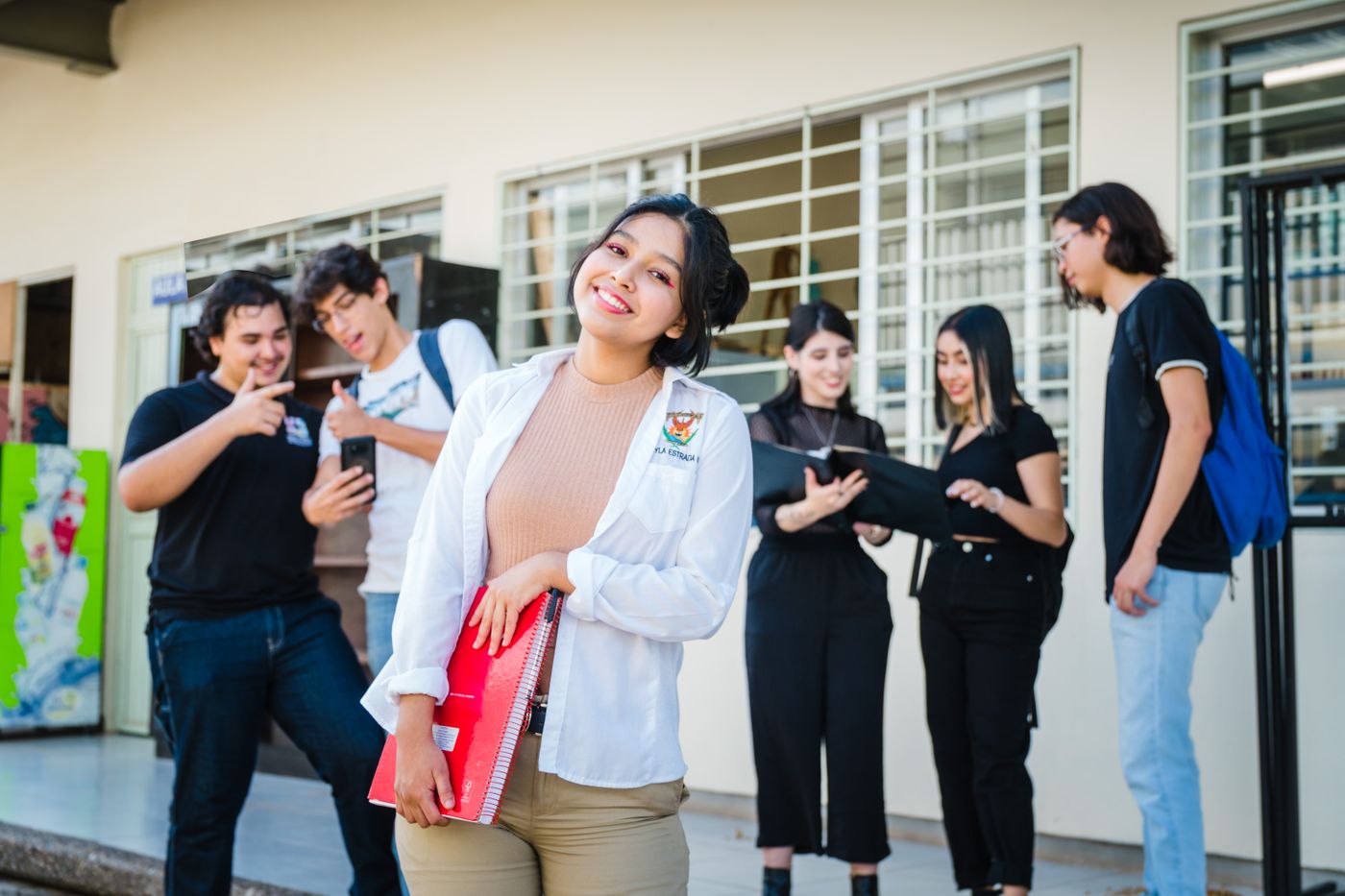
Back-to-school Spanish lives in backpacks, lists, and the first week everyone swears they will be organized. Photo from Pexels.
## Profe is casual, not disrespectful
Profe is a common short form of profesor or profesora.[^rae-profesor] It can sound warm and normal. The respectful part comes from the rest of the sentence.
Profe, ¿me explica otra vez?
Teacher, could you explain again?
No entendí la tarea.
I did not understand the homework.
## Acordeón is not always music
Acordeón is the instrument, yes.[^rae-acordeon] In Mexican school slang, it can also mean a cheat sheet, especially one folded small. This is useful to understand; it is not advice to bring one.
| Student phrase | Meaning | Safe with teacher? |
|---|---|---|
| No hice la tarea | I did not do the homework | Honest |
| Me fue mal | I did badly | Yes |
| Reprobé | I failed | Yes |
| Me da flojera | I can't be bothered | Not ideal |
| Traía acordeón | I had a cheat sheet | Confession energy |
Acordeón is the word you want to recognize before someone jokes about the exam. Photo from Pexels.
## Back-to-school errands
The SEP calendar sets the school-year rhythm nationally, and families build errands around it.[^sep] That is why regreso a clases appears in store signs, family chats, and news segments. For the shopping half of the season, [the papelería and school-supply run](/blog/utiles-escolares-spanish) has its own vocabulary.
Ya compré la mochila.
I already bought the backpack.
Me falta forrar los cuadernos.
I still need to cover the notebooks.
Qué flojera levantarme temprano.
I really don't feel like waking up early.
The slang gets casual among students; with teachers, keep the respect switched on. Photo from Pexels.
Use profe kindly, learn tarea early, and treat acordeón as a cultural footnote unless you enjoy consequences. School Spanish is daily-life Spanish wearing a backpack.
[^rae-clase]: [Diccionario de la lengua española, clase](https://dle.rae.es/clase) - Real Academia Española
[^rae-tarea]: [Diccionario de la lengua española, tarea](https://dle.rae.es/tarea) - Real Academia Española
[^rae-profesor]: [Diccionario de la lengua española, profesor](https://dle.rae.es/profesor) - Real Academia Española
[^rae-acordeon]: [Diccionario de la lengua española, acordeón](https://dle.rae.es/acorde%C3%B3n) - Real Academia Española
[^sep]: [Secretaria de Educacion Publica](https://www.gob.mx/sep)
FAQ:
Q: What does regreso a clases mean?
A: Regreso a clases means back to school or return to classes.
Q: What does profe mean?
A: Profe is a common short form of profesor or profesora.
Q: What does tarea mean?
A: Tarea means homework or task.
Q: What is an acordeón in Mexican school slang?
A: Acordeón can mean a cheat sheet, because it folds like the instrument.
Q: What does compañero mean?
A: Compañero means classmate, coworker, or companion depending on context.
Q: Is flojera used by students?
A: Yes. Me da flojera means I can't be bothered or I feel too lazy to do it.
Q: How do students say they failed?
A: Common phrases include reprobé, me fue mal, or no pasé el examen.
Sources:
- Diccionario de la lengua española, clase: https://dle.rae.es/clase
- Diccionario de la lengua española, tarea: https://dle.rae.es/tarea
- Diccionario de la lengua española, profesor: https://dle.rae.es/profesor
- Diccionario de la lengua española, acordeón: https://dle.rae.es/acorde%C3%B3n
- SEP, calendario escolar: https://www.gob.mx/sep
Related words: chamba, flojera, menso, aguanta