---
title: "Mexican Spanish for Directions When Google Maps Betrays You"
description: "Learn practical Mexican Spanish for asking directions: por dónde, derecho, hasta, esquina, enfrente, cruzando, queda, and landmarks."
type: "article"
category: "getting_around"
url: "https://consalsa.app/blog/mexican-spanish-directions"
canonical: "https://consalsa.app/blog/mexican-spanish-directions"
published: "2026-06-01"
updated: "2026-06-01"
author: "Andrey the Nomad"
site: "ConSalsa.App"
license: "https://consalsa.app/about"
---

# Mexican Spanish for Directions When Google Maps Betrays You
URL: https://consalsa.app/blog/mexican-spanish-directions
Date: 2026-06-01
Updated: 2026-06-01
Category: getting_around
Keywords: mexican spanish directions, ask directions in mexico spanish, por donde queda meaning, spanish directions mexico city, google maps mexico spanish
Summary: Learn practical Mexican Spanish for asking directions: por dónde, derecho, hasta, esquina, enfrente, cruzando, queda, and landmarks.

Quick answer:
- For directions in Mexico, ask one next-step question: ¿por dónde queda...?, ¿sigo derecho?, ¿hasta la esquina?, or ¿está cerca?
- Use landmarks more than addresses. Pharmacies, OXXOs, churches, parks, gates, and corners are easier to confirm.
- Derecho means straight ahead, esquina means corner, enfrente means across/in front, and cruzando means crossing.
- If you miss the answer, say perdón, ¿me repites? and listen for the first action: derecho, izquierda, derecha, or cruzando.

What you'll learn:
- How to ask for directions without asking for an entire route.
- How to understand common direction words in Mexico City and other Mexican cities.
- How to confirm landmarks, corners, and entrances before you walk the wrong way.
- How to recover when someone answers too fast.

Don't sound gringo:
Don't ask for the whole route at once if you're already lost. Ask the next move: ¿derecho?, ¿a la izquierda?, ¿cruzo? Mexico City directions work step by step.

Body:

Google Maps is useful until it tells you to enter through a wall, walk across six lanes, or "arrive" at the back of a building with no door and one suspicious plant. That is when you need Mexican Spanish for directions: <mark lang="es-MX">¿por dónde queda?</mark>, <mark lang="es-MX">siga derecho</mark>, <mark lang="es-MX">en la esquina</mark>, <mark lang="es-MX">enfrente</mark>, <mark lang="es-MX">cruzando</mark>.

The goal is not to understand a whole paragraph. The goal is to catch the next move.

## The direction phrase map

Use these before your battery and patience both hit 4 percent.

| Need | Say this | Listen for |
|---|---|---|
| Where is it? | ¿Por dónde queda...? | derecho, esquina, enfrente |
| Is it close? | ¿Queda cerca? | sí / no / caminando |
| Do I keep going? | ¿Sigo derecho? | sí, hasta... |
| Which entrance? | ¿Por dónde está la entrada? | por aquí / por allá |
| Repeat please | Perdón, ¿me repites? | slower answer |
| Confirm landmark | ¿Frente al OXXO? | sí / exacto |

<mark lang="es-MX">Dirección</mark> means direction or address depending on context.[^rae-direccion] In a street moment, you usually want direction first and address second.

## Ask for the next step

Do not ask:

<mark lang="es-MX">¿Cómo llego desde mi estado actual de incertidumbre hasta el destino completo?</mark>

Ask:

<ul class="examples">
  <li class="example">
    <div class="es" lang="es-MX">Disculpa, ¿por dónde queda la entrada?</div>
    <div class="en" lang="en">Excuse me, which way is the entrance?</div>
  </li>
  <li class="example">
    <div class="es" lang="es-MX">¿Sigo derecho hasta la esquina?</div>
    <div class="en" lang="en">Do I keep going straight until the corner?</div>
  </li>
  <li class="example">
    <div class="es" lang="es-MX">¿Está enfrente de la farmacia?</div>
    <div class="en" lang="en">Is it across from the pharmacy?</div>
  </li>
</ul>

**A good direction question should be answerable with one gesture.**
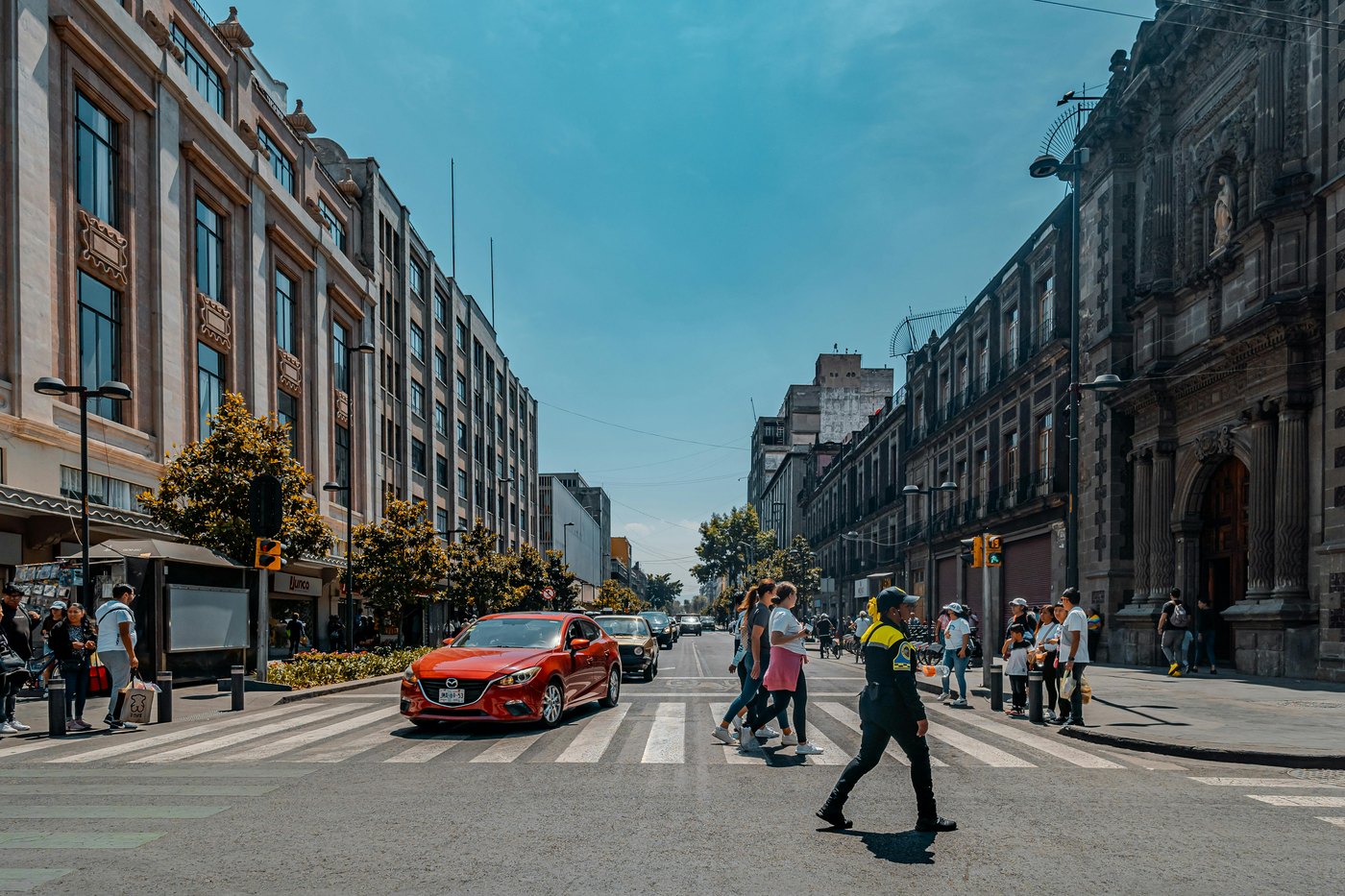
<figure>
  <img src="/images/blog/cdmx-crosswalk-centro.jpg" alt="People crossing a busy street in Mexico City in warm afternoon light." loading="lazy" />
  <figcaption>In CDMX, "across" and "on the corner" can matter more than the address. Photo by <a href="https://www.pexels.com/photo/people-crossing-street-in-mexico-city-20848557/" target="_blank" rel="noopener noreferrer">Jimmy Elizarraras on Pexels</a>.</figcaption>
</figure>

## The words that carry most routes

These words show up constantly.

| Word | What to do |
|---|---|
| derecho | go straight |
| esquina | corner |
| enfrente | in front / across from |
| cruzando | crossing / after crossing |
| hasta | until / as far as |
| por allá | over that way |
| por aquí | this way / around here |

<mark lang="es-MX">Esquina</mark> means corner,[^rae-esquina] and <mark lang="es-MX">frente</mark> is the base behind <mark lang="es-MX">enfrente</mark> and <mark lang="es-MX">frente a</mark>.[^rae-frente] These are not just vocabulary words. They are how people make the city visible.

<div id="midpost-newsletter-slot"></div>

## Cruzando does a lot of work

<mark lang="es-MX">Cruzar</mark> means to cross.[^rae-cruzar] In directions, <mark lang="es-MX">cruzando</mark> often means after crossing or across.

Listen for:

<ul class="examples">
  <li class="example">
    <div class="es" lang="es-MX">Está cruzando la calle.</div>
    <div class="en" lang="en">It is across the street.</div>
  </li>
  <li class="example">
    <div class="es" lang="es-MX">Cruzas y sigues derecho.</div>
    <div class="en" lang="en">You cross and keep going straight.</div>
  </li>
  <li class="example">
    <div class="es" lang="es-MX">Está cruzando, junto al banco.</div>
    <div class="en" lang="en">It is across, next to the bank.</div>
  </li>
</ul>

The word <mark lang="es-MX">derecho</mark> has several meanings in Spanish,[^rae-derecho] but in directions it is your friend: straight ahead.

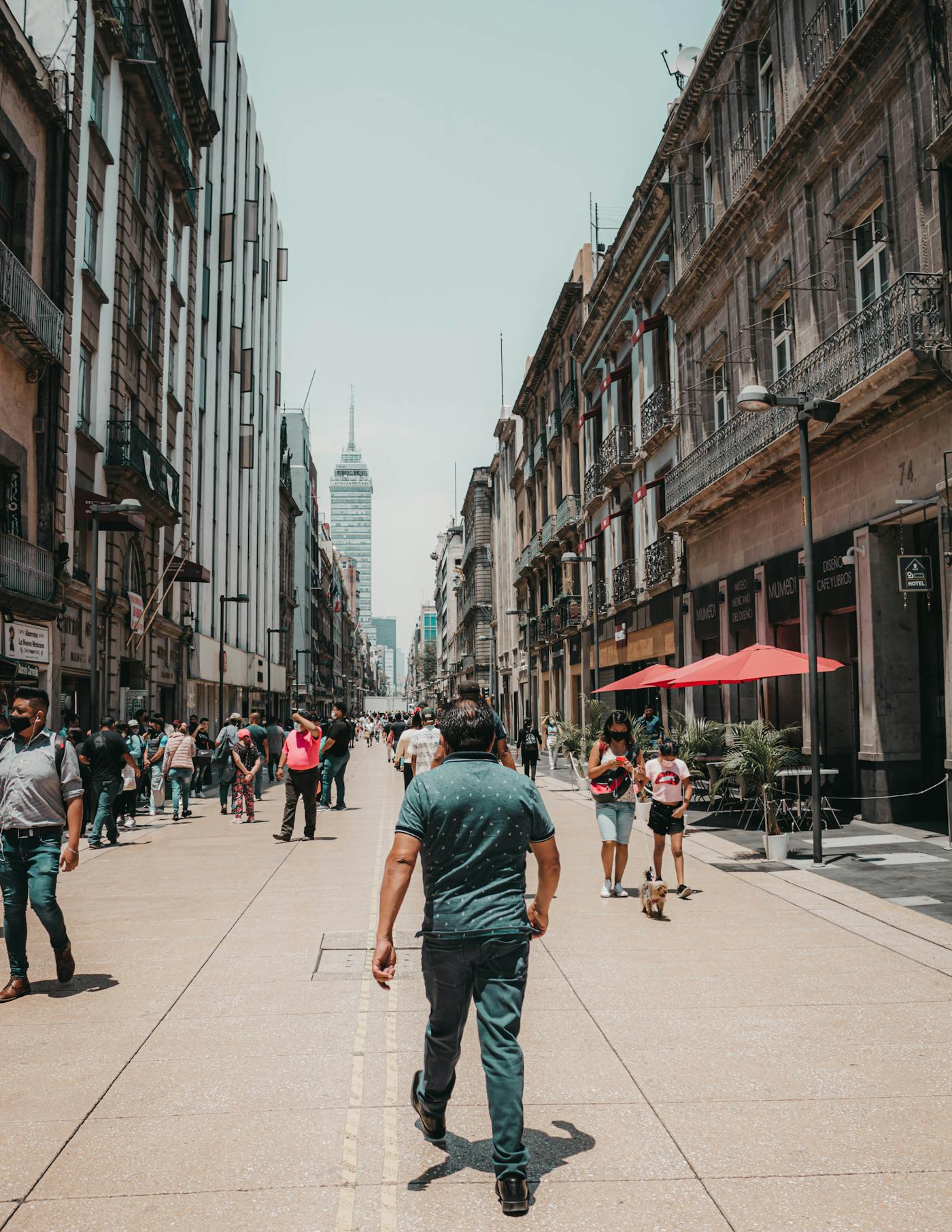
<figure>
  <img src="/images/blog/cdmx-torre-latino-pedestrians.jpg" alt="People walking near Torre Latinoamericana in Mexico City." loading="lazy" />
  <figcaption>Landmarks turn vague directions into something your body can follow. Photo from <a href="https://www.pexels.com/photo/12317587/" target="_blank" rel="noopener noreferrer">Pexels</a>.</figcaption>
</figure>

## Recovery phrases

Someone will answer too fast. This is not a personal failure. This is just Tuesday.

Use:

<ul class="examples">
  <li class="example">
    <div class="es" lang="es-MX">Perdón, ¿me repites?</div>
    <div class="en" lang="en">Sorry, can you repeat that?</div>
  </li>
  <li class="example">
    <div class="es" lang="es-MX">Más despacio, por favor.</div>
    <div class="en" lang="en">Slower, please.</div>
  </li>
  <li class="example">
    <div class="es" lang="es-MX">¿Entonces sigo derecho?</div>
    <div class="en" lang="en">So I keep going straight?</div>
  </li>
</ul>

Confirm the one thing you understood. If they nod, move. If they correct you, congratulations: your Spanish just became useful.

Mexico City phrase guides aimed at learners also emphasize city vocabulary and location words because street signs, neighborhood talk, and directions are where textbook Spanish gets stress-tested.[^spanishny-city]

[^rae-direccion]: [Diccionario de la lengua española, dirección](https://dle.rae.es/direcci%C3%B3n) — Real Academia Española
[^rae-esquina]: [Diccionario de la lengua española, esquina](https://dle.rae.es/esquina) — Real Academia Española
[^rae-frente]: [Diccionario de la lengua española, frente](https://dle.rae.es/frente) — Real Academia Española
[^rae-cruzar]: [Diccionario de la lengua española, cruzar](https://dle.rae.es/cruzar) — Real Academia Española
[^rae-derecho]: [Diccionario de la lengua española, derecho](https://dle.rae.es/derecho) — Real Academia Española
[^spanishny-city]: [spanishNY, City vocabulary for Mexico City](https://spanishny.com/city-vocabulary-for-mexico-city/) — spanishNY

FAQ:
Q: How do you ask for directions in Mexican Spanish?
A: Say disculpa, ¿por dónde queda...? or disculpa, ¿sabes dónde está...? Then name the place.

Q: What does por dónde queda mean?
A: It means roughly which way is it or where is it located. It is very useful for asking directions.

Q: How do you say straight ahead in Spanish?
A: Say derecho. In directions, sigue derecho means keep going straight.

Q: What does enfrente mean?
A: Enfrente usually means in front or across from, depending on the context. Use it with a landmark.

Q: How do you ask if something is nearby?
A: Say ¿está cerca? or ¿queda cerca?

Q: What should I say if someone gives directions too fast?
A: Say perdón, ¿me repites? or más despacio, por favor.

Q: Should I ask for addresses or landmarks in CDMX?
A: Landmarks often work better. Ask for corners, entrances, pharmacies, stations, parks, and recognizable businesses.

Sources:
- Diccionario de la lengua española, dirección: https://dle.rae.es/direcci%C3%B3n
- Diccionario de la lengua española, esquina: https://dle.rae.es/esquina
- Diccionario de la lengua española, frente: https://dle.rae.es/frente
- Diccionario de la lengua española, cruzar: https://dle.rae.es/cruzar
- Diccionario de la lengua española, derecho: https://dle.rae.es/derecho
- spanishNY, City vocabulary for Mexico City: https://spanishny.com/city-vocabulary-for-mexico-city/

Related words: sale, mande, aguas, ahorita