---
title: "Pan de Muerto, Explained: Why the Bones, the Sugar, and How to Order It"
description: "Learn what pan de muerto means, why the bread has bone shapes, regional variations, and the Spanish to order it in Mexico."
type: "article"
category: "food"
url: "https://consalsa.app/blog/pan-de-muerto-explained"
canonical: "https://consalsa.app/blog/pan-de-muerto-explained"
published: "2026-10-08"
updated: "2026-10-08"
author: "Andrey the Nomad"
site: "ConSalsa.App"
license: "https://consalsa.app/terms#ip"
---

# Pan de Muerto, Explained: Why the Bones, the Sugar, and How to Order It
URL: https://consalsa.app/blog/pan-de-muerto-explained
Date: 2026-10-08
Updated: 2026-10-08
Category: food
Keywords: pan de muerto meaning, what is pan de muerto, pan de muerto bones meaning, order pan de muerto spanish
Summary: Learn what pan de muerto means, why the bread has bone shapes, regional variations, and the Spanish to order it in Mexico.

Quick answer:
- Pan de muerto is a sweet Mexican bread eaten around Día de Muertos and often placed on ofrendas.
- The raised strips are commonly explained as bones; the round center is often read as a skull or tear-like detail.
- At a bakery, ask for size, topping, filling, and flavor: chico, grande, con azúcar, con ajonjolí, relleno, or de azahar.
- Regional versions vary, so the best question is ¿de qué estilo es?

What you'll learn:
- What pan de muerto is and why it appears in October and November.
- How to talk about the bone-shaped decoration without being weird.
- The bakery Spanish for sugar, sesame, filling, orange blossom, and hot chocolate.
- How to order it politely and understand regional or modern versions.

Don't sound gringo:
Do not ask if pan de muerto has 'real bones' as your bakery joke. Ask about azahar, ajonjolí, relleno, or size; that sounds curious instead of twelve years old.

Body:

Pan de muerto is a sweet Mexican bread eaten around Día de Muertos and often placed on ofrendas. The raised strips are commonly explained as bones; the round center is often read as a skull or tear-like detail.[^src1]

If you are learning Spanish from the US, this is exactly the kind of seasonal phrase that can make you feel suddenly local or suddenly clumsy. The difference is usually not grammar. It is knowing when you are talking about bread, when you are talking about memory, and when the right move is simply to listen.

## What pan de muerto is

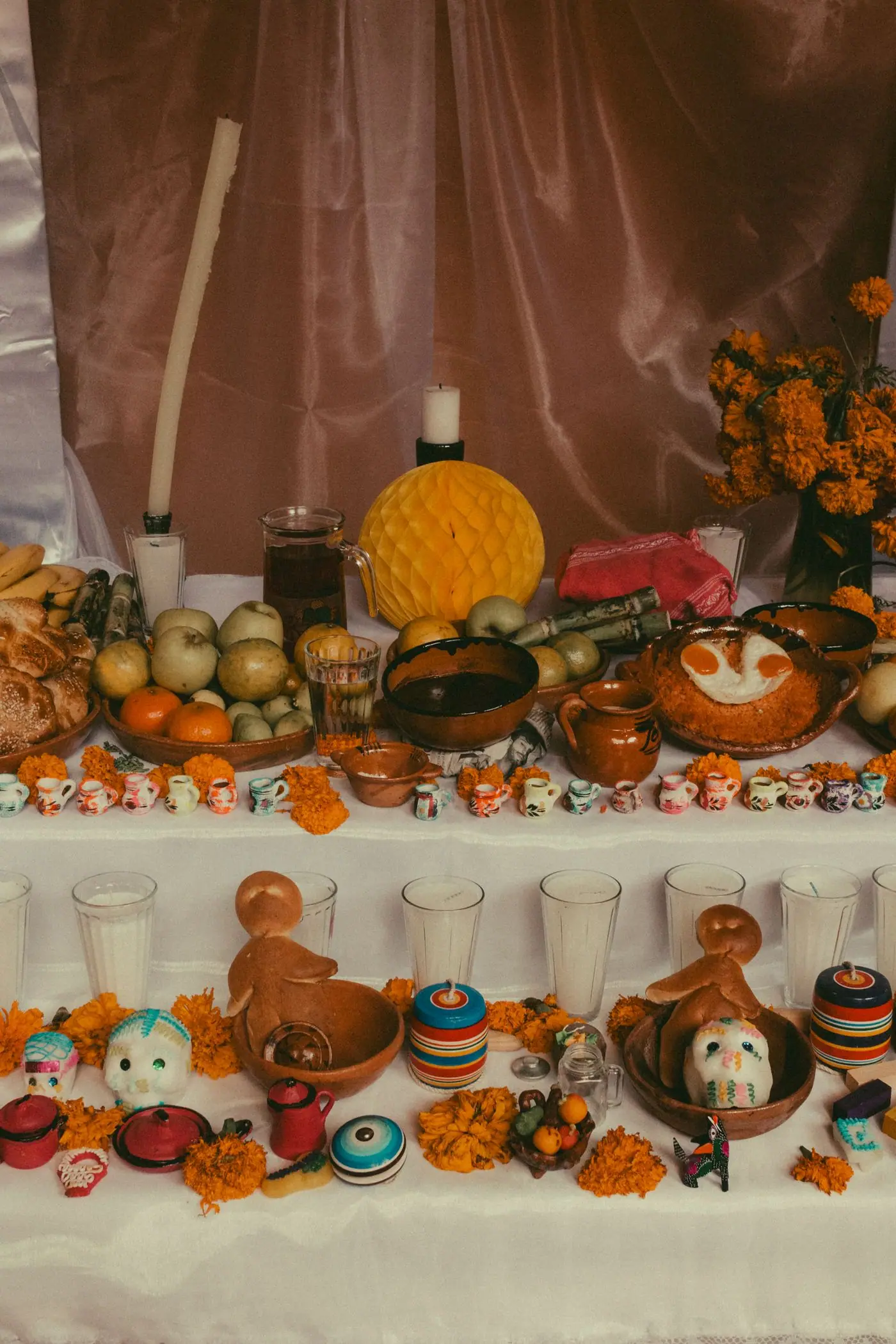
At the bakery counter, <mark lang="es-MX">pan de muerto</mark> is not mysterious. It is bread, but seasonal bread with memory attached. You will usually see round loaves dusted with sugar, sometimes sesame, sometimes filled, and almost always sold with the quiet assumption that everyone already knows October has arrived. By then the [cempasúchil marigolds](/blog/cempasuchil-marigold) are already stacked high at the market. The words are simple: <mark lang="es-MX">pan</mark> means bread and <mark lang="es-MX">muerto</mark> means dead.[^src3][^src4] The cultural weight is bigger than the grammar.[^src5]

<figure>
  <img src="/images/blog/optimized/pan-de-muerto-explained-1-1400-3a07f297.webp" alt="A Day of the Dead ofrenda with pan de muerto, fruit, marigolds, sugar skulls, and rows of tiny painted clay mugs." loading="lazy" />
  <figcaption>Pan de muerto usually lands on the ofrenda first, next to fruit, marigolds, and sugar skulls.</figcaption>
</figure>

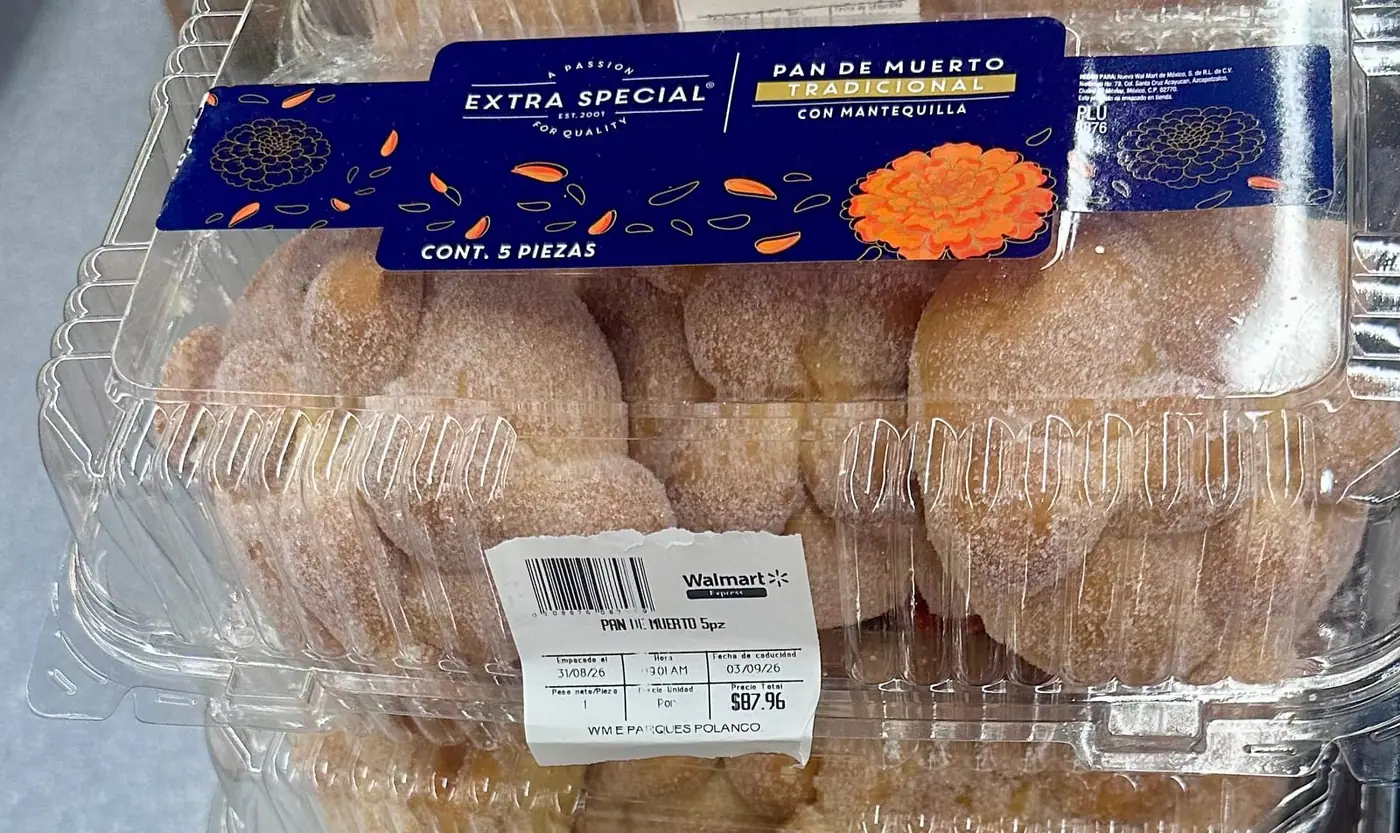
October is the polite version of the timeline. Supermarkets move first, and they move early: the pack below was on a shelf in Polanco on 31 August, packed that same morning, a full two months before anyone lights a candle. The panaderías hold out a few weeks longer and then give in too.

<figure>
  <img src="/images/blog/optimized/pan-de-muerto-2-1400-68c9dbcd.webp" alt="A five-pack of sugar-topped pan de muerto sealed in a Walmart clamshell, the price sticker reading Empacado el 31/08/26." loading="lazy" />
  <figcaption>Walmart Express, Parques Polanco, 31 August 2026. Packed that morning, $87.96 for five. Photo by <a href="/author/andreythenomad">Andrey the Nomad</a> for ConSalsa.App.</figcaption>
</figure>

## Why the bones are there

The strips across the top are commonly explained as <mark lang="es-MX">huesitos</mark>, little bones. Some bakers and cultural explainers describe the center as a skull or a tear-like shape. You do not need to deliver a lecture in line. Just know enough not to stare at the bread like it is Halloween merch. A good learner question is <mark lang="es-MX">¿qué significa la forma?</mark>

## How to order without freezing

The useful bakery script is short. Say <mark lang="es-MX">buenas</mark>, point if needed, and ask: <mark lang="es-MX">me da un pan de muerto chico, por favor</mark>. If the tray has multiple styles, ask <mark lang="es-MX">¿cuál me recomienda?</mark> or <mark lang="es-MX">¿tiene relleno?</mark>. If you hear <mark lang="es-MX">azahar</mark>, think orange blossom. If you hear <mark lang="es-MX">ajonjolí</mark>, think sesame.

<ul class="examples">
  <li class="example">
    <div class="es" lang="es-MX">Me da un pan de muerto chico, por favor.</div>
    <div class="en" lang="en">Could I have a small pan de muerto, please?</div>
  </li>
  <li class="example">
    <div class="es" lang="es-MX">¿Tiene relleno de nata?</div>
    <div class="en" lang="en">Do you have one filled with nata?</div>
  </li>
  <li class="example">
    <div class="es" lang="es-MX">¿Con qué se acompaña, chocolate o café?</div>
    <div class="en" lang="en">What do people have it with, hot chocolate or coffee?</div>
  </li>
</ul>

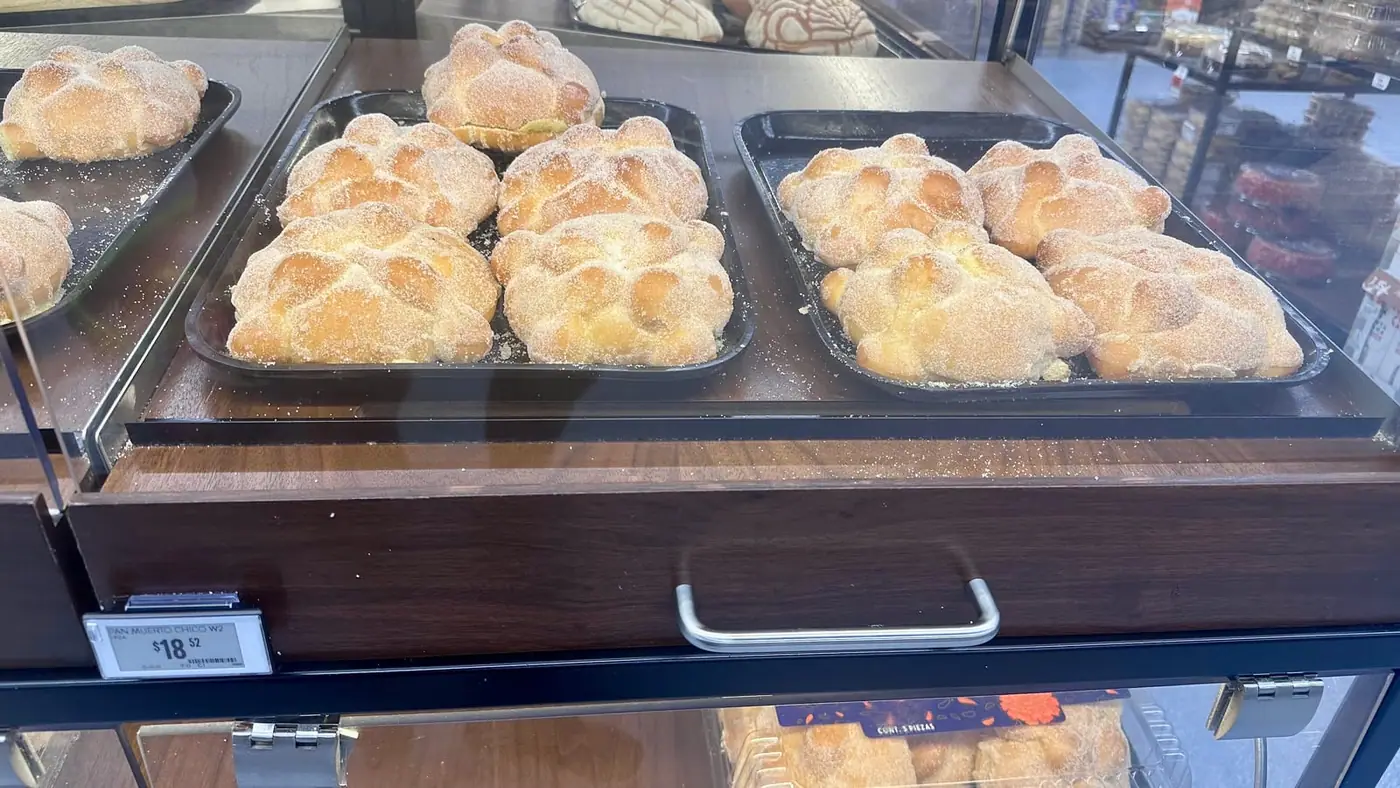
The size word is the one that does real work at the counter. <mark lang="es-MX">Chico</mark> and <mark lang="es-MX">grande</mark> are usually priced separately and labelled separately, so saying which one you want saves the whole guessing exchange.
<figure>
  <img src="/images/blog/optimized/pan-de-muerto-explained-4-1400-d5303117.webp" alt="Trays of plain sugar-dusted pan de muerto in a supermarket bakery case, with a shelf label reading PAN MUERTO CHICO." loading="lazy" />
  <figcaption>The label does the ordering for you: <mark lang="es-MX">pan muerto chico</mark>, $18.52 a piece. Photo by <a href="/author/andreythenomad">Andrey the Nomad</a> for ConSalsa.App.</figcaption>
</figure>

<div id="midpost-newsletter-slot"></div>

## Modern versions and regional variation

Some bakeries now sell <mark lang="es-MX">pan de muerto relleno</mark> with cream, chocolate, nata, or seasonal flavors. That does not erase the older versions; it is bakery culture doing what bakery culture does. Regional shapes and preparations vary too, which is why <mark lang="es-MX">¿de qué estilo es?</mark> is a better question than assuming one Instagram version is the official one.[^src2]

## Tone and etiquette

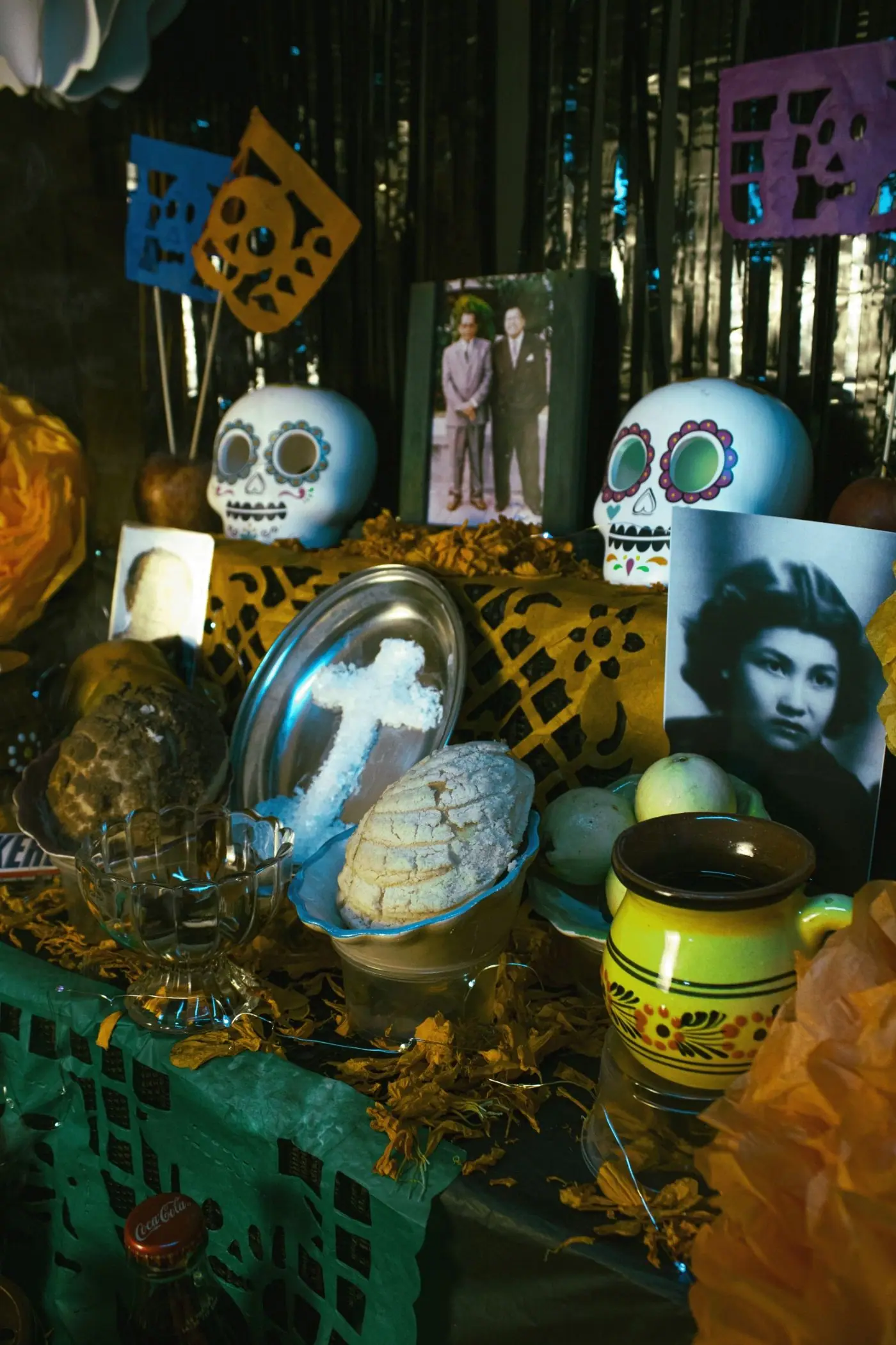
If the bread is on a public bakery tray, order it. If it is on a family [ofrenda](/blog/day-of-the-dead-altar-objects), pause. Food on an altar is not a snack bowl for visitors. Ask first, listen, and let the host explain whether the bread will later be shared.

<figure>
  <img src="/images/blog/optimized/pan-de-muerto-explained-2-1400-82d3d96e.webp" alt="Close-up of a home altar with two decorated sugar skulls, framed black-and-white family photos, pan dulce, and a painted talavera jug." loading="lazy" />
  <figcaption>On a home ofrenda, the bread sits beside photos of the people being remembered - not a snack tray.</figcaption>
</figure>

| Situation | Better move | Why |
|---|---|---|
| You are unsure | ¿Qué significa? | Short and honest |
| You need local usage | ¿Cómo lo dicen ustedes? | Invites lived context |
| You might overstep | Lo digo con respeto | Lowers the temperature |
| Someone corrects you | Gracias, así lo digo mejor | Keeps connection open |

<figure>
  <img src="/images/blog/optimized/pan-de-muerto-explained-3-1400-c074bdb7.webp" alt="A tiered ofrenda dedicated to pets, with pan de muerto, fruit, marigolds, candles, and cut-paper papel picado." loading="lazy" />
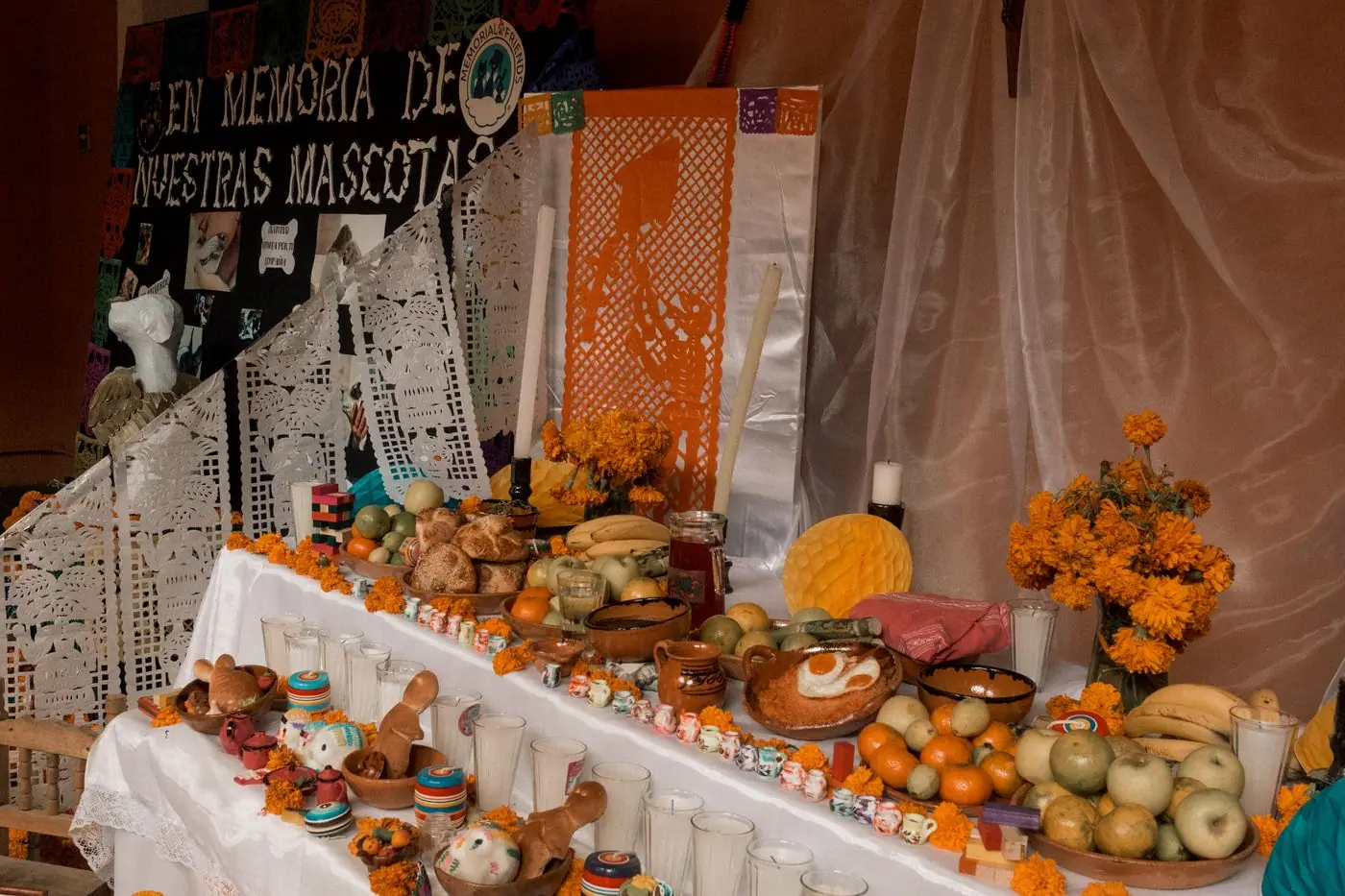
  <figcaption>Even a pet ofrenda follows the same logic: bread, fruit, flowers, and a photo of who is missed.</figcaption>
</figure>

## The tiny conversation that makes you sound warmer

The best pan de muerto Spanish is not fancy. It is the Spanish that lets the baker, your coworker, or your partner's family feel that you are paying attention. If someone brings a box to work, you can say <mark lang="es-MX">se ve buenísimo</mark> before you start asking questions. If a friend tells you their mom only buys from one bakery, ask <mark lang="es-MX">¿cuál es la panadería buena?</mark> That word, <mark lang="es-MX">buena</mark>, does a lot. It says you know there is usually a local favorite, not just a generic dessert.

If you are invited to a home, keep your first question about the person, not the object. <mark lang="es-MX">¿Ustedes lo ponen en la ofrenda?</mark> is more natural than asking for the "meaning" like you are interviewing a tour guide. If they say yes, follow with <mark lang="es-MX">qué bonito</mark> and let them decide how much to share. Some families talk openly. Some keep it simple. Both responses are normal.

For ordering, the most useful extra phrase is <mark lang="es-MX">para llevar</mark>. Say <mark lang="es-MX">me da dos chicos para llevar</mark> if you are taking them home. If the bakery has a line, do not rehearse a whole paragraph. Point, smile, and use the nouns you know: <mark lang="es-MX">azúcar</mark>, <mark lang="es-MX">ajonjolí</mark>, <mark lang="es-MX">relleno</mark>, <mark lang="es-MX">chocolate</mark>. That is enough Spanish to participate without making the moment about your Spanish.

One more very real detail: people may have opinions. Someone will say the filled ones are too much. Someone else will insist the classic sugar one is boring. This is your opening to practice preferences: <mark lang="es-MX">a mí me gusta más el clásico</mark>, <mark lang="es-MX">se me antoja el relleno</mark>, <mark lang="es-MX">está muy dulce para mí</mark>. Food opinions are low-stakes, which makes them perfect language practice.

Pan de muerto is worth learning because it gives you a tiny doorway into Mexican seasonal life: the bakery line, the office box, the family altar, the cup of chocolate. Learn the words, ask one good question, and let the people around you show you which version matters where they are.

[^src1]: [AP News, pan de muerto tradition](https://apnews.com/article/fb1b57baaeb7f4b3fb5d74e0ebd4d610)
[^src2]: [Mexico in My Kitchen, Pan de Muerto](https://www.mexicoinmykitchen.com/pan-de-muerto-mexican-bread-of-dead/)
[^src3]: [Diccionario de la lengua española, pan](https://dle.rae.es/pan)
[^src4]: [Diccionario de la lengua española, muerto](https://dle.rae.es/muerto)
[^src5]: [UNESCO, traditional Mexican cuisine](https://ich.unesco.org/en/RL/traditional-mexican-cuisine-ancestral-ongoing-community-culture-the-michoacan-paradigm-00400)

FAQ:
Q: What does pan de muerto mean?
A: Pan de muerto means bread of the dead. It is a sweet Mexican bread associated with Día de Muertos and ofrendas.

Q: Why does pan de muerto have bones on top?
A: The raised strips are commonly explained as bones. Some explanations also read the round center as a skull or tear-shaped symbol.

Q: What does azahar mean in pan de muerto?
A: Azahar means orange blossom. Many classic versions use orange blossom or orange flavor.

Q: How do I order pan de muerto in Mexico?
A: Say me da un pan de muerto, por favor, then specify chico, grande, con azúcar, con ajonjolí, or relleno.

Q: Is pan de muerto only for ofrendas?
A: No. It can be placed on an ofrenda, shared at home, bought at bakeries, or eaten with hot chocolate or coffee.

Q: What is pan de muerto relleno?
A: It is filled pan de muerto. Fillings can include cream, chocolate, nata, or other modern bakery variations.

Q: Is pan de muerto the same everywhere in Mexico?
A: No. Shape, flavor, topping, and name can vary by region and bakery.

Sources:
- AP News, pan de muerto tradition: https://apnews.com/article/fb1b57baaeb7f4b3fb5d74e0ebd4d610
- Mexico in My Kitchen, Pan de Muerto: https://www.mexicoinmykitchen.com/pan-de-muerto-mexican-bread-of-dead/
- Diccionario de la lengua española, pan: https://dle.rae.es/pan
- Diccionario de la lengua española, muerto: https://dle.rae.es/muerto
- UNESCO, traditional Mexican cuisine: https://ich.unesco.org/en/RL/traditional-mexican-cuisine-ancestral-ongoing-community-culture-the-michoacan-paradigm-00400

Related words: echarse-un-taco, mande, sale