---
title: "Qué Pedo: One Word Doing Half the Work in Mexican Slang"
description: "Researchers pulled fifteen fixed expressions off this single word out of a corpus of nearly two thousand. The dictionary carries some of them. It does not carry the greeting."
type: "article"
category: "slang"
url: "https://consalsa.app/blog/que-pedo-meaning"
canonical: "https://consalsa.app/blog/que-pedo-meaning"
published: "2026-11-06"
updated: "2026-11-06"
author: "Andrey the Nomad"
site: "ConSalsa.App"
license: "https://consalsa.app/terms#ip"
---

# Qué Pedo: One Word Doing Half the Work in Mexican Slang
URL: https://consalsa.app/blog/que-pedo-meaning
Date: 2026-11-06
Updated: 2026-11-06
Category: slang
Keywords: que pedo meaning, no hay pedo meaning, ni pedo meaning, estar pedo meaning, mexican slang pedo, que pedo contigo
Summary: Researchers pulled fifteen fixed expressions off this single word out of a corpus of nearly two thousand. The dictionary carries some of them. It does not carry the greeting.

Quick answer:
- The dictionary splits it three ways: intestinal gas, a fight or problem, and being drunk. Only the middle one carries most of the traffic.
- ¿Qué pedo? on its own is a greeting between friends. ¿Qué pedo contigo? is an accusation.
- No hay pedo means no problem, ni pedo means oh well, and es otro pedo means that is a separate matter.
- It is marked coarse. Fine with friends, wrong with a landlord, a doctor or your partner's mother.

What you'll learn:
- A decoder for the fifteen expressions, sorted by the verb that sets each one.
- Which uses are recorded in dictionaries and which are only in speech.
- Why al pedo means the opposite here of what it means in Argentina.
- Where this word stops being casual and starts being a problem.

Don't sound gringo:
¿Qué pedo? and ¿Qué pedo contigo? are two different speech acts and the difference is one word. Drop contigo and you are saying hello. Keep it and you are asking somebody to explain their behavior.

Body:

In 2024 a researcher working from a 1,945-phrase database compiled by the LEXICOL group pulled out fifteen Mexican set phrases built on a single word.[^lexicol] The word is <mark lang="es-MX">pedo</mark>, and the interesting part of their table is the column listing which dictionary each expression appears in. For the ones you will hear most, that column is empty.

## Three unrelated meanings, one entry

El Colegio de México files it in three roman-numeral groups, marked coarse throughout.[^dem-pedo]

| Group | What it covers | Examples the dictionary prints |
|---|---|---|
| I | Intestinal gas | Echarse un pedo |
| II | A fight, a conflict, a worry | Se armó un gran pedo. ¿Cuál es tu pedo? |
| III | Drunk, or the drunkenness itself | Andar pedo. Agarrar un pedo |

Group II is where the language actually lives, and it is the group English has no single equivalent for. It is not exactly problem, not exactly business, not exactly beef. It is the thing at issue, whatever that is.

The same group carries four fixed phrases the dictionary lists outright: <mark lang="es-MX">ponerse al pedo</mark>, to square up; <mark lang="es-MX">hacerla de pedo</mark>, to make things difficult; <mark lang="es-MX">ni pedo</mark>, which the dictionary glosses simply as <mark lang="es-MX">ni modo</mark>; and <mark lang="es-MX">al pedo</mark>.[^dem-pedo]

Stop on that last one.

<div class="note-card is-safety">
  <span class="note-label">A trap if you studied elsewhere</span>
  <p>In Mexico <b lang="es-MX">al pedo</b> means in excellent condition, or under heavy demand: the dictionary's own examples are an engine running perfectly and a boss working everyone hard. In Argentina the same two words mean pointlessly, for nothing. If your Spanish came from Buenos Aires content, you will read a compliment as an insult.</p>
</div>

<figure>
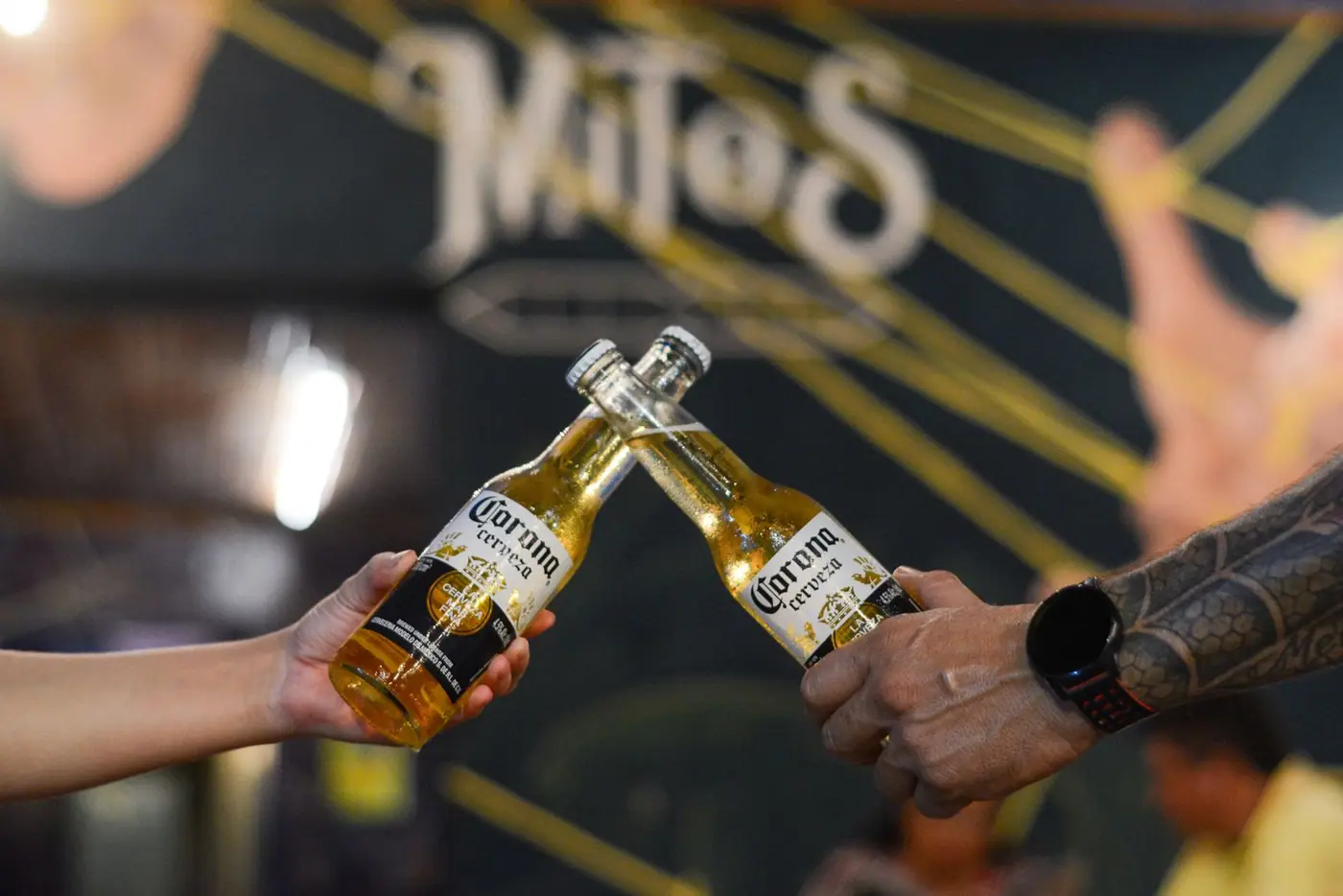
  <img src="/images/blog/optimized/pexels-joseismaelespinola-corona-toast-1400-1722d84f.webp" alt="Two people clinking bottles of Corona beer in a social setting." loading="lazy" />
  <figcaption>The third branch of the word, in progress. Photo by <a href="https://www.pexels.com/photo/close-up-of-two-people-clinking-beer-bottles-16924651/" target="_blank" rel="noopener noreferrer">Joseismaelespinola on Pexels</a>.</figcaption>
</figure>

## The greeting is the part nobody wrote down

The 2024 study lined fifteen Mexican expressions up against Colombian equivalents and noted, for each, which reference work records it. <mark lang="es-MX">Estar pedo</mark>, <mark lang="es-MX">hacerla de pedo</mark>, <mark lang="es-MX">querer pedos</mark> and <mark lang="es-MX">sin pedos</mark> all turned up in the Diccionario del español de México or the Chilangonario. Six of the fifteen came back with a dash in that column: <mark lang="es-MX">¿qué pedo?</mark>, <mark lang="es-MX">¡qué pedo!</mark>, <mark lang="es-MX">qué pedo wey</mark>, <mark lang="es-MX">es otro pedo</mark>, <mark lang="es-MX">agarrar el pedo</mark> and <mark lang="es-MX">cada quien en su pedo</mark>.[^lexicol]

The most frequent uses are the least documented ones. That is not a scandal, it is how spoken language works, but it does explain why looking this up leaves you no better off than before.

A separate study at the Universidad Autónoma de Nuevo León took three Mexican words with unusual polysemic range, <mark lang="es-MX">pedo</mark>, <mark lang="es-MX">madre</mark> and <mark lang="es-MX">onda</mark>, and ran them against oral corpora from Monterrey, tracking how age, gender and education shifted the reading.[^humanitas] Three words. Enough material for a journal article each.

## The decoder

Here is the practical version. The frame around the word does all of the work.

| What you hear | What it means | Who says it |
|---|---|---|
| ¿Qué pedo? | What is up | Friends, greeting |
| ¿Qué pedo contigo? | What is wrong with you | An accusation |
| ¡Qué pedo! | Whoa, or oh no | Reacting to news |
| Se armó un pedo | A fight broke out | About an event |
| No hay pedo | No problem | Answering an apology |
| Ni pedo | Oh well | Accepting a loss |
| Es otro pedo | That is a separate matter | Changing subject |
| Agarrar el pedo | To catch on | About understanding |
| Agarrar un pedo | To get drunk | About a night out |
| Hacerla de pedo | To make a fuss | Complaint about someone |
| Ponerse al pedo | To square up | A real warning |
| Bajarle a su pedo | To calm down | Said to someone heated |
| Cada quien en su pedo | Mind your own | About a third party |
| Buen pedo, mal pedo | A good guy, a bad one, or a bad situation | Describing a person or a scene |

<div class="chat-thread">
  <div class="chat-head"><span class="chat-avatar"></span><span>same two words, twice</span><span class="chat-meta">group chat, Friday</span></div>
  <ul class="chat-msgs">
    <li class="in"><span class="es" lang="es-MX">¿qué pedo? ¿vas o no?</span><span class="en">hey, are you coming or not?</span></li>
    <li class="out"><span class="es" lang="es-MX">voy voy, ya salí</span><span class="en">coming, I just left</span></li>
    <li class="in"><span class="es" lang="es-MX">¿qué pedo contigo, güey? llevamos una hora</span><span class="en">what is wrong with you? we have been here an hour</span></li>
  </ul>
  <p class="chat-read">Line one is hello. Line three is a complaint. <strong>The word that changed it is contigo</strong>, and there is no tone of voice that rescues the second one.</p>
</div>

<div id="midpost-newsletter-slot"></div>

## The drunk branch, and why it is so productive

Group III gives you an adjective and a noun in the same breath. <mark lang="es-MX">Estar pedo</mark> is to be drunk and <mark lang="es-MX">agarrar un pedo</mark> is to get that way.[^dem-pedo] <mark lang="es-MX">Una peda</mark>, the drinking session itself, is not in the entry at all, and you will hear it constantly. It carries no judgment with it either. A <mark lang="es-MX">peda</mark> is just Friday.

The vocabulary has plenty to describe. Mexico's national survey on drug, alcohol and tobacco use, run across 56,877 people, found binge drinking in the past month rising from 12.3% to 19.8% between 2011 and 2016, with the sharpest relative growth among women.[^saludmental] Nuevo León led the country at 30.3%.[^saludmental]

<figure>
  <img src="/images/blog/optimized/pexels-daryl-parada-guadalajara-bar-1400-67047403.webp" alt="People sitting outside at an open-air bar in the evening in Guadalajara." loading="lazy" />
  <figcaption>Guadalajara. Photo by <a href="https://www.pexels.com/photo/people-sitting-outside-the-bar-10833944/" target="_blank" rel="noopener noreferrer">Daryl Parada on Pexels</a>.</figcaption>
</figure>

The government's own summary of that survey carries the rest of the state-by-state table.[^encodat]

## Where it stops being casual

The dictionary marks the whole family coarse, and Mexicans hear that marking even when they use the word forty times a day. The register ladder for a greeting runs like this.

<ol class="ladder">
  <li>
    <div class="rung-card">
      <span class="rung-label">anywhere</span>
      <span class="rung-es" lang="es-MX">¿Cómo está?</span>
      <span class="rung-en" lang="en">How are you?</span>
      <span class="rung-note">Landlord, doctor, your partner's mother, a police officer.</span>
    </div>
  </li>
  <li>
    <div class="rung-card">
      <span class="rung-label">neutral</span>
      <span class="rung-es" lang="es-MX">¿Qué tal?</span>
      <span class="rung-en" lang="en">How is it going?</span>
      <span class="rung-note">Colleagues, shopkeepers you see often, anyone your age.</span>
    </div>
  </li>
  <li>
    <div class="rung-card">
      <span class="rung-label">casual</span>
      <span class="rung-es" lang="es-MX">¿Qué onda?</span>
      <span class="rung-en" lang="en">What is up?</span>
      <span class="rung-note">The workhorse. Foreigners can use this from week one.</span>
    </div>
  </li>
  <li>
    <div class="rung-card">
      <span class="rung-label">friends</span>
      <span class="rung-es" lang="es-MX">¿Qué pedo?</span>
      <span class="rung-en" lang="en">What is up, but coarse.</span>
      <span class="rung-note">Requires an existing friendship. Not a way to make one.</span>
    </div>
  </li>
  <li>
    <div class="rung-card">
      <span class="rung-label">close friends</span>
      <span class="rung-es" lang="es-MX">¿Qué pedo, güey?</span>
      <span class="rung-en" lang="en">Same, plus a claim of intimacy.</span>
      <span class="rung-note">Fine with people who call you güey first.</span>
    </div>
  </li>
</ol>

<ul class="examples">
  <li class="example">
    <div class="es" lang="es-MX">No hay pedo, yo lo arreglo.</div>
    <div class="en" lang="en">No problem, I will sort it out.</div>
  </li>
  <li class="example">
    <div class="es" lang="es-MX">Ni pedo, será para la próxima.</div>
    <div class="en" lang="en">Oh well, next time then.</div>
  </li>
  <li class="example">
    <div class="es" lang="es-MX">Ese cuate es buen pedo, te va a caer bien.</div>
    <div class="en" lang="en">That guy is good people, you will like him.</div>
  </li>
</ul>

<figure>
  <img src="/images/blog/optimized/pexels-sofia-gonte-cdmx-neon-street-1400-32fb002c.webp" alt="Neon signs lighting up a busy street in Mexico City at night." loading="lazy" />
  <figcaption>Mexico City after dark, where most of this vocabulary gets its exercise. Photo by <a href="https://www.pexels.com/photo/cdmx-28057251/" target="_blank" rel="noopener noreferrer">Sofia Gonte on Pexels</a>.</figcaption>
</figure>

You will never use all fifteen of these. Four or five of them land on you every week anyway, and until you can tell <mark lang="es-MX">no hay pedo</mark> from <mark lang="es-MX">¿qué pedo contigo?</mark> at conversational speed, you are guessing at whether the room is relaxed or annoyed.

For the party branch specifically, [the Mexican words for a night out](/blog/mexican-party-words) covers what happens after the <mark lang="es-MX">peda</mark> starts.

[^dem-pedo]: [Diccionario del español de México, pedo](https://dem.colmex.mx/ver/pedo) - El Colegio de México.
[^lexicol]: [La unidad léxica pedo desde una perspectiva fraseológica en el argot mexicano y colombiano](http://www.scielo.org.co/scielo.php?script=sci_arttext&pid=S0121-053X2024000100007) - Cuadernos de Lingüística Hispánica, n. 43, 2024.
[^humanitas]: [Zulema Cruz y Ma. Eugenia Flores, Vocablos polisémicos en la cultura mexicana](https://humanitas.uanl.mx/index.php/ah/article/view/295) - Humanitas n. 44, Universidad Autónoma de Nuevo León.
[^saludmental]: [Tendencias nacionales en el consumo de alcohol en México, ENCODAT 2016-2017](https://www.scielo.org.mx/scielo.php?script=sci_arttext&pid=S0185-33252018000100007) - Salud Mental, Instituto Nacional de Psiquiatría Ramón de la Fuente Muñiz.
[^encodat]: [Encuesta Nacional de Consumo de Drogas, Alcohol y Tabaco, resumen ejecutivo](https://www.gob.mx/cms/uploads/attachment/file/1044514/ENCODAT-_ResumenEjecutivo.pdf) - Gobierno de México.

FAQ:
Q: What does qué pedo mean in Mexican Spanish?
A: On its own, between friends, it is a greeting: what is up. With a rising, sharper tone or followed by contigo, it becomes what is your problem.

Q: Is pedo a bad word?
A: El Colegio de México marks it coarse. Among friends nobody registers it, but it does not belong in a work meeting, at a clinic, or with people older than you.

Q: What does no hay pedo mean?
A: No problem, no worries. It is the standard casual reply to an apology or a small logistical hitch.

Q: What is the difference between ni pedo and no hay pedo?
A: Ni pedo accepts something that already went wrong, roughly oh well. No hay pedo says nothing is wrong in the first place.

Q: Does al pedo mean useless like in Argentina?
A: No, and this one catches people. In Mexico the dictionary gives al pedo as in excellent condition or under heavy demand, which is close to the opposite.

Q: What does estar pedo mean?
A: Drunk. Andar pedo is the same, agarrar un pedo is getting drunk, and una peda is the drinking session itself.

Q: What does agarrar el pedo mean?
A: To catch on, to finally get what somebody is telling you. Note the definite article, which is what separates it from agarrar un pedo.

Q: Can I say qué pedo to someone I just met?
A: If you are both under thirty and it is a party, yes. Anywhere else, ¿qué onda? does the same job with none of the risk.

Q: Is qué pedo in the dictionary?
A: Not as a greeting. A 2024 study lined fifteen pedo phrases up against the dictionaries and ¿qué pedo? came back with nothing, while the conflict and drunk expressions were all recorded.

Sources:
- Diccionario del español de México, pedo - El Colegio de México: https://dem.colmex.mx/ver/pedo
- La unidad léxica pedo desde una perspectiva fraseológica en el argot mexicano y colombiano - Cuadernos de Lingüística Hispánica, n. 43, 2024: http://www.scielo.org.co/scielo.php?script=sci_arttext&pid=S0121-053X2024000100007
- Zulema Cruz y Ma. Eugenia Flores, Vocablos polisémicos en la cultura mexicana - Humanitas, Universidad Autónoma de Nuevo León, n. 44: https://humanitas.uanl.mx/index.php/ah/article/view/295
- Tendencias nacionales en el consumo de alcohol en México, ENCODAT 2016-2017 - Salud Mental, INPRFM: https://www.scielo.org.mx/scielo.php?script=sci_arttext&pid=S0185-33252018000100007
- Encuesta Nacional de Consumo de Drogas, Alcohol y Tabaco, resumen ejecutivo - Gobierno de México: https://www.gob.mx/cms/uploads/attachment/file/1044514/ENCODAT-_ResumenEjecutivo.pdf

Related words: que-pedo, pedo, estar-pedo, peda