---
title: "What to Say at a Taquería When the Line Is Moving Too Fast"
description: "Learn fast Mexican Spanish for ordering tacos under pressure: quantities, toppings, salsa, para llevar, and what to say when you freeze."
type: "article"
category: "food"
url: "https://consalsa.app/blog/taqueria-line-spanish"
canonical: "https://consalsa.app/blog/taqueria-line-spanish"
published: "2026-05-28"
updated: "2026-05-28"
author: "Andrey the Nomad"
site: "ConSalsa.App"
license: "https://consalsa.app/about"
---
# What to Say at a Taquería When the Line Is Moving Too Fast
URL: https://consalsa.app/blog/taqueria-line-spanish
Date: 2026-05-28
Updated: 2026-05-28
Category: food
Keywords: ordering tacos in spanish, taqueria spanish, mexican spanish taco stand, what to say at a taqueria, mexican food spanish phrases
Summary: Learn fast Mexican Spanish for ordering tacos under pressure: quantities, toppings, salsa, para llevar, and what to say when you freeze.
Quick answer:
- At a fast taquería, say the quantity, taco type, toppings, and whether it is for here or to go: dos de pastor con todo, para aquí.
- The most useful pressure phrases are me das, con todo, sin cebolla, salsa aparte, para llevar, aquí, and otro igual.
- If you freeze, point and say ¿cómo se llama ese? or me das dos de esos, por favor.
- Keep it short and warm. A busy taco line rewards clear Spanish more than perfect Spanish.
What you'll learn:
- The order of information taqueros expect when the line is moving fast.
- How to customize toppings and salsa without slowing everyone down.
- What to say when you forget the taco name but know exactly which one you want.
- How to ask for one more, pay, and leave the counter without awkwardness.
Don't sound gringo:
If the line is flying, don't open with a textbook paragraph. Say the order first — me da dos de pastor — then customize. The taquero is not grading your subjunctive.
Body:
At a fast taquería, order in this order: quantity, taco type, toppings, and whether it is para aquí or para llevar. That is the whole survival script.
The taco line feels chaotic because it is loud, hot, and efficient. The Spanish is smaller than the moment feels.
The taquero is not waiting for a beautiful sentence. They need the information in the right order.
## The order of the order
At a fast taquería, give information in this order:
1. Quantity
2. Taco type
3. Toppings
4. Here or to go
Like this:
Tres de pastor con todo, para aquí.
Three al pastor with everything, for here.
Or:
Dos de bistec sin cebolla, para llevar.
Two steak tacos without onion, to go.
That is the skeleton. Once you have it, the line stops feeling like a courtroom.
## The fast phrase table
| You want to say... | Say this | Why it works |
|---|---|---|
| Can I get...? | ¿Me das...? | Casual and normal |
| With everything | Con todo | Standard taquería move |
| Without onion | Sin cebolla | Short and clear |
| Sauce on the side | Salsa aparte | Saves your shirt and mood |
| A little salsa | Poquita salsa | Humble, wise |
| To go | Para llevar | Universal |
| For here | Para aquí / aquí | Short |
| One more like that | Otro igual | Beautifully efficient |
| How much is it? | ¿Cuánto es? | Street-food classic |
The magic phrase is **¿me das...?** It sounds warmer than a bare order and less stiff than quisiera.
¿Me das cuatro de suadero?
Can I get four suadero tacos?
## If you do not know the taco name
The word taco covers a lot of food territory in Mexico.[^dem-taco] You may see the one you want and forget the name at exactly the wrong moment.
Point gently and say:
¿Cómo se llama ese?
What is that one called?
Me das dos de esos, por favor.
Can I get two of those, please?
Pointing is not failure. Pointing is a valid grammatical structure in a loud room.
## Con todo, but with self-respect
**Con todo** usually means the house setup: cebolla, cilantro, salsa, lime, maybe pineapple, maybe other things depending on the taco.[^rae-cebolla][^rae-cilantro][^rae-salsa]
But con todo is not a binding legal contract. You can modify it.
| If you want... | Say this |
|---|---|
| Everything except onion | Con todo, sin cebolla |
| Everything but less salsa | Con todo, pero poquita salsa |
| No cilantro | Sin cilantro |
| Salsa on the side | Salsa aparte |
| No salsa | Sin salsa |
The most useful learner phrase is:
Con todo, pero poquita salsa.
With everything, but just a little salsa.
This says: I respect the taco, and I would also like to survive.
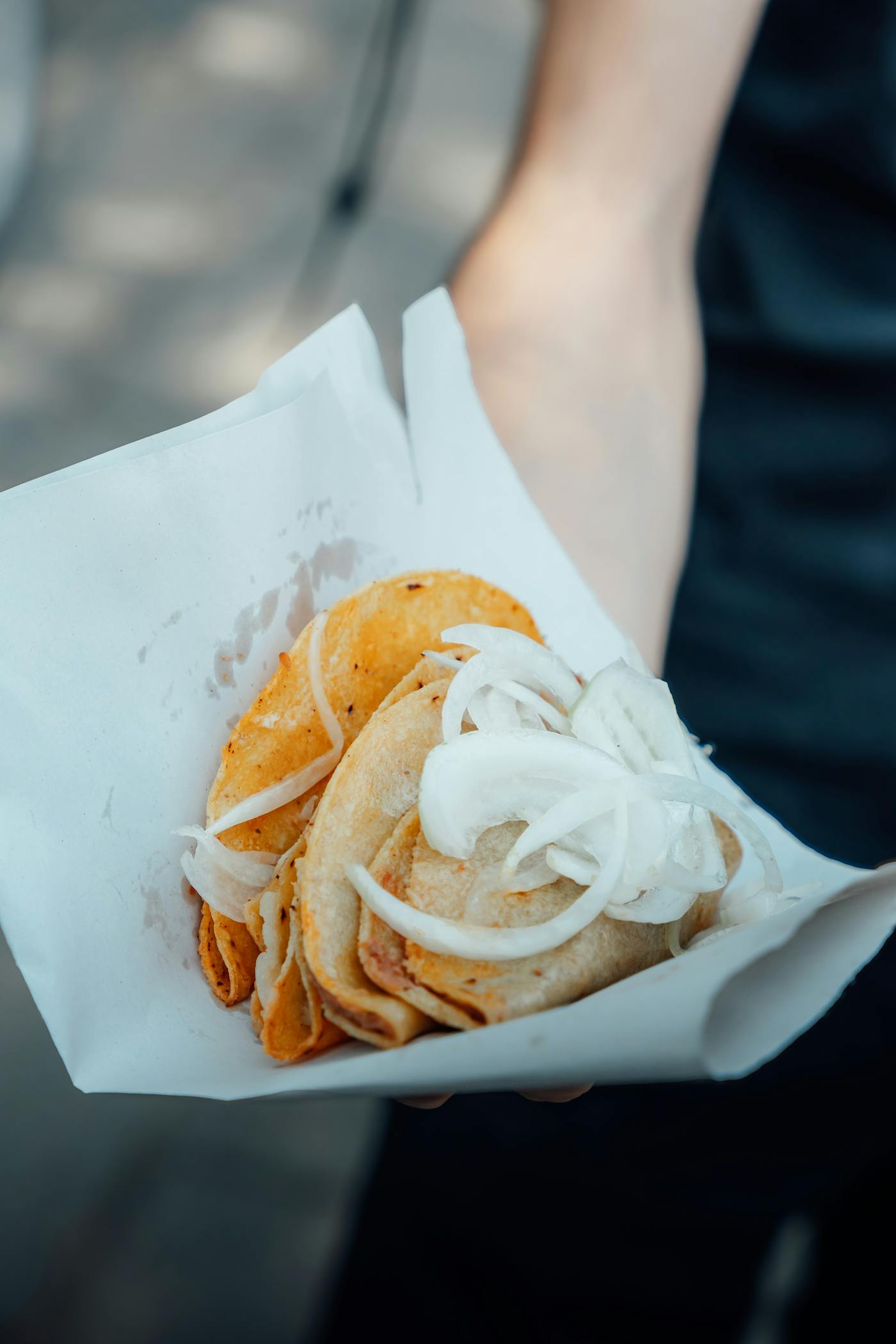
The phrase poquita salsa is not cowardice. It is strategy. Photo from Pexels.
## For here, to go, and paying
The verb llevar means to carry or take, which is why para llevar works for to-go food.[^rae-llevar]
Useful phrases:
¿Pago aquí?
Do I pay here?
¿Cuánto es?
How much is it?
Fueron tres de pastor y dos de bistec.
It was three al pastor and two steak tacos.
If someone hands you food and says something you do not catch, [sale](/words/sale) is often a safe tiny closer:
Sale, gracias.
Cool, thanks.
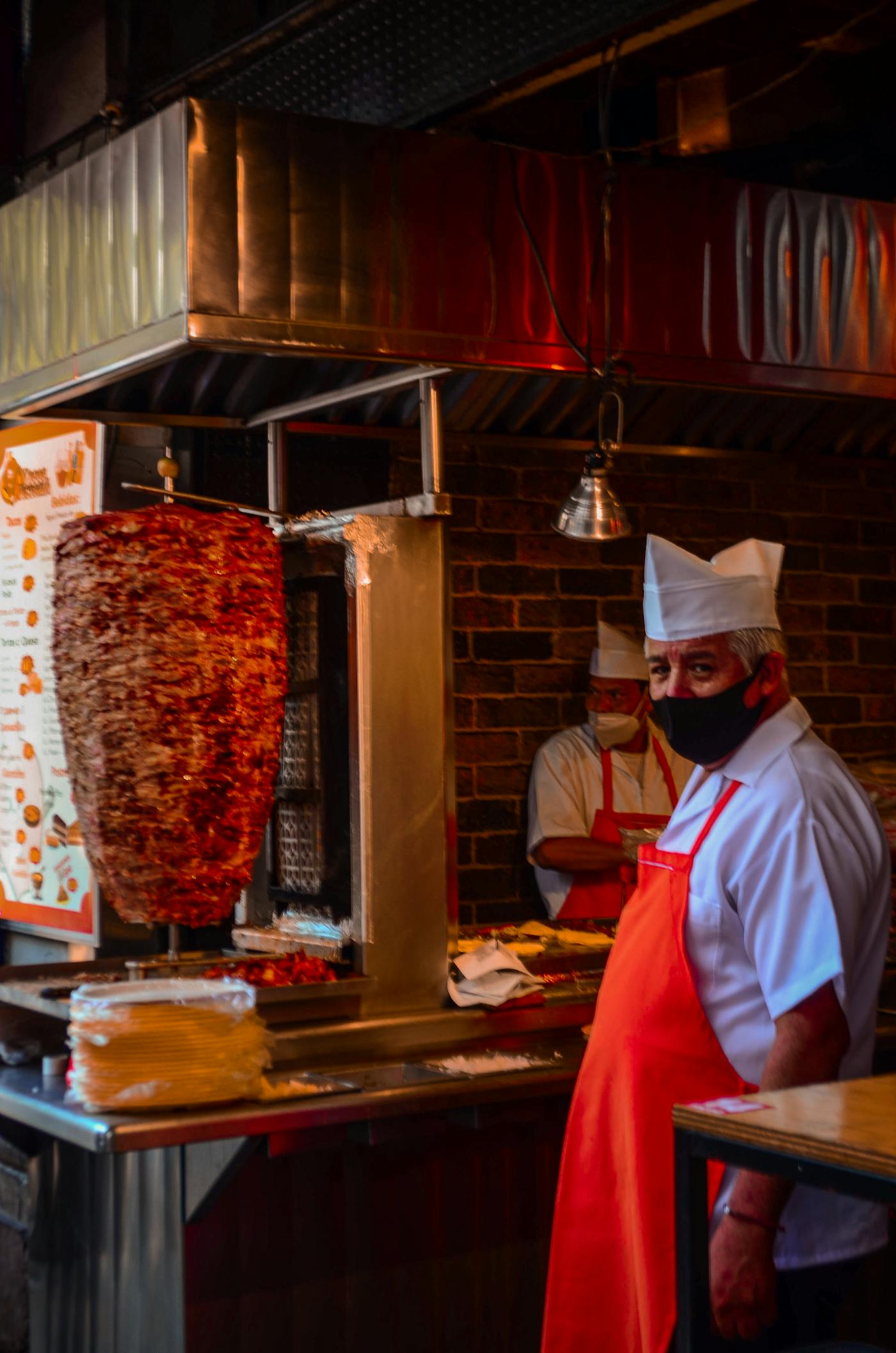
Fast Spanish is easier when you stop trying to make every sentence impressive. Photo from Pexels.
## What sounds too textbook
These are not wrong. They are just not line-friendly.
| Too much | Better |
|---|---|
| Quisiera ordenar tres tacos al pastor | Tres de pastor, por favor |
| Deseo consumir aquí | Para aquí |
| ¿Podría proporcionarme salsa? | ¿Me das salsa? |
| No deseo cebolla en mi comida | Sin cebolla |
Mexican Spanish is not less polite because it is shorter. In a taquería, short is often the polite thing. The word taquería itself simply names the place where tacos are made or sold.[^rae-taqueria]
## A full fast order
Here is the whole thing:
Buenas, ¿me das tres de pastor con todo, pero poquita salsa? Para aquí, por favor.
Hi, can I get three al pastor with everything, but just a little salsa? For here, please.
That sentence does everything: greeting, quantity, taco type, toppings, where you are eating, and a little human warmth.
You can spend years learning Spanish and still freeze at a taco stand. That does not mean your Spanish is bad. It means the taco stand is real life.
Real life is faster than the app. Luckily, it is also tastier.
[^dem-taco]: [Diccionario del español de México, taco](https://dem.colmex.mx/ver/taco) — El Colegio de México
[^rae-taqueria]: [Diccionario de la lengua española, taquería](https://dle.rae.es/taquer%C3%ADa) — Real Academia Española
[^rae-cebolla]: [Diccionario de la lengua española, cebolla](https://dle.rae.es/cebolla) — Real Academia Española
[^rae-cilantro]: [Diccionario de la lengua española, cilantro](https://dle.rae.es/cilantro) — Real Academia Española
[^rae-salsa]: [Diccionario de la lengua española, salsa](https://dle.rae.es/salsa) — Real Academia Española
[^rae-llevar]: [Diccionario de la lengua española, llevar](https://dle.rae.es/llevar) — Real Academia Española
FAQ:
Q: How do you order tacos quickly in Mexico?
A: Say the number, taco type, toppings, and whether it is for here or to go. For example: dos de pastor con todo, para aquí.
Q: What does con todo mean at a taquería?
A: Con todo means with the standard toppings for that place, often onion, cilantro, salsa, lime, and sometimes extras depending on the taco.
Q: How do you say no onion in Mexican Spanish?
A: Say sin cebolla. You can also say sin cilantro, salsa aparte, or poquita salsa.
Q: What do you say if you do not know the taco name?
A: Point and say ¿cómo se llama ese? or me das dos de esos, por favor.
Q: How do you say one more of the same taco?
A: Say otro igual, por favor. It means another one like that.
Q: How do you say to go at a taquería?
A: Say para llevar. If you are eating there, say para aquí or aquí.
Q: Is me das rude when ordering tacos?
A: No. Me das is casual and common in Mexican counter service. Add por favor or gracias and it feels warm enough for a busy taquería.
Sources:
- Diccionario del español de México, taco: https://dem.colmex.mx/ver/taco
- Diccionario de la lengua española, taquería: https://dle.rae.es/taquer%C3%ADa
- Diccionario de la lengua española, cebolla: https://dle.rae.es/cebolla
- Diccionario de la lengua española, cilantro: https://dle.rae.es/cilantro
- Diccionario de la lengua española, salsa: https://dle.rae.es/salsa
- Diccionario de la lengua española, llevar: https://dle.rae.es/llevar
Related words: sale, aguas, no-manches, chido