---
title: "A Kilo Is Thirty Tortillas: How to Buy Them at a Tortillería"
description: "At a Mexican tortillería you order fresh tortillas by weight: un kilo, medio kilo, un cuarto. Here is what to say, what to expect, and how to reheat them."
type: "article"
category: "markets"
url: "https://consalsa.app/blog/tortilleria-spanish"
canonical: "https://consalsa.app/blog/tortilleria-spanish"
published: "2026-08-25"
updated: "2026-08-25"
author: "Andrey the Nomad"
site: "ConSalsa.App"
license: "https://consalsa.app/about"
---
# A Kilo Is Thirty Tortillas: How to Buy Them at a Tortillería
URL: https://consalsa.app/blog/tortilleria-spanish
Date: 2026-08-25
Updated: 2026-08-25
Category: markets
Keywords: tortilleria spanish, how to buy tortillas in mexico, fresh tortillas mexico, medio kilo de tortillas, nixtamal tortillas, tortilleria vs supermarket tortillas
Summary: At a Mexican tortillería you order fresh tortillas by weight: un kilo, medio kilo, un cuarto. Here is what to say, what to expect, and how to reheat them.
Quick answer:
- At a tortillería you order by weight, not by package: un kilo, medio kilo, or un cuarto.
- Un cuarto (250 g) is a completely normal small order, roughly enough for two people at one meal.
- They come straight off the machine, hot, weighed on a scale and wrapped in paper.
- In central and southern Mexico tortillas are corn by default; flour tortillas are a northern thing.
What you'll learn:
- The five short phrases that cover a whole tortillería visit.
- How to order by weight and how much a kilo actually feeds.
- Why nixtamal tortillas taste different from the bagged supermarket ones.
- How to reheat tortillas on a comal so they go soft again instead of stiff.
Don't sound gringo:
Do not ask for a package or count them out one by one. At a tortillería you order weight: medio kilo, por favor. And un cuarto is a normal order, not a shy one - nobody is judging the size of your tortilla purchase.
Body:
I lived on my street for weeks before I noticed the pattern. Around one in the afternoon, people started coming back up the block carrying the same thing: a flat paper packet held against the chest, the way you carry something warm. Always the same hour. Always the same shape.
The shop itself I had walked past a hundred times. A roll-up metal door, a machine the size of a small car roaring inside, a belt of tortillas dropping out one after another, and a smell of cooked corn that gets into the whole block.
I had been buying bagged tortillas at the supermarket. Cold ones. For weeks.
Here is what I was missing. At a tortillería you buy by weight, not by package: un kilo, medio kilo, un cuarto. They come off the machine hot, get weighed on a scale, and go home wrapped in paper.
It is one of the most ordinary transactions in Mexico, and one of the last ones most foreigners figure out.
## What you actually say
The whole visit is five phrases long. **Learn the middle column and you are done.**
| What you need | Say this | Meaning |
|---|---|---|
| Hello | Buenas | Hi |
| One kilo | Un kilo, por favor | A kilo, please |
| Half a kilo | Medio kilo | Half a kilo |
| A quarter | Un cuarto | 250 grams |
| A kilo and a half | Kilo y medio | 1.5 kilos |
| Anything else? | Es todo, gracias | That's all, thanks |
| Paying | ¿Cuánto es? | How much is it? |
The script does not get longer than that. No quisiera adquirir, no full sentences, no explaining yourself. You say a weight, they hand you a warm packet, you pay coins.
Buenas, ¿me da medio kilo?
Hi, can I get half a kilo?
Un cuarto, por favor.
A quarter kilo, please.
Es todo, gracias.
That's all, thanks.
## Ordering by weight, and how much a kilo really is
This is the part that trips people up. There is no small, medium or large. There is weight.
A kilo of corn tortillas is roughly thirty of them, depending on thickness. That is a lot of tortillas for one person, and gone in one sitting in a family of four.
| You order | Roughly | Good for |
|---|---|---|
| Un cuarto | 250 g, about 7-8 tortillas | One or two people, one meal |
| Medio kilo | 500 g, about 15 | Two or three people |
| Un kilo | 1 kg, about 30 | A family meal, or leftovers on purpose |
| Kilo y medio | 1.5 kg | A comida with guests |
**Un cuarto is a completely normal order.** I want to be clear about that, because a lot of foreigners over-order out of embarrassment and then eat stale tortillas for three days. Quarter kilos get sold all day. Nobody blinks.
The other direction matters too. If someone has invited you to a family comida and asked you to bring the tortillas, un kilo is the answer, and you want to time the walk so they arrive still warm. Showing up with a cold supermarket bag is a small, quiet own goal.
If you want them thinner or thicker, some shops will ask or will let you ask:
¿Me las da delgaditas?
Can I get them thin?
¿Están calientitas?
Are they hot?
Calientitas is the word you will hear more than calientes. Mexican Spanish leans hard on the diminutive, and the suffix is not only about smallness - it also carries affection and respect.[^dem-diminutivo] Here it is not about size at all. It is about affection. Warm-and-nice rather than hot.
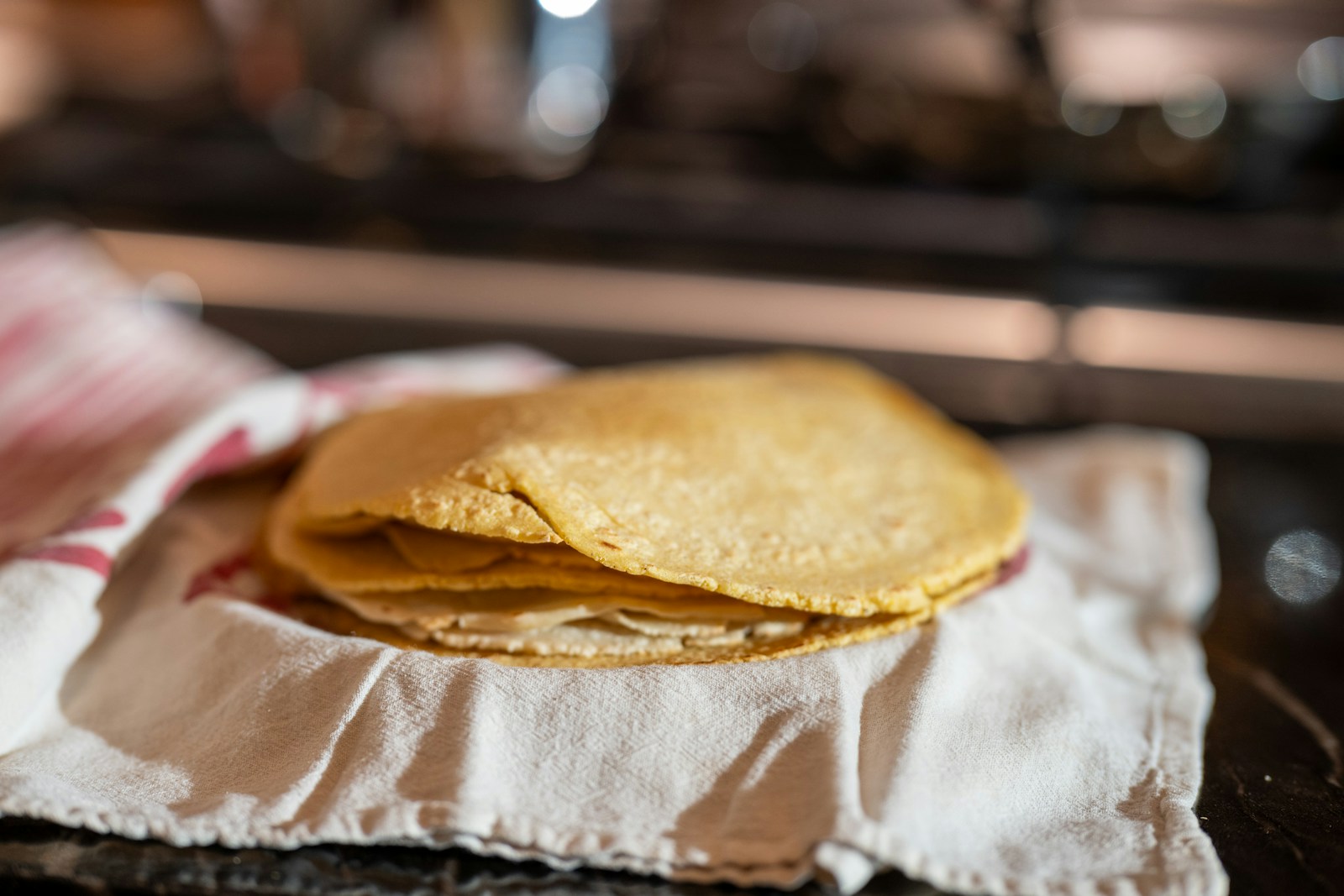
A kilo is about thirty tortillas. They arrive as one warm stack, not as a counted number. Photo by Michael Kahn on Unsplash.
## The queue, and how to find your place in it
There is often no line, exactly. There is a cluster of people who all know the order they arrived in.
The question that solves this:
¿Quién es el último?
Who's last?
¿Quién sigue?
Who's next?
Someone raises a hand or says yo. Now you know you go after that person, and the next person who walks in will ask you the same thing. That is the whole system, and it works better than a rope line.
Two other things worth knowing. Peak hours are real: late morning before the midday meal, and again in the early evening. And you pay at the end, usually in cash, usually in coins.
## Nixtamal: why fresh ones taste like something
Corn does not become masa on its own. It gets cooked in water with lime, left to sit, rinsed, and then ground. That process is nixtamalización, and the cooked corn is nixtamal.[^larousse-nixtamal]
It softens the grain and loosens the skin so the corn can be ground into masa, and it also changes the food itself: the alkaline cook makes the corn's nutrients available in a way raw ground corn never is.[^sader-nixtamal] The Secretaría de Agricultura describes it as a process that has been in practice for thousands of years, and dates tortillas as an everyday food back well over two millennia.[^sader-nixtamal]
So a fresh tortilla is not just a warmer version of the bagged one. It is a different object with a different smell. **You will notice it in the first five seconds, before you have any vocabulary for it.**
Masa is the dough itself, and many tortillerías sell it by the kilo too, for people making tamales, gorditas or sopes at home.[^larousse-masa]
¿Tiene masa?
Do you have masa?
Medio kilo de masa, por favor.
Half a kilo of masa, please.
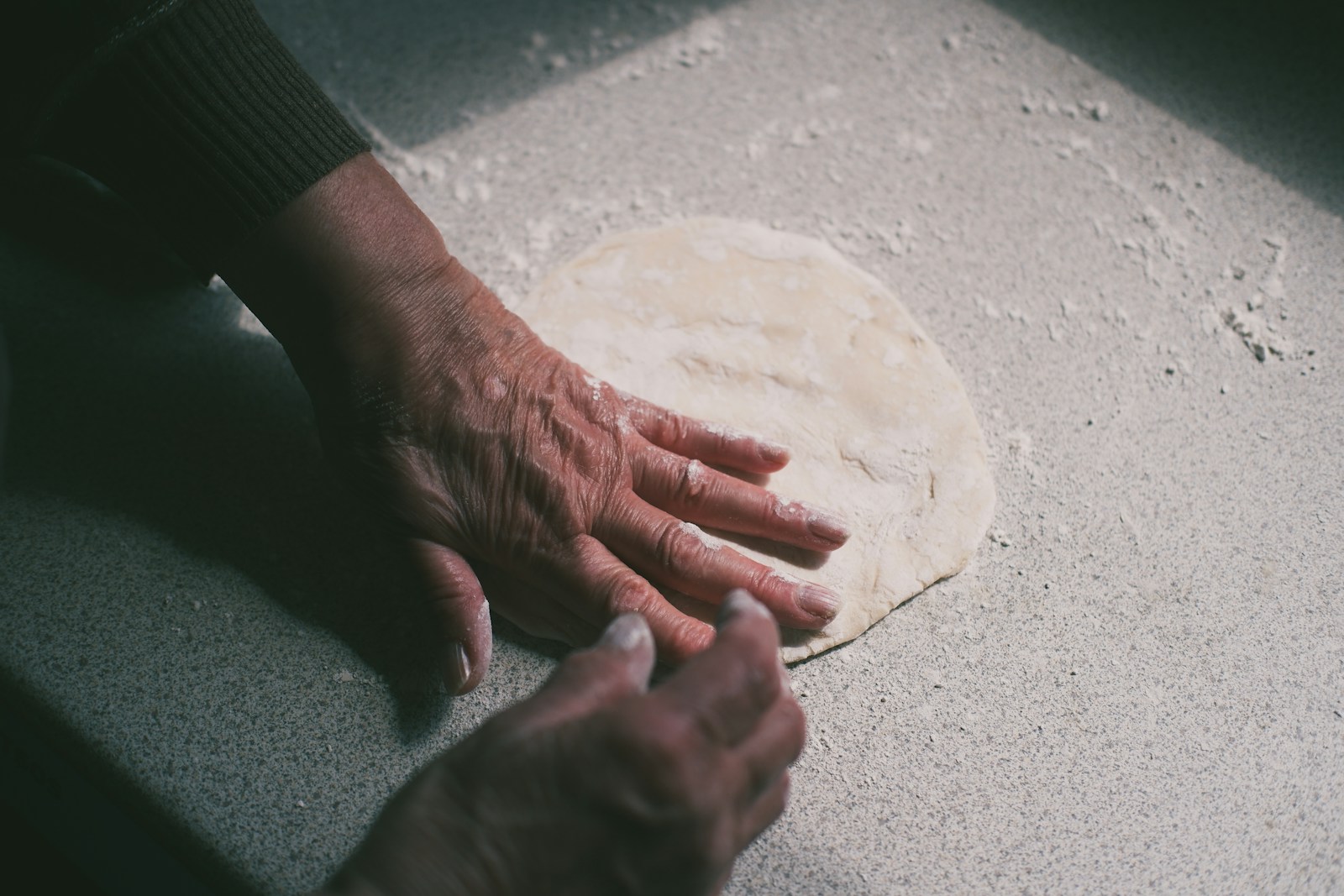
Masa is sold by the kilo too, for anyone making tamales, sopes or gorditas at home. Photo by Leandros Papakarmezis on Unsplash.
## Maíz or harina, and where the line falls
Ask for tortillas in Mexico City and you will get corn. Nobody asks. Tortilla means the corn one in the center and the south, and the wheat one has to be named.[^rae-tortilla]
Tortillas de harina are northern. Wheat arrived with the Spanish, and the flour tortilla grew out of the mission kitchens and the ranch food of the north, above all in Sonora, where the huge, paper-thin ones are folded in quarters to sell.[^larousse-harina]
| | Tortilla de maíz | Tortilla de harina |
|---|---|---|
| Where it is the default | Center and south | North |
| Made from | Nixtamalized corn masa | Wheat flour and fat |
| Typical size | Small, 12-15 cm | Larger, sometimes very large |
| Classic use | Tacos, everything | Burritos, quesadillas norteñas |
Neither one is more Mexican than the other. They just live in different parts of the map, and a tortillería de barrio in the capital will almost always be a corn operation.
## Tortillería against the supermarket bag
This is the comparison that made me change my habits. The supermarket pack is engineered to survive a week on a shelf and is often built from dehydrated nixtamalized corn flour rather than fresh masa.[^larousse-tortilla] The tortillería version was corn that morning.
| | Tortillería | Supermarket bag |
|---|---|---|
| Temperature | Hot, in paper | Cold, in plastic |
| Sold as | Weight | Fixed package |
| Best window | Same day | Days |
| Price | Cheap, per kilo | Higher per kilo |
| Where it goes stale to | Chilaquiles and totopos | The bin, usually |
Price is the part people underestimate. Tortillas are treated as a basic staple, and Profeco runs a national price monitor specifically for the kilo of tortillas, sampling hundreds of tortillerías and publishing what each one charges so shoppers can compare.[^profeco] As of 2026 the national average sits around 24 pesos a kilo, with Mexico City near 21 to 22 and a national spread running from roughly 16 pesos in Veracruz to about 33 in Baja California.[^milenio-tortilla] The number moves by state, by shop and by month, so check the monitor for today's figure. The honest summary either way: it is one of the cheapest things you can buy in this country, and a quarter kilo costs less than almost anything else you will hand over coins for.
One small naming note, because it matters. The shop is la tortillería and the person running the machine is el tortillero. Do not improvise a feminine form of that word - in Mexico it lands as a slur for a lesbian, not a job title. If a woman is serving you, señora or joven works, or just skip the noun and say buenas.
## Reheating them properly
Fresh tortillas go stiff within hours. That is not a defect, it is what happens to food without preservatives in it. The fix is a comal, or any dry flat pan.
Medium heat, no oil, twenty to thirty seconds a side, flipped a couple of times. If they are a day old, flick a few drops of water on them first and let the steam do the work.
| Method | Result |
|---|---|
| Dry comal, medium heat | Soft, smells like corn again |
| Comal plus a few drops of water | Best rescue for day-old ones |
| Microwave under a damp cloth | Fine in a rush, goes chewy fast |
| Straight from the fridge | Cracks on the first fold |
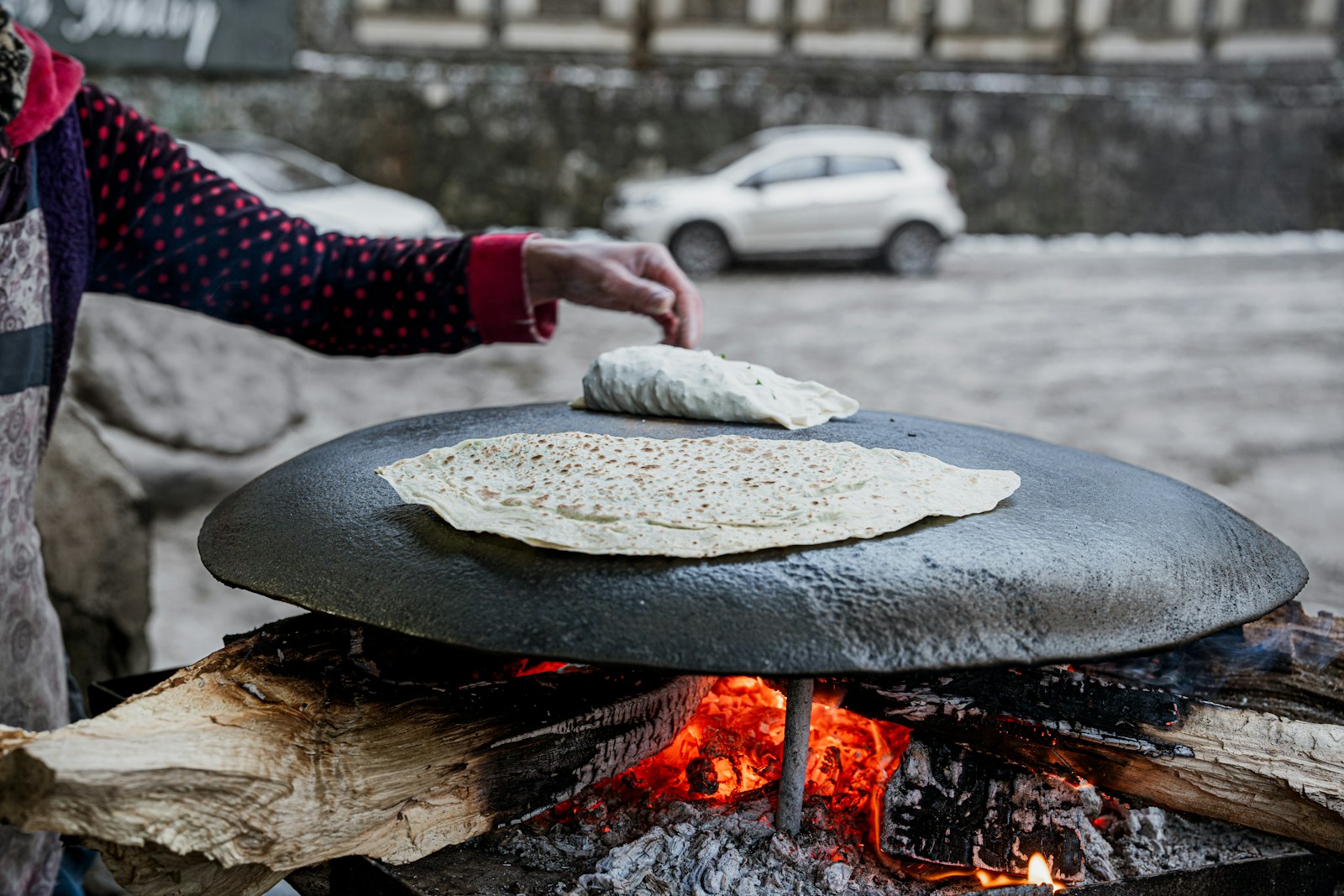
A comal is just a flat dry griddle. No oil, medium heat, and keep them moving. Photo by Nurlan Isazade on Unsplash.
Keep them wrapped while they wait. The paper they came in works, a clean cloth works better, and a lidded basket works best. Once they go properly hard, they are not ruined either - that is what chilaquiles and sopa de tortilla are for.
## The part nobody tells you
The reason to do this is not really the tortillas, although the tortillas are better.
It is that the tortillería puts you inside a small daily rhythm that a supermarket cannot give you. Same hour, same street, same handful of neighbors, the same person who starts recognizing your order and reaching for the paper before you say the weight. After a few weeks you stop rehearsing the phrase in your head on the walk over.
That is roughly the point where Spanish stops being a subject and starts being a Tuesday. Say buenas, say a weight, say gracias, walk home holding something warm.
If you want the next step, it is [echarse un taco](/words/echarse-un-taco) with what you just bought, ideally before it cools down.
[^rae-tortilla]: [Diccionario de la lengua española, tortilla](https://dle.rae.es/tortilla) — Real Academia Española
[^dem-diminutivo]: [Diccionario del español de México, diminutivo](https://dem.colmex.mx/ver/diminutivo) — El Colegio de México
[^sader-nixtamal]: [Del maíz a la tortilla y el proceso de nixtamalización](https://www.gob.mx/agricultura/articulos/del-maiz-a-la-tortilla-y-el-proceso-de-nixtamalizacion) — Secretaría de Agricultura y Desarrollo Rural
[^larousse-nixtamal]: [Larousse Cocina, Nixtamalización](https://laroussecocina.mx/palabra/nixtamalizacion/) — Larousse Cocina
[^larousse-tortilla]: [Larousse Cocina, Tortilla](https://laroussecocina.mx/palabra/tortilla/) — Larousse Cocina
[^larousse-masa]: [Larousse Cocina, Masa de maíz o masa para tortillas](https://laroussecocina.mx/palabra/masa-de-maiz-o-masa-para-tortillas/) — Larousse Cocina
[^larousse-harina]: [Larousse Cocina, Tortilla de harina](https://laroussecocina.mx/palabra/tortilla-de-harina/) — Larousse Cocina
[^profeco]: [Profeco, monitoreo de precios del kilo de tortilla](https://www.gob.mx/profeco/prensa/monitoreo-de-precios-de-kilo-de-tortilla-se-realiza-para-informar-y-orientar-a-la-poblacion-profeco) — Procuraduría Federal del Consumidor
[^milenio-tortilla]: [Precio de tortilla 2026 en México: esto cuesta el kilo en cada estado](https://www.milenio.com/estados/precio-de-tortilla-2026-en-mexico-esto-cuesta-el-kilo-en-cada-estado) — Milenio
FAQ:
Q: How do you buy tortillas in Mexico?
A: You go to a tortillería and order by weight. Say un kilo, medio kilo, or un cuarto, por favor. They weigh them straight off the machine and wrap them in paper.
Q: How many tortillas are in a kilo?
A: Roughly thirty, depending on how thick they are. Half a kilo is about fifteen, and a quarter kilo is about seven or eight.
Q: Is un cuarto de tortillas too small to order?
A: No. A quarter kilo is a normal everyday order for one or two people. Tortillerías sell it all day long.
Q: What is the difference between tortillería tortillas and supermarket tortillas?
A: Tortillería tortillas are made fresh that hour, usually from nixtamalized corn masa, and handed to you hot. Supermarket packs are cold, made to last on a shelf, and often built from dehydrated corn flour.
Q: What is nixtamal?
A: Nixtamal is corn that has been cooked in water with lime, which softens the grain, loosens the skin and makes the corn more nutritious before it is ground into masa.
Q: Are tortillas corn or flour in Mexico?
A: In central and southern Mexico, corn is the default and tortillas de harina are a specialty. In the north, especially Sonora, wheat flour tortillas are everyday food.
Q: How much does a kilo of tortillas cost?
A: As of 2026 the national average is around 24 pesos a kilo, and it varies a lot by state: roughly 16 pesos at the cheapest end in Veracruz, up to about 33 in Baja California, with Mexico City near 21 to 22. Profeco publishes a national price monitor if you want the current number.
Q: How do you reheat tortillas properly?
A: On a dry comal or pan over medium heat, about twenty to thirty seconds a side, flipping a couple of times. For day-old ones, flick a few drops of water on them first.
Sources:
- Diccionario de la lengua española, tortilla: https://dle.rae.es/tortilla
- Diccionario del español de México, diminutivo: https://dem.colmex.mx/ver/diminutivo
- Del maíz a la tortilla y el proceso de nixtamalización: https://www.gob.mx/agricultura/articulos/del-maiz-a-la-tortilla-y-el-proceso-de-nixtamalizacion
- Larousse Cocina, Nixtamalización: https://laroussecocina.mx/palabra/nixtamalizacion/
- Larousse Cocina, Tortilla: https://laroussecocina.mx/palabra/tortilla/
- Larousse Cocina, Masa de maíz o masa para tortillas: https://laroussecocina.mx/palabra/masa-de-maiz-o-masa-para-tortillas/
- Larousse Cocina, Tortilla de harina: https://laroussecocina.mx/palabra/tortilla-de-harina/
- Profeco, monitoreo de precios del kilo de tortilla: https://www.gob.mx/profeco/prensa/monitoreo-de-precios-de-kilo-de-tortilla-se-realiza-para-informar-y-orientar-a-la-poblacion-profeco
- Milenio, Precio de tortilla 2026 en México: esto cuesta el kilo en cada estado: https://www.milenio.com/estados/precio-de-tortilla-2026-en-mexico-esto-cuesta-el-kilo-en-cada-estado
Related words: sale, ahorita, echarse-un-taco, orale