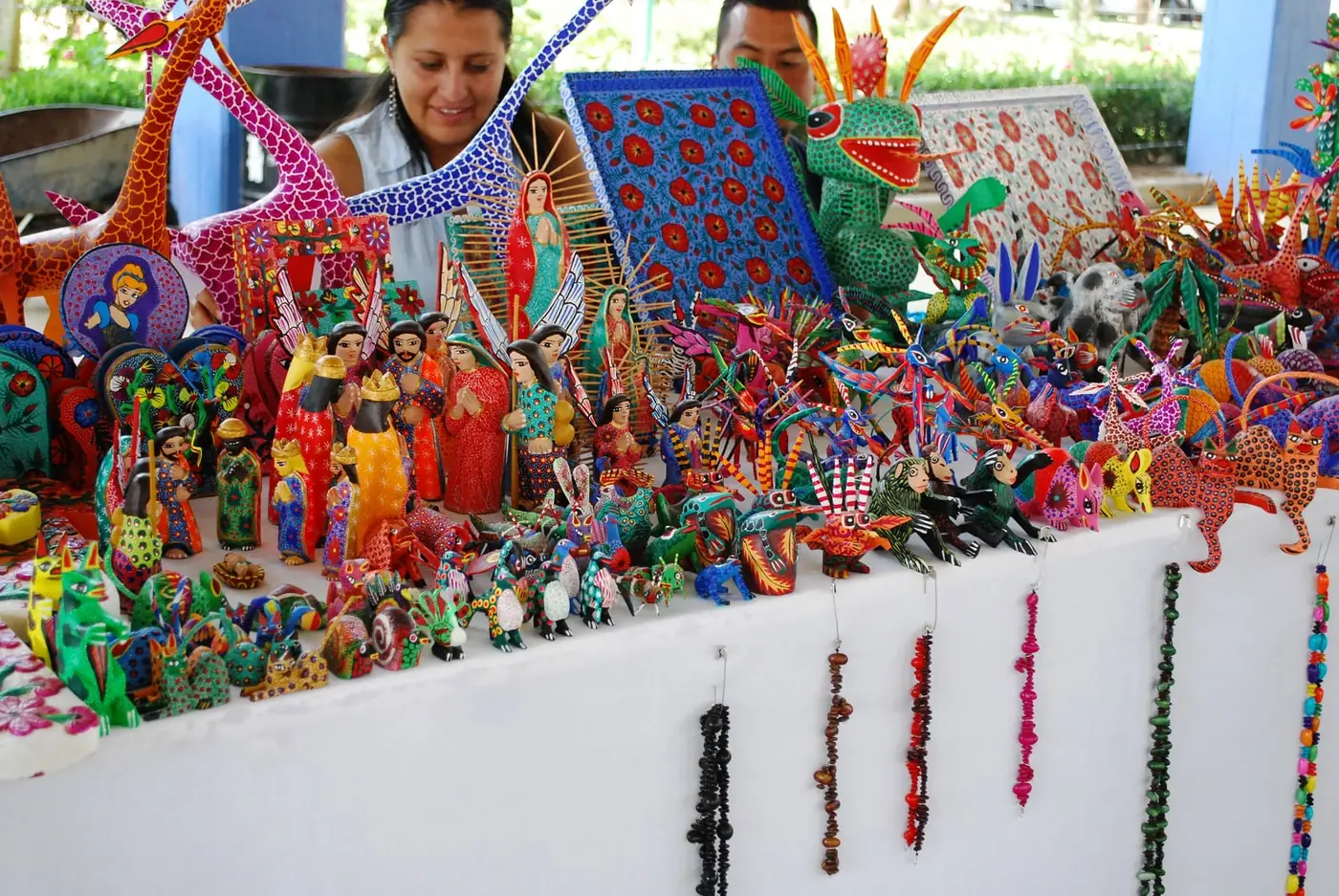
---
title: "What Is an Alebrije? The Bright Creature Behind the Souvenir Shelf"
description: "Learn what an alebrije is, where the tradition comes from, how Oaxaca wood carvings fit in, and how to talk about them without flattening the craft."
type: "article"
category: "guides"
url: "https://consalsa.app/blog/what-is-an-alebrije"
canonical: "https://consalsa.app/blog/what-is-an-alebrije"
published: "2026-10-01"
updated: "2026-10-01"
author: "Andrey the Nomad"
site: "ConSalsa.App"
license: "https://consalsa.app/terms#ip"
---

# What Is an Alebrije? The Bright Creature Behind the Souvenir Shelf
URL: https://consalsa.app/blog/what-is-an-alebrije
Date: 2026-10-01
Updated: 2026-10-01
Category: guides
Keywords: what is an alebrije, alebrije meaning, alebrijes mexico, coco alebrije meaning
Summary: Learn what an alebrije is, where the tradition comes from, how Oaxaca wood carvings fit in, and how to talk about them without flattening the craft.

Quick answer:
- An alebrije is a brightly colored fantastical creature in Mexican folk art.
- The papier-mâché tradition is associated with Pedro Linares in Mexico City.
- Oaxaca is famous for carved wooden figures often discussed alongside alebrijes.
- They are not simply spirit animals; that framing is often a pop-culture simplification.

What you'll learn:
- What alebrijes are and why they look so wonderfully impossible.
- The difference between Mexico City papier-mâché origins and Oaxaca wood-carving traditions.
- How Coco shaped what many foreigners think alebrijes are.
- How to ask about the artisan, material, and technique respectfully.

Don't sound gringo:
Do not ask an artisan what your spirit animal would be. It is a Coco-shaped question and it lands as if you had asked a glassblower for your birthstone. Ask what the piece is made of and how long it took — those are the questions that get you a real conversation and usually a better price.

Body:

An <mark lang="es-MX">alebrije</mark> is a brightly colored fantastical creature, and the dictionary definition quietly contains the argument people have about them: a small handmade sculpture, made of **paper, cardboard, or copal wood**.[^dem-alebrije]

Those are two different crafts, from two different states, with two different histories. They share a name and not much else.

## One word, two traditions

| | Mexico City | Oaxaca |
|---|---|---|
| material | paper and cardboard, <mark lang="es-MX">cartonería</mark> | <mark lang="es-MX">madera de copal</mark>, carved |
| technique | built up in layers over a frame | cut from a single piece, then painted |
| origin of the name | this is where it comes from | adopted later |
| what to call the maker | <mark lang="es-MX">cartonero</mark> | <mark lang="es-MX">tallador</mark> or <mark lang="es-MX">artesano</mark> |
| where you meet it | CDMX workshops, the October parade | Oaxaca villages, especially San Martín Tilcajete and Arrazola |

The Oaxacan wood carvings are the ones most visitors buy, and they are genuinely spectacular. But the word did not start there.

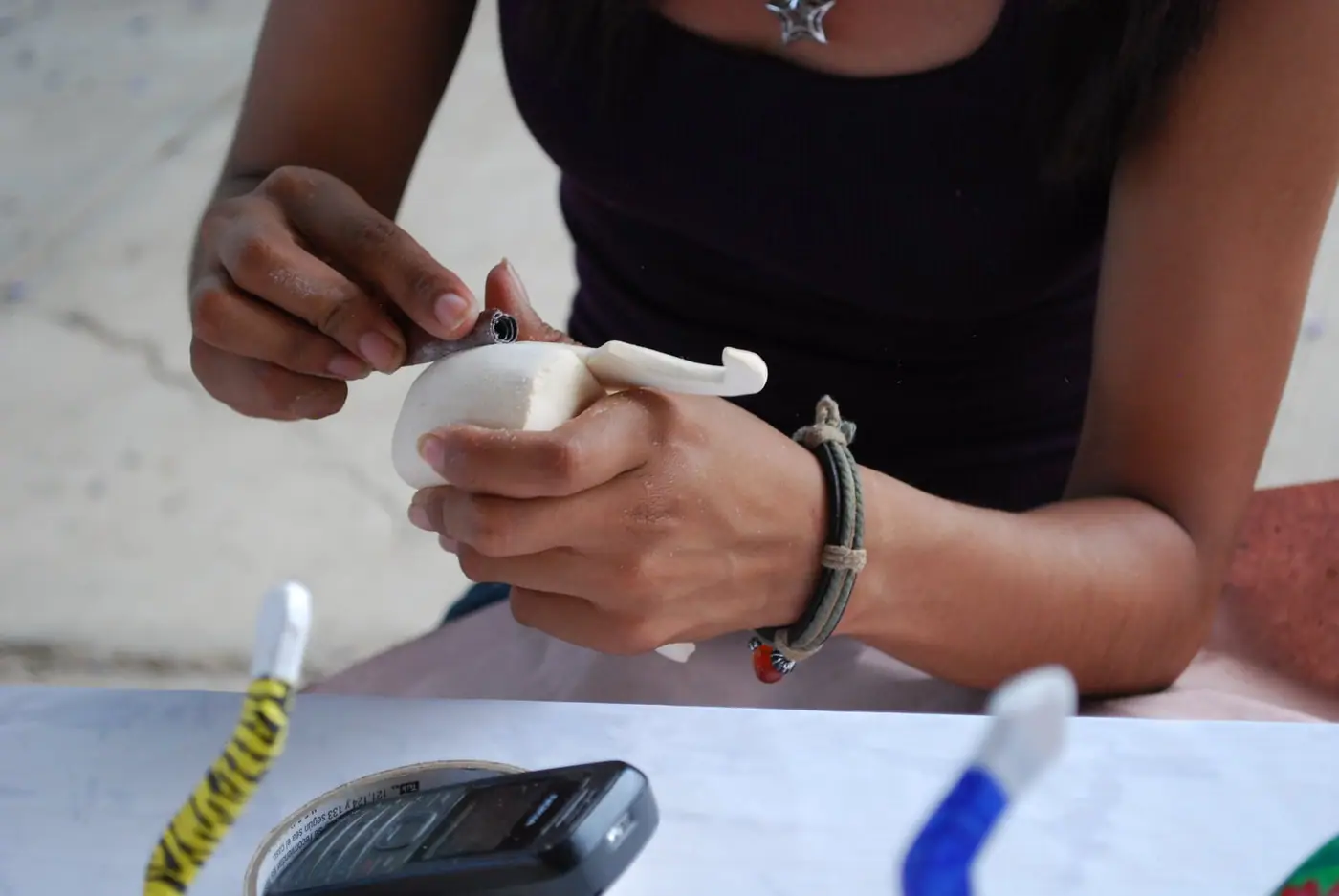
<mark lang="es-MX">Copal</mark> is worth a note, since it does double duty in Mexican culture. It is a resin from trees of the Burseraceae family, burned as ceremonial incense[^dem-copal] — and the same trees give the soft, pale wood that the Oaxacan pieces are carved from. The tree that scents an <mark lang="es-MX">ofrenda</mark> is the tree the carvings come out of.

<figure>
  <img src="/images/blog/optimized/what-is-an-alebrije-1-1400-1726f810.webp" alt="Hands sanding a raw carved copal wood figure before painting" loading="lazy" />
  <figcaption>Carved from copal, sanded, painted afterwards. A different craft from the paper ones, sharing a name. Photo by AlejandroLinaresGarcia, <a href="https://creativecommons.org/licenses/by-sa/4.0/">CC BY-SA 4.0</a>.</figcaption>
</figure>

## The dream, and the man who had it

The name comes from one person. Pedro Linares López was a <mark lang="es-MX">cartonero</mark> in Mexico City — papier-mâché was the family trade, inherited from his father.[^infobae]

At thirty he fell seriously ill and, by his own account, dreamed of a forest full of impossible animals: a donkey with wings, a rooster with bull's horns, a lion with a dog's head. All of them were shouting the same word, which was not a word — <em>alebrijes</em>. When he recovered he began building what he had seen.[^infobae]

He was awarded the Premio Nacional de Ciencias y Artes in 1990, two years before he died. And in 2024 Mexico City formally recognized the Linares family as creators of the alebrije and the craft as heritage of the city.[^cultura-linares]

**So the tradition is not ancient.** It is roughly ninety years old and it has an author, which makes it unusual among the things sold as Mexican folk art — most have no name attached, and this one has a name, a date, and a hospital bed.

<div class="note-card is-tip">
  <span class="note-label">If you are in CDMX in October</span>
  <p>The Museo de Arte Popular runs an annual <span lang="es-MX">Desfile y Concurso de Alebrijes Monumentales</span> — hundreds of artisans build pieces up to four metres tall and walk them through the historic center. It started in 2007 and it is free. If you only ever see alebrijes on a souvenir shelf, this is the correction.</p>
</div>

The parade is a city-backed event rather than a private one, run with the Secretaría de Cultura, and the winning pieces stay on display afterwards.[^cultura-desfile]

## What Coco did to the word

Most people outside Mexico met alebrijes through the 2017 film, where they appear as glowing spirit guides. That is a lovely invention and it is an invention.

<div class="chat-thread">
  <div class="chat-head"><span class="chat-avatar"></span><span>Taller en Tilcajete</span><span class="chat-meta">two versions of the same question</span></div>
  <ul class="chat-msgs">
    <li class="out"><span class="es" lang="es-MX">¿y cuál sería mi alebrije?</span><span class="en">so which one would be my alebrije?</span></li>
    <li class="in"><span class="es" lang="es-MX">jaja eso es de la película</span><span class="en">haha that's from the movie</span></li>
    <li class="out"><span class="es" lang="es-MX">ah perdón, ¿y esta de qué madera es?</span><span class="en">ah sorry, and what wood is this one?</span></li>
    <li class="in"><span class="es" lang="es-MX">copal, mire, todavía huele</span><span class="en">copal, here, it still smells</span></li>
  </ul>
  <p class="chat-read">The second question got him the piece in his hands. <strong>Ask about material and method, not meaning.</strong> The spirit-guide framing is film mythology, and artisans field it about forty times a day.</p>
</div>

None of this means you should feel bad for loving the film. It sent an enormous amount of attention and money to Oaxacan workshops. It just is not where the tradition comes from, and knowing the difference is the whole gap between a tourist and a good customer.
<div id="midpost-newsletter-slot"></div>

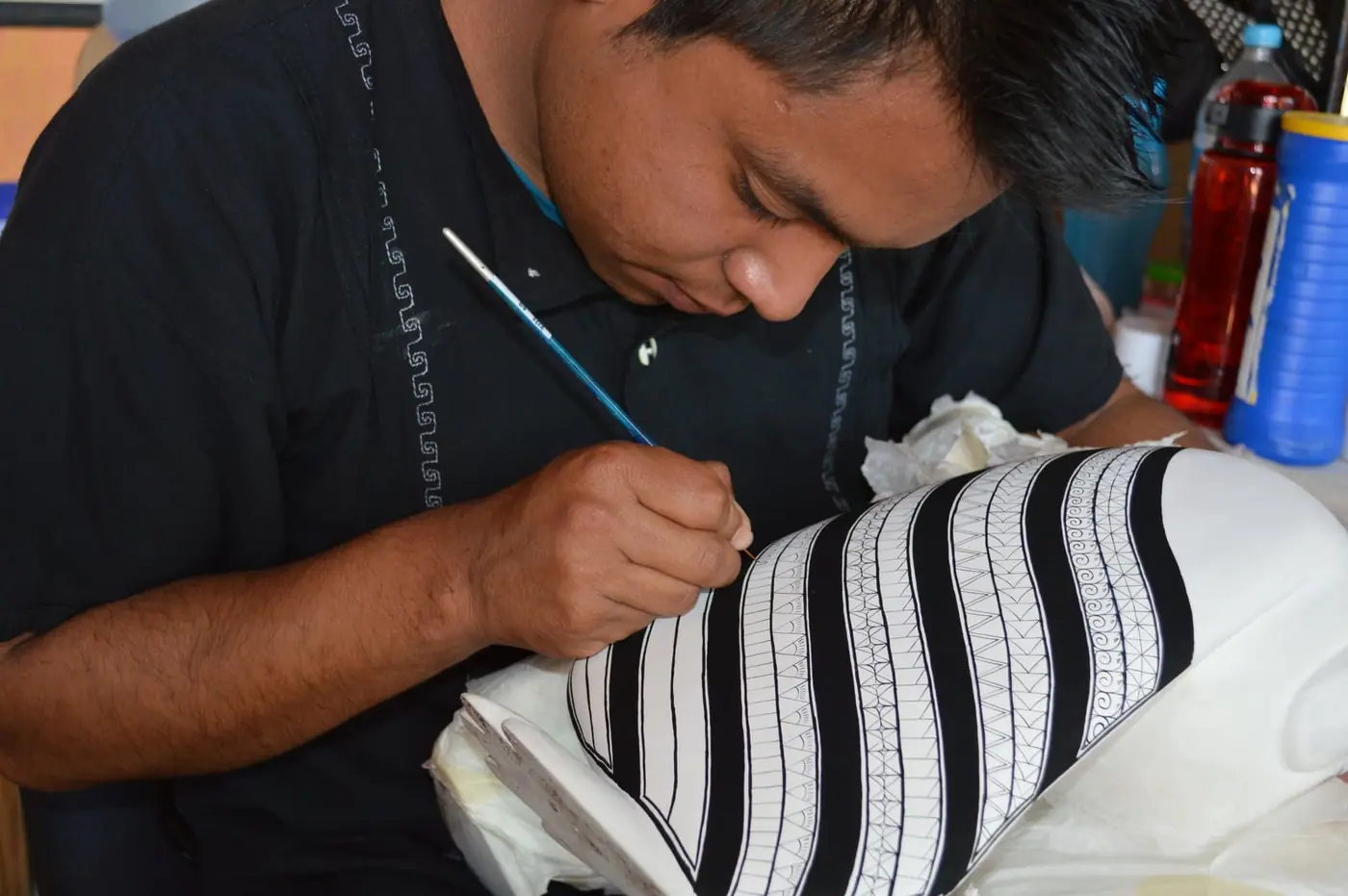
<figure>
  <img src="/images/blog/optimized/what-is-an-alebrije-2-1400-69523522.webp" alt="An artisan painting fine black and white lines onto a carved wooden figure" loading="lazy" />
  <figcaption>The painting is the slow part. A detailed piece can take weeks of it. Photo by AlejandroLinaresGarcia, <a href="https://creativecommons.org/licenses/by-sa/4.0/">CC BY-SA 4.0</a>.</figcaption>
</figure>

## Buying one properly

<div class="do-dont">
  <div class="dd-col dd-do">
    <p class="dd-title">Good questions</p>
    <ul>
      <li><b lang="es-MX">¿Usted lo talló?</b> — did you carve this one yourself?</li>
      <li><b lang="es-MX">¿Cuánto tardó?</b> — how long did it take?</li>
      <li><b lang="es-MX">¿Es de copal?</b> — is it copal wood?</li>
      <li><b lang="es-MX">¿Lo pintó a mano libre?</b> — freehand, or with a stencil?</li>
    </ul>
  </div>
  <div class="dd-col dd-dont">
    <p class="dd-title">Poor questions</p>
    <ul>
      <li><b lang="es-MX">¿Cuál es mi animal espiritual?</b> — film, not craft.</li>
      <li>Haggling hard on a piece that took three weeks.</li>
      <li>Asking if they have it <b>in a different color</b>.</li>
      <li>Calling it <b lang="es-MX">artesanía típica</b> to the person who made it.</li>
    </ul>
  </div>
</div>

The haggling one deserves saying plainly. Bargaining is normal in Mexican markets and nobody will be offended by an attempt. But a hand-carved, hand-painted piece is priced against weeks of labour, and pushing a carver down forty percent because a mass-produced version exists three stalls along is a different transaction from negotiating over a keyring.

Ask what makes theirs different. Usually they will tell you, at length, and the price stops being the point.

<figure>
  <img src="/images/blog/optimized/what-is-an-alebrije-3-1400-6fcfd7ca.webp" alt="A stall in Oaxaca displaying rows of brightly painted wooden alebrijes" loading="lazy" />
  <figcaption>Some stalls carve, some resell. The question that separates them is who made it. Photo by AlejandroLinaresGarcia, <a href="https://creativecommons.org/licenses/by-sa/4.0/">CC BY-SA 4.0</a>.</figcaption>
</figure>

Ninety years, one fever dream, two crafts, and a film that got the look right and the meaning wrong. That is the entire story, and it fits in the answer to "what is that?"

*Hero photo by AlejandroLinaresGarcia, [CC BY-SA 4.0](https://creativecommons.org/licenses/by-sa/4.0/).*

[^dem-alebrije]: [Diccionario del español de México, alebrije](https://dem.colmex.mx/ver/alebrije) - El Colegio de México
[^dem-copal]: [Diccionario del español de México, copal](https://dem.colmex.mx/ver/copal) - El Colegio de México
[^cultura-linares]: [Secretaría de Cultura CDMX, reconocimiento a la familia Linares, creadora de los alebrijes](https://cultura.cdmx.gob.mx/comunicacion/nota/314-24) - Gobierno de la Ciudad de México
[^cultura-desfile]: [Secretaría de Cultura CDMX, Desfile y Concurso de Alebrijes Monumentales del Museo de Arte Popular](https://www.cultura.cdmx.gob.mx/comunicacion/nota/347-24)
[^infobae]: [Infobae, quién fue Pedro Linares López, creador de los alebrijes](https://www.infobae.com/mexico/2024/05/26/quien-fue-pedro-linares-lopez-creador-de-los-alebrijes/)

FAQ:
Q: What is an alebrije?
A: A brightly painted fantastical creature from Mexican folk art, usually combining parts of several animals into one impossible body.

Q: Where did alebrijes come from?
A: From Pedro Linares López, a papier-mâché artisan in Mexico City. The tradition is tied to a fever dream in which he saw impossible creatures shouting a word that sounded like alebrijes.

Q: Are the Oaxacan wooden ones alebrijes?
A: They are a separate tradition, carved from copal wood in towns like San Martín Tilcajete and Arrazola, and painted with fine patterns. They are widely sold as alebrijes now, but the papier-mâché and wood-carving traditions began independently.

Q: Are alebrijes spirit animals?
A: No, and this is the most common misunderstanding. The spirit-guide framing comes from pop culture. The Mexican concepts closest to that idea are the nahual and the tona, which are separate things entirely.

Q: How do you pronounce alebrije?
A: Roughly ah-leh-BREE-heh. The j is the throaty Spanish h sound, the same one in Juárez.

Q: What should I ask when buying one?
A: ¿Es tallado en copal? and ¿usted lo pintó? Both questions are normal, welcome, and they tell you whether you are buying a piece of craft or a factory copy.

Q: Are they religious objects?
A: No. Unlike ofrenda items, alebrijes have no ritual function. They are art, and they can be bought, gifted and displayed without any ceremonial weight.

Q: Is there an alebrije parade?
A: Yes. Mexico City holds an annual parade of monumental alebrijes, with enormous versions built on frames and paraded through the center, which is where the papier-mâché origin is most visible.

Sources:
- Diccionario del español de México, alebrije: https://dem.colmex.mx/ver/alebrije
- Diccionario del español de México, copal: https://dem.colmex.mx/ver/copal
- Secretaría de Cultura CDMX, reconocimiento a la familia Linares, creadora de los alebrijes: https://cultura.cdmx.gob.mx/comunicacion/nota/314-24
- Secretaría de Cultura CDMX, Desfile y Concurso de Alebrijes Monumentales del Museo de Arte Popular: https://www.cultura.cdmx.gob.mx/comunicacion/nota/347-24
- Infobae, quién fue Pedro Linares López, creador de los alebrijes: https://www.infobae.com/mexico/2024/05/26/quien-fue-pedro-linares-lopez-creador-de-los-alebrijes/

Related words: chido, padre, neta, fresa