---
title: "Who Is La Catrina? The Elegant Skeleton Behind Día de Muertos"
description: "Learn who La Catrina is, her Posada/Rivera history, and why the elegant skeleton became a Día de Muertos icon."
type: "article"
category: "guides"
url: "https://consalsa.app/blog/who-is-la-catrina"
canonical: "https://consalsa.app/blog/who-is-la-catrina"
published: "2026-10-14"
updated: "2026-10-14"
author: "Andrey the Nomad"
site: "ConSalsa.App"
license: "https://consalsa.app/terms#ip"
---
# Who Is La Catrina? The Elegant Skeleton Behind Día de Muertos
URL: https://consalsa.app/blog/who-is-la-catrina
Date: 2026-10-14
Updated: 2026-10-14
Category: guides
Keywords: who is la catrina, la catrina meaning, catrina day of the dead
Summary: Learn who La Catrina is, her Posada/Rivera history, and why the elegant skeleton became a Día de Muertos icon.
Quick answer:
- La Catrina is an elegant female skeleton figure strongly associated with Día de Muertos imagery.
- Her roots trace to José Guadalupe Posada's satirical calavera and later Diego Rivera's mural image.
- She was not originally just a costume; she carried social satire about class and Europeanized fashion.
- Today she appears in parades, makeup, art, and decorations, but the history matters.
What you'll learn:
- Where La Catrina comes from before the face-paint version.
- How Posada and Rivera shaped the image people recognize today.
- What La Catrina has to do with elegance and class satire.
- How to compliment Catrina makeup without sounding tacky.
Don't sound gringo:
Do not describe Catrina makeup as just 'Mexican skull face.' Say Catrina, notice the elegance, and remember the satire underneath.
Body:
La Catrina is an elegant female skeleton figure strongly associated with [Día de Muertos](/blog/dia-de-los-muertos-or-dia-de-muertos) imagery. Her roots trace to José Guadalupe Posada's satirical calavera and later Diego Rivera's mural image.[^src1]
La Catrina is one of those images people recognize before they understand it. That makes the Spanish extra useful: the word helps you ask about makeup, art, class satire, parades, and public memory without reducing the figure to a [decorative skull](/blog/what-do-sugar-skulls-mean).
## La Calavera Garbancera before La Catrina
Before La Catrina became the face you see in makeup tutorials, there was Posada's Calavera Garbancera.[^src3][^src5] The joke was not just "skeleton in a hat." It was satire aimed at social pretension: people dressing up status while death quietly makes everyone equal.
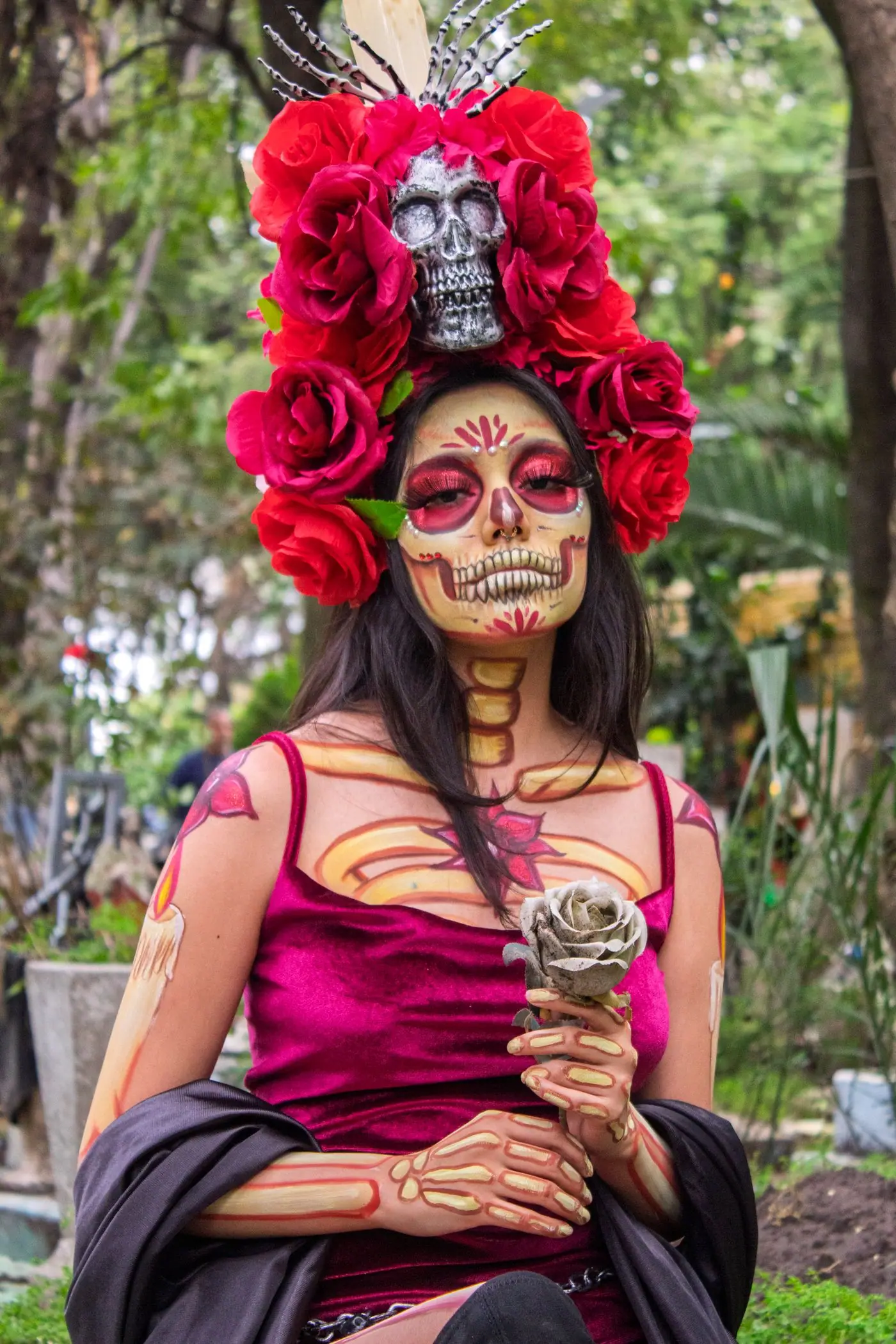
A strong Catrina image should show elegance and craft, not just a generic skull face.
## What Posada was mocking
That is why the elegance is not decoration. The hat, posture, dress, and polished look are part of the punchline. A plain skull is not automatically La Catrina. The figure works because she looks refined, almost aristocratic, while being unmistakably dead.[^src4]
## How Rivera helped fix the image
Diego Rivera helped cement the image in public imagination by placing the figure in a famous mural scene.[^src2] From there, La Catrina became a shared visual language: art history, parade, makeup, costume, tourism, and local pride all at once.
¿Qué significa?
What does it mean?
¿Cómo lo dicen ustedes?
How do you all say it?
Gracias, así lo digo mejor.
Thanks, now I can say it better.
## Catrina makeup today
In real conversation, talk about the craft first. Te quedó increíble el maquillaje sounds warmer than naming the figure like you are labeling a museum slide. If someone wants to talk history, great. If they want to talk eyeliner, follow them there.
## Compliments that respect the work
A compliment about the makeup lands better than a compliment about the person wearing it. The work takes hours, and saying so is both more accurate and more welcome than anything about how somebody looks in it.
Makeup and costume photos work when they highlight the person's artistry and public celebration.
| Situation | Better move | Why |
|---|---|---|
| You are unsure | ¿Qué significa? | Short and honest |
| You need local usage | ¿Cómo lo dicen ustedes? | Invites lived context |
| You might overstep | Lo digo con respeto | Lowers the temperature |
| Someone corrects you | Gracias, así lo digo mejor | Keeps connection open |
The visual point is polished satire: beauty, death, and style in the same frame.
## The compliment that does not flatten the image
If someone has Catrina makeup, the safest compliment is about the work: te quedó increíble el maquillaje, qué detalle tan bonito, or se ve muy elegante. Those phrases notice effort without turning the person into a costume category. Avoid qué sexy calavera unless you already have the kind of relationship where that tone is welcome.
It also helps to know that La Catrina is not simply "the Mexican skull lady." The image has a route: Posada's satirical print, Rivera's famous mural setting, and decades of popular reinvention. That route is why a museum label, a parade costume, and a face-paint tutorial can all point to the same figure while carrying different levels of seriousness.
When you are talking with Mexicans, a good move is to ask about the local version instead of giving your summary. Try ¿aquí se disfrazan de Catrina?, ¿hay desfile?, or ¿quién hizo tu maquillaje? If someone mentions Posada or Rivera, follow them there. If they just want to talk about how long the makeup took, follow that too.
For ConSalsa.App's audience, this is a perfect example of social Spanish. You are not trying to sound like an art historian at a party. You are trying to recognize that the word Catrina has elegance, satire, death, beauty, and Mexican public culture packed into it. Keep your Spanish humble and your curiosity specific, and you will sound much more human.
A small pronunciation detail: Catrina has the stress on tri. Say it like a name, not like a brand. That tiny bit of care helps when you are complimenting someone's look or asking about a public display.
The cleanest move is to treat La Catrina as a living public image with a history, not a costume label you slap on every skull face. Compliment the artistry, ask who made the look, and keep enough curiosity open for the satire underneath the elegance.
If you are posting a photo, a better caption is usually specific: La Catrina en el desfile, maquillaje de Catrina, or inspirado en La Catrina. That last phrase helps when the look borrows from the image without claiming to be the definitive version.
[^src1]: [Secretaría de Cultura, José Guadalupe Posada](https://www.gob.mx/cultura/prensa/euforia-internacional-por-jose-guadalupe-posada)
[^src2]: [Museo Mural Diego Rivera](https://museomuraldiegorivera.inba.gob.mx/)
[^src3]: [Museo José Guadalupe Posada](https://museoposada.com/)
[^src4]: [Diccionario de la lengua española, catrín](https://dle.rae.es/catr%C3%ADn)
[^src5]: [Diccionario de la lengua española, calavera](https://dle.rae.es/calavera)
FAQ:
Q: Who is La Catrina?
A: La Catrina is an elegant skeleton figure linked to Mexican art, satire, and Día de Muertos imagery.
Q: Was La Catrina always called La Catrina?
A: No. Posada's famous image was La Calavera Garbancera before later cultural use helped fix La Catrina as the familiar name.
Q: What was Posada mocking?
A: The image mocked social pretension and people trying to appear European or upper-class while denying local roots.
Q: How did Diego Rivera matter?
A: Rivera helped popularize the figure in a famous mural, placing her inside a broader Mexican historical scene.
Q: Can I dress as La Catrina?
A: In public costume contexts, many people do. Do it with care, artistry, and respect rather than treating it as random skull makeup.
Q: How do I compliment the makeup?
A: Say te quedó increíble el maquillaje, qué detalle tan bonito, or se ve muy elegante.
Q: Is every skull-face makeup La Catrina?
A: Not exactly. La Catrina is specifically elegant, dressed-up, and historically loaded.
Sources:
- Secretaría de Cultura, José Guadalupe Posada: https://www.gob.mx/cultura/prensa/euforia-internacional-por-jose-guadalupe-posada
- Museo Mural Diego Rivera: https://museomuraldiegorivera.inba.gob.mx/
- Museo José Guadalupe Posada: https://museoposada.com/
- Diccionario de la lengua española, catrín: https://dle.rae.es/catr%C3%ADn
- Diccionario de la lengua española, calavera: https://dle.rae.es/calavera
Related words: fresa, neta, padre, chido