---
title: "What Breed Is Dante in Coco? Meet the Xoloitzcuintle Without Mangling the Name"
description: "Learn what a Xoloitzcuintle is, why Dante from Coco is a Mexican hairless dog, and the Spanish around this ancient breed."
type: "article"
category: "guides"
url: "https://consalsa.app/blog/xoloitzcuintle-coco-dog"
canonical: "https://consalsa.app/blog/xoloitzcuintle-coco-dog"
published: "2026-10-04"
updated: "2026-10-04"
author: "Andrey the Nomad"
site: "ConSalsa.App"
license: "https://consalsa.app/terms#ip"
---

# What Breed Is Dante in Coco? Meet the Xoloitzcuintle Without Mangling the Name
URL: https://consalsa.app/blog/xoloitzcuintle-coco-dog
Date: 2026-10-04
Updated: 2026-10-04
Category: guides
Keywords: what breed is the dog in coco, xoloitzcuintle meaning, dante coco dog breed, mexican hairless dog
Summary: Learn what a Xoloitzcuintle is, why Dante from Coco is a Mexican hairless dog, and the Spanish around this ancient breed.

Quick answer:
- Dante from Coco is based on a Xoloitzcuintle, often called a Xolo or Mexican hairless dog.
- The breed has deep roots in Mexico and is associated with pre-Hispanic cultures.
- Xoloitzcuintle is pronounced roughly sho-lo-eets-KWEENT-leh, though many people simply say Xolo.
- Do not reduce the breed to a movie prop; it has real cultural and historical significance.

What you'll learn:
- What breed Dante is in Coco and how to say Xoloitzcuintle.
- Why the dog matters beyond the movie reference.
- How Xolo became the short, usable name.
- How to talk about the breed respectfully as a fan or traveler.

Don't sound gringo:
Do not power through the full word at speed to prove you can. Mexicans mostly say Xolo, and a foreigner who says Xolo sounds relaxed while a foreigner who sprints at xoloitzcuintle and crashes sounds like they were rehearsing. Learn the long one slowly, use the short one in public.

Body:

Dante, the dog in <em>Coco</em>, is a <mark lang="es-MX">xoloitzcuintle</mark> — the Mexican hairless dog, usually shortened to <mark lang="es-MX">xolo</mark>.

The name is two Nahuatl words stuck together, and once you split them the whole thing stops being intimidating: <mark lang="es-MX">Xólotl</mark>, the god associated with dusk and the underworld, plus <mark lang="es-MX">itzcuintli</mark>, dog. The god's dog.

## Saying it, one piece at a time

The dictionary is unusually helpful here — it prints the pronunciation directly: <em>sholoitscuíntle</em>.[^dem-xolo] It also records the variants you will see written, including <mark lang="es-MX">xoloizcuintle</mark> and <mark lang="es-MX">xoloescuintle</mark>, so if the spelling looks unstable to you, that is because it is.

<ol class="ladder">
  <li>
    <div class="rung-card">
      <span class="rung-label">start here</span>
      <span class="rung-es" lang="es-MX">xolo</span>
      <span class="rung-en" lang="en">SHO-lo</span>
      <span class="rung-note">The <span lang="es-MX">x</span> is a <em>sh</em>. This alone is what most people say most of the time.</span>
    </div>
  </li>
  <li>
    <div class="rung-card">
      <span class="rung-label">add the middle</span>
      <span class="rung-es" lang="es-MX">xolo-its</span>
      <span class="rung-en" lang="en">sho-lo-EETS</span>
      <span class="rung-note">The <span lang="es-MX">itz</span> is a quick <em>eets</em>, not a separate beat you lean on.</span>
    </div>
  </li>
  <li>
    <div class="rung-card">
      <span class="rung-label">the stressed part</span>
      <span class="rung-es" lang="es-MX">-cuín-</span>
      <span class="rung-en" lang="en">KWEEN</span>
      <span class="rung-note">This is where the weight goes. Everything else is lighter than this syllable.</span>
    </div>
  </li>
  <li>
    <div class="rung-card">
      <span class="rung-label">land softly</span>
      <span class="rung-es" lang="es-MX">xoloitzcuintle</span>
      <span class="rung-en" lang="en">sho-lo-eets-KWEEN-tleh</span>
      <span class="rung-note">The <span lang="es-MX">-tle</span> ending is one soft syllable. Do not turn it into <em>tull</em>.</span>
    </div>
  </li>
</ol>

<div class="note-card is-tip">
  <span class="note-label">Nobody is testing you</span>
  <p>In practice you will hear <span lang="es-MX">xolo</span> far more than the full word, the same way nobody says <em>Labrador Retriever</em> twice in one conversation. Use the short form freely. Keep the long one for when someone asks what breed it is and you want to answer properly.</p>
</div>

<figure>
  <img src="/images/blog/optimized/xoloitzcuintle-coco-dog-1-1400-8edfa480.webp" alt="A Xoloitzcuintle standing on grass in a garden" loading="lazy" />
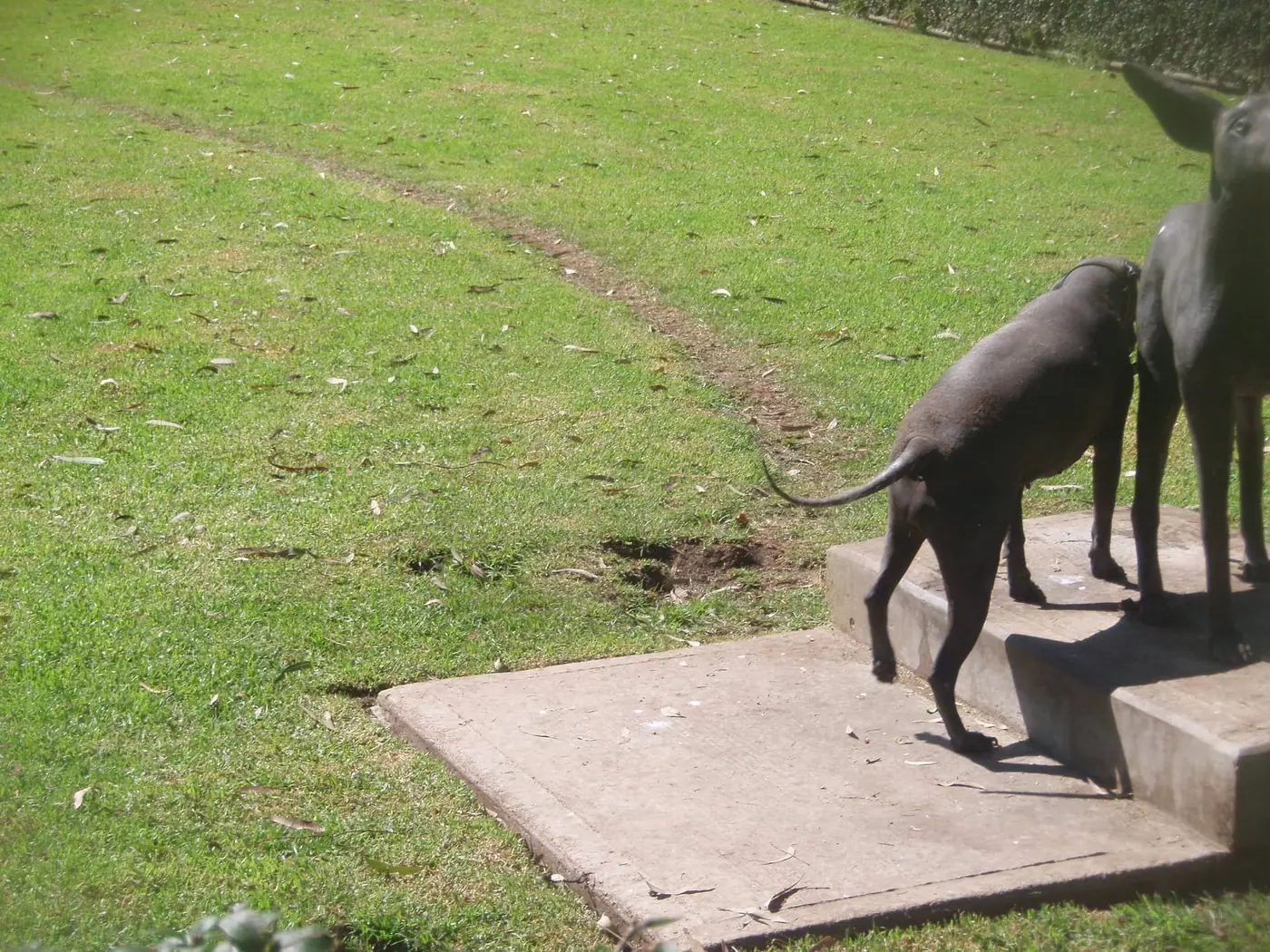
  <figcaption>Four syllables, one stressed. Most people stop after the first two. Photo by Correogsk, <a href="https://creativecommons.org/licenses/by-sa/3.0/">CC BY-SA 3.0</a>.</figcaption>
</figure>

## Not all of them are hairless

The surprise for most people: the breed comes in a coated variety as well as the famous bare one, and both are recognized in the standard. It also comes in three sizes — toy, miniature and standard — which is why two dogs that look nothing alike can be the same breed.[^akc]

| What you might assume | What is actually true |
|---|---|
| they are all hairless | there is a coated variety too |
| they are all one size | three sizes, toy through standard |
| the skin is delicate | it is, and they do get sunburnt |
| they are hypoallergenic | no dog reliably is |
| it is a rare novelty breed | it is a national symbol with a long record |

The sunburn thing is real and worth knowing before you compliment someone on their dog's outfit. A <mark lang="es-MX">xolo</mark> in a t-shirt in Mexico City is not being dressed up, it is wearing sunscreen.

<div id="midpost-newsletter-slot"></div>

## The dog you were buried with

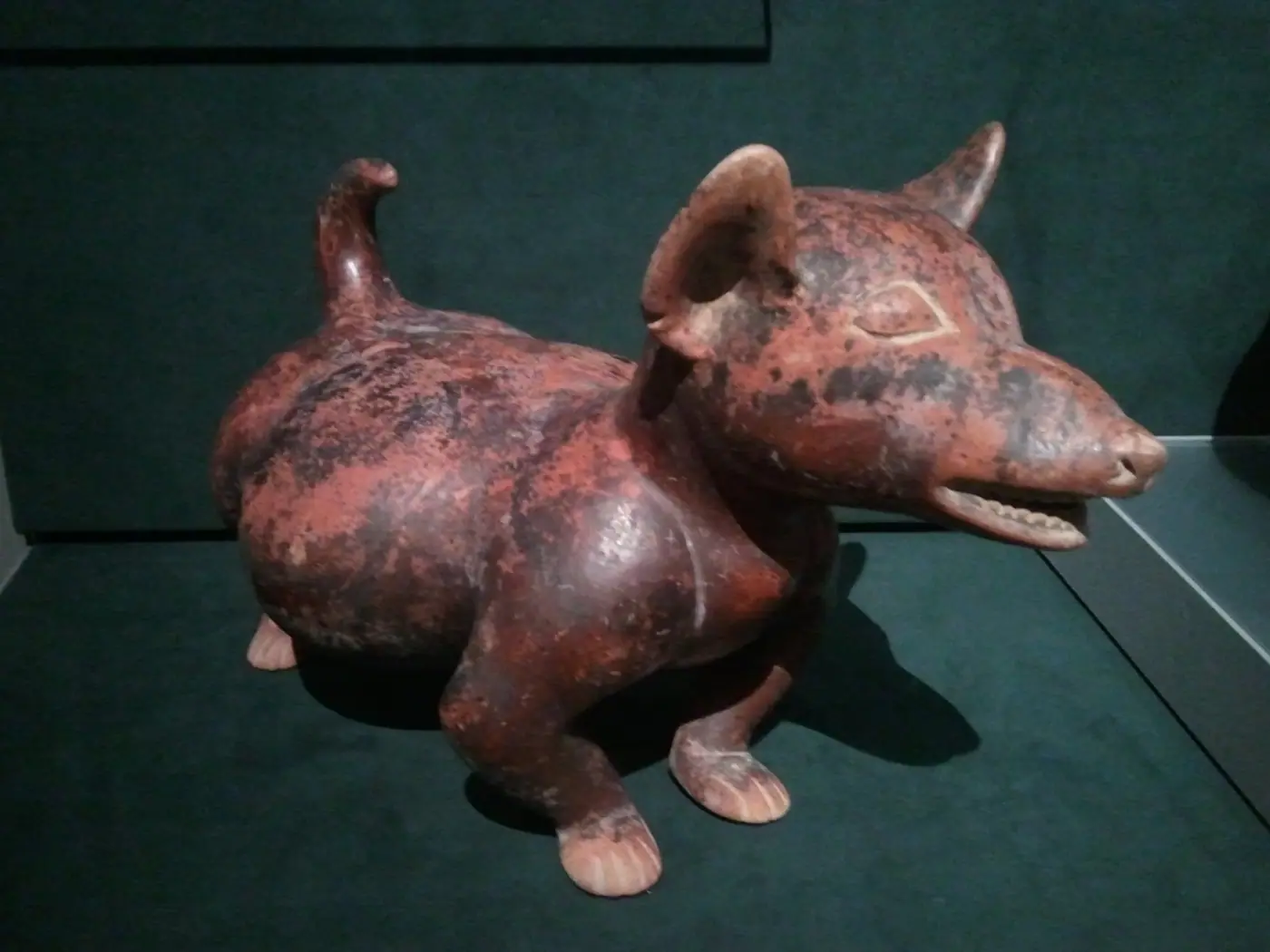
This is where the breed stops being a curiosity. Raúl Valadez Azúa, an archaeozoologist at UNAM's Institute of Anthropological Research who has worked on the breed for three decades, puts the oldest finds at around the seventh century of our era, with hairless dogs turning up in funerary contexts and as guardians of spaces treated as sacred.[^gaceta-unam][^iia-unam]

The ceramic record suggests the breed took shape roughly two thousand years ago somewhere in western Mexico and spread from there about five hundred years later.[^valadez]

And the Mexica practice attached to it is very specific. The dead were to be buried with a dog to help them on the journey to the underworld — and the tradition called for a tawny, reddish-brown one, not just any dog.[^gaceta-unam] The animal was a companion for a crossing, which is precisely the job Dante does in the film.

If you want the crossing itself rather than the dog, Mictlán has its own geography, and it explains a lot of the imagery you will see in late October.

<figure>
  <img src="/images/blog/optimized/xoloitzcuintle-coco-dog-2-1400-19e2f2c6.webp" alt="A pre-Hispanic ceramic effigy of a hairless dog" loading="lazy" />
  <figcaption>Seventh-century burials, and the same silhouette on a sofa in Coyoacan today. Photo by EgorovaSvetlana, <a href="https://creativecommons.org/licenses/by-sa/4.0/">CC BY-SA 4.0</a>.</figcaption>
</figure>

Mexico City made the recognition official in 2016, declaring the <mark lang="es-MX">xolo</mark> cultural heritage and a symbol of the capital.[^excelsior] It is on Tijuana's football club badge too, which is where [Los Xolos](/blog/liga-mx-team-nicknames) get their name.

## The word is still in daily use, aimed at children

Here is the connection almost nobody makes. <mark lang="es-MX">Itzcuintli</mark>, the dog half of the name, did not stay in the dictionary of ancient things. It turned into <mark lang="es-MX">escuincle</mark>, which is the ordinary, everyday Mexican word for a kid.[^dem-escuincle]

It is popular register and mildly rough — you would say <mark lang="es-MX">sus escuincles ya están grandes</mark> about someone's children with affection, and <mark lang="es-MX">ya cállense, escuincles</mark> to a room of them with rather less. Either way, every time a Mexican parent shouts it across a park, they are using a Nahuatl word for dog.

The other one you will hear at the vet or the park is <mark lang="es-MX">pelón</mark>, which just means bald or shaved-headed.[^dem-pelon] <mark lang="es-MX">¿Es pelón o con pelo?</mark> is the normal way to ask which variety someone's <mark lang="es-MX">xolo</mark> is, and it is a much more natural question than anything with the word <em>hairless</em> in it.

## Talking about it without sounding like a tourist

<div class="do-dont">
  <div class="dd-col dd-do">
    <p class="dd-title">Fine</p>
    <ul>
      <li><b lang="es-MX">¿Es xolo?</b> — the normal way to ask.</li>
      <li><b lang="es-MX">¿Puedo acariciarlo?</b> before touching. The skin is sensitive.</li>
      <li>Saying you know the breed from <em>Coco</em>. Everybody does.</li>
      <li>Asking whether theirs is <b lang="es-MX">pelón o con pelo</b>.</li>
    </ul>
  </div>
  <div class="dd-col dd-dont">
    <p class="dd-title">Not great</p>
    <ul>
      <li>Calling it ugly, even affectionately, in front of the owner.</li>
      <li><b>Is that a Mexican hairless?</b> shouted across a park.</li>
      <li>Touching a stranger's dog because it looks unusual.</li>
      <li>Asking if it is <b>the dead dog from the movie</b>.</li>
    </ul>
  </div>
</div>

That last one comes up more than you would think. Dante is alive for most of <em>Coco</em>; he is the one who crosses and comes back. Getting it wrong is harmless but it does announce that you watched it on a plane.

<figure>
  <img src="/images/blog/optimized/xoloitzcuintle-coco-dog-3-1400-9b27fce3.webp" alt="A Xoloitzcuintle walking across a lawn" loading="lazy" />
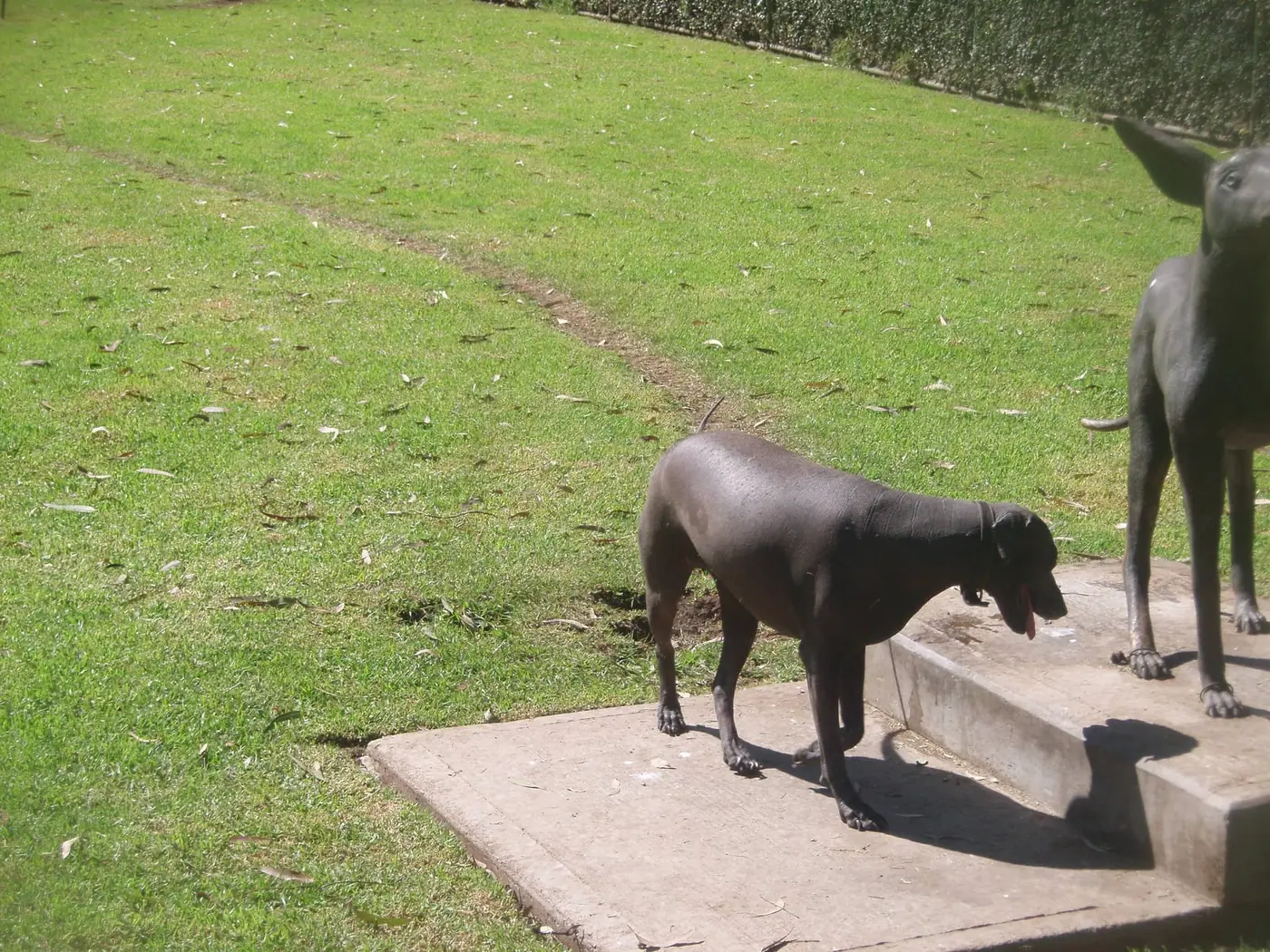
  <figcaption>Ask before you touch. There is no coat between your hand and the dog. Photo by Correogsk, <a href="https://creativecommons.org/licenses/by-sa/3.0/">CC BY-SA 3.0</a>.</figcaption>
</figure>

Two thousand years, one animated film, and a name that comes apart cleanly once somebody shows you where to cut it.

*Hero photo by Correogsk, [CC BY-SA 3.0](https://creativecommons.org/licenses/by-sa/3.0/).*

[^dem-xolo]: [Diccionario del español de México, xoloitzcuintle](https://dem.colmex.mx/ver/xoloitzcuintle) - El Colegio de México
[^gaceta-unam]: [Gaceta UNAM, xoloitzcuintle, ¿compañero de vida y muerte?](https://www.gaceta.unam.mx/xoloitzcuintle-companero-de-vida-y-muerte/) - Universidad Nacional Autónoma de México
[^iia-unam]: [Instituto de Investigaciones Antropológicas UNAM, historia del xoloitzcuintle en México](https://www.iia.unam.mx/publicacion/historia-del-xoloitzcuintle-en-mexico)
[^valadez]: [Raúl Valadez, perros pelones del México prehispánico](https://dialnet.unirioja.es/descarga/articulo/3199902.pdf) - Dialnet
[^dem-escuincle]: [Diccionario del español de México, escuincle](https://dem.colmex.mx/ver/escuincle) - El Colegio de México
[^dem-pelon]: [Diccionario del español de México, pelón](https://dem.colmex.mx/ver/pelon) - El Colegio de México
[^akc]: [American Kennel Club, Xoloitzcuintli breed standard](https://www.akc.org/dog-breeds/xoloitzcuintli/)
[^excelsior]: [Excélsior, el xoloitzcuintle declarado patrimonio cultural de la CDMX](https://www.excelsior.com.mx/comunidad/2016/08/12/1110619)

FAQ:
Q: What does xoloitzcuintle mean?
A: The name joins Xólotl, the Aztec god associated with death and the journey of the sun, with itzcuintli, the Nahuatl word for dog. So it is closer to Xólotl's dog than to hairless dog.

Q: How do you pronounce xoloitzcuintle?
A: Roughly sho-lo-eets-KWEENT-leh. The x is a sh sound, as it is in Xochimilco and México in older spellings. Most people shorten it to Xolo, and nobody will mind if you do.

Q: Is Dante from Coco a real breed?
A: Yes. Dante is a Xoloitzcuintle, and the choice was deliberate - the breed is traditionally associated with guiding souls through the underworld, which is why he guides Miguel.

Q: Are all Xolos hairless?
A: No. The breed has both a hairless and a coated variety, and both can appear in the same litter. The coated ones are just as pure-bred, despite being far less famous.

Q: Why is the breed connected to the dead?
A: In pre-Hispanic belief the dog accompanied the soul across the waters on the way to Mictlán, the underworld. Dogs were sometimes buried alongside people for exactly that reason.

Q: Is it rude to call one a Mexican hairless dog?
A: Not rude, but it flattens things. Mexican hairless dog describes the coat; Xolo carries the history. Saying Xolo also signals that you know it is not simply an odd-looking pet.

Q: How big do they get?
A: There are three recognized sizes - toy, miniature and standard - so a Xolo can be a lap dog or a knee-high dog depending on the line.

Q: What should I not say about them?
A: Avoid treating the breed as a movie prop or as an exotic curiosity. It is a genuinely ancient Mexican breed with real cultural weight, and it was close to extinction within living memory.

Sources:
- Diccionario del español de México, xoloitzcuintle: https://dem.colmex.mx/ver/xoloitzcuintle
- Gaceta UNAM, xoloitzcuintle, ¿compañero de vida y muerte?: https://www.gaceta.unam.mx/xoloitzcuintle-companero-de-vida-y-muerte/
- Instituto de Investigaciones Antropológicas UNAM, historia del xoloitzcuintle en México: https://www.iia.unam.mx/publicacion/historia-del-xoloitzcuintle-en-mexico
- Raúl Valadez, perros pelones del México prehispánico: https://dialnet.unirioja.es/descarga/articulo/3199902.pdf
- American Kennel Club, Xoloitzcuintli breed standard: https://www.akc.org/dog-breeds/xoloitzcuintli/
- Diccionario del español de México, escuincle: https://dem.colmex.mx/ver/escuincle
- Diccionario del español de México, pelón: https://dem.colmex.mx/ver/pelon
- Excélsior, el xoloitzcuintle declarado patrimonio cultural de la CDMX: https://www.excelsior.com.mx/comunidad/2016/08/12/1110619

Related words: neta, chido, padre, menso