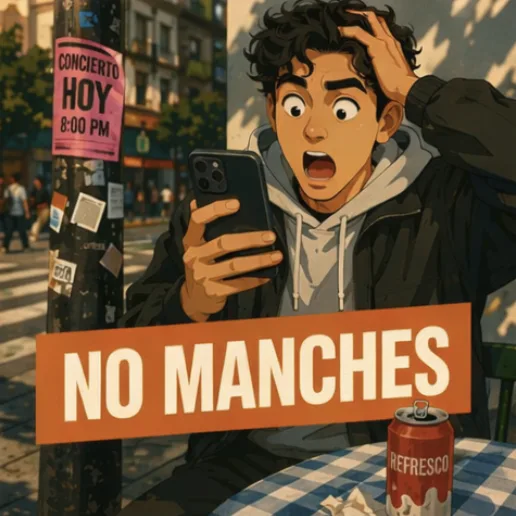
Using Grindr in Mexico City is not just about knowing Spanish. It is about reading tone, privacy, neighborhood signals, and the tiny words that make a chat feel normal instead of translated at knifepoint.
CDMX has one of the most visible queer scenes in Latin America, with Zona Rosa still acting as a major nightlife and meeting point, plus spillover into Juarez, Roma, Condesa, Centro, and beyond.
Apps are part of that ecosystem. They are also still apps, which means the usual mix: nice people, flaky people, tourists, locals, bots, bad texters, and one man whose entire personality is “sin foto no contesto.”
This guide is for English speakers using Grindr or other gay dating apps in Mexico City who want to understand the Spanish, avoid sounding stiff, and not accidentally use words that carry more baggage than they expected.
First, know the city you are texting in
Mexico City is big, queer, layered, and not one single vibe. Zona Rosa has long been tied to gay and lesbian nightlife, especially around Amberes and nearby streets.
Roma and Condesa can feel more mixed, international, and app-heavy. Juarez sits between worlds. Centro has its own nightlife corridors. Polanco may read polished. Doctores, Narvarte, Escandon, Santa Maria, Coyoacan, and other areas all have their own social temperatures.
That matters because app language changes with context. A message from someone two blocks from Amberes on a Saturday night may be direct because everyone is already out. A profile in a more residential area may be more private. A local guy may write in Spanish, Spanglish, English, or pure emoji weather. Do not overinterpret one word. Read the whole chat.
Also: foreigners can get a lot of attention in CDMX. Some of it is curiosity. Some of it is genuine attraction. Some of it is people practicing English. Some of it is “tourist with a hotel room.” Enjoy attention, but keep your brain plugged in.
The profile words you will see
These are common words and labels you may see in profiles, bios, and first messages. Some are neutral. Some are intimate. Some are loaded. Understand more than you use.
| Word or phrase | What it usually means | Tone in Mexico City | Should you use it? |
|---|---|---|---|
| discreto | Private, low-profile, not publicly open | Common, sometimes sensitive | Use respectfully |
| de clóset | Closeted | Direct, personal | Understand it; do not label someone else |
| ambiente | Queer/gay scene, “family,” nightlife context | Friendly and useful | Yes, carefully |
| oso | Bear | Usually descriptive | Yes, if relevant |
| activo | Top | Sexual role label | Only if you are discussing that |
| pasivo | Bottom | Sexual role label | Only if you are discussing that |
| versátil | Versatile | Sexual role label | Only if you are discussing that |
| ligue | Hookup, flirtation, someone you picked up | Casual | Useful |
| plan | A plan, often a date or hookup depending on context | Context-dependent | Ask clearly |
| antro | Club or nightlife spot | Very Mexican, casual | Yes: antro |
| sin foto no contesto | No photo, no reply | Blunt but common | Understand it |
| no drogas | No drugs | Boundary | Respect it |
“Discreto” deserves special attention. In a Mexico dating-app context, it can mean “I am not out,” “I do not show face pics,” “do not greet me like we know each other in public,” “I keep this part of my life private,” or “I want this to stay low-profile.”
It is not automatically shady. It is a privacy signal, so handle it like an adult.
What does “¿qué buscas?” mean?
The most important dating app question in Mexican Spanish is:
-
¿Qué buscas?What are you looking for?
It can mean “Are you looking for dates, friends, chatting, sex, drinks, something now, something later, or just attention while waiting for an Uber?” The phrase is neutral. Your answer sets the tone.
Here are natural answers that do not sound like you copied them from a Spanish exam:
| If you mean… | Say this | What it feels like |
|---|---|---|
| Chat first | Estoy viendo qué onda. | Casual, noncommittal |
| Dates | Algo tranquilo, salir por algo. | Low-pressure |
| Friends / scene | Conocer gente y salir al ambiente. | Friendly, social |
| Tonight | Algo hoy, si hay buena vibra. | Direct but not crude |
| Not sure | La verdad no sé, estoy abierto. | Honest |
| You are just browsing | Nomás viendo qué onda. | Very casual |
| You want to slow it down | Prefiero platicar tantito primero. | Clear boundary |
Notice the useful Mexican words hiding in there: qué onda, la verdad, buena vibra, tantito. You are not trying to become a telenovela. You are just making the message feel human.
First messages that sound normal
On apps, short usually wins. Mexican Spanish also tends to soften directness with small warm words: oye, qué onda, jaja, va, sale, porfa. That does not mean you need to be vague. It means you can be clear without sounding like a form.
Try these:
-
Qué onda, ¿cómo vas?Hey, how's it going?
-
Hola, estás guapo. ¿Por dónde andas?Hi, you're handsome. What area are you around?
-
Qué buena vibra tu perfil.Your profile has a nice vibe.
-
¿Qué buscas por acá?What are you looking for around here?
If you are not fully comfortable in Spanish, say that early and simply:
-
Mi español no es perfecto, pero le intento jaja.My Spanish isn't perfect, but I'm trying haha.
That sentence does more work than you think. It lowers the pressure, shows effort, and gives the other person permission to switch languages if they want.
Google Translate vs normal CDMX app Spanish
The danger is not making mistakes. The danger is sounding strangely formal in a context where everyone else is writing from bed, from the club line, or from a taco stand.
| Situation | Too stiff | More natural | Why it works |
|---|---|---|---|
| Asking location | ¿En qué ubicación te encuentras actualmente? | ¿Por dónde estás? | Short and app-native |
| Confirming a plan | Estoy de acuerdo. | Sale, va. | Mexican, casual, clear |
| Asking to meet first | Me gustaría reunirnos en un lugar público. | ¿Te late vernos primero por un café? | Warmer and safer |
| Saying you are nearby | Me encuentro cerca de usted. | Ando cerca. | Natural casual Spanish |
| Asking for a photo | ¿Puede enviarme una fotografía? | ¿Me mandas foto? | Direct but normal |
| Declining | No estoy interesado. | Gracias, pero paso. | Polite enough, not dramatic |
| Running late | Estoy retrasado. | Voy tarde, perdón. | Human, not airport signage |
| Ending kindly | Fue agradable hablar contigo. | Qué gusto platicar contigo. | Warm and natural |
The safest learner voice is clear, friendly, and lightly casual. Do not open with heavy slang. Do not call everyone güey. Do not use a word just because it sounds spicy.
Your goal is to sound like a respectful person with a pulse.
Neighborhood words and nightlife context
You will see location shorthand constantly:
- Zona / la Zona: usually Zona Rosa if the chat is queer nightlife coded
- Juarez: Colonia Juarez, often near Zona Rosa or Reforma
- Roma / Roma Norte: popular, international, queer-friendly, bar-heavy
- Condesa: social, walkable, app-active, often tourist-heavy
- Centro: can mean very different things depending on the exact spot
- por Reforma: around Paseo de la Reforma
- por Insurgentes: along or near Avenida Insurgentes
If someone says:
-
Ando por la Zona.I'm around Zona Rosa.
-
Estoy cerca de Insurgentes.I'm near Insurgentes.
-
¿Vienes al antro o qué?Are you coming to the club or what?
That last “o qué?” can sound pushy in English, but in Mexican Spanish it can simply be playful. Tone is doing the driving.
Slang to understand before you repeat it
Mexican gay slang is not one tidy dictionary. Some words are community terms. Some are insults. Some are reclaimed by certain people.
Some are racialized, class-coded, gendered, or tied to older ideas about masculinity. A foreigner repeating them without context can sound careless fast.
Here is the beginner safety map:
| Term | Basic meaning | Risk level | Better learner move |
|---|---|---|---|
| gay | Gay | Low | Fine |
| queer | Queer | Low to medium; depends on person/language | Fine in English; in Spanish, listen first |
| LGBT / LGBTQ+ | Community umbrella | Low | Safe |
| ambiente | Queer scene/community | Low | Useful |
| oso | Bear | Low if descriptive | Use only when relevant |
| joto | Gay man; also used as a slur | High | Understand, do not casually use |
| puto | Slur/coward insult in many Mexican contexts | Very high | Do not use |
| mayate | Loaded term around sexuality and masculinity | High | Understand only |
| chacal | Can mean rough trade / hypermasculine type in gay slang; also has other meanings | Medium to high | Avoid labeling people |
| vestida | Drag queen / transvestite depending on context | Medium | Use more specific respectful language |
This is where Mexico’s wider language politics matter. For example, the Associated Press has reported repeatedly on Mexico’s homophobic soccer chant problem and the sanctions around it.
The point for learners is simple: “people say it” does not mean “you should say it.” Some words are audible because prejudice is audible.
If a Mexican queer friend uses a reclaimed word for themselves, that is their context. If you are a visiting gringo putting it in your Grindr bio after three days in Roma Norte, that is a different context. The language is not only grammar. It is permission.

Photo etiquette, privacy, and “discreto”
Photos are a whole social language. “Sin foto no contesto” is blunt, but common. “No face pics” does not always mean someone is fake.
In Mexico, people may be private because of family, work, neighborhood, safety, or the simple fact that not everyone wants their face floating around an app.
Useful phrases:
-
¿Tienes foto de cara?Do you have a face pic?
-
Soy discreto, no comparto fotos.I'm discreet; I don't share photos.
-
Prefiero mandar foto cuando haya más confianza.I prefer to send a photo when there's more trust.
-
Todo bien, respeto eso.All good, I respect that.
Privacy etiquette is very simple: do not screenshot, do not share photos, do not out people, and do not act offended when someone has boundaries. A little respect goes a long way in every language.
Safety Spanish for meeting someone
Mexico City is not uniquely scary, and it is not magically safe because the bar has good lighting.
Treat it like a huge city with nightlife: stay aware, keep your belongings close, and do not let a hot profile turn off your judgment.
Use these phrases when you want a safer setup:
| Need | Spanish phrase | Meaning |
|---|---|---|
| Meet in public | ¿Te late vernos primero en un lugar público? | Want to meet first in a public place? |
| Send location | Te mando mi ubicación. | I’ll send you my location. |
| Ask for area | ¿Por dónde estás? | What area are you around? |
| Slow down | Prefiero platicar un poco más. | I’d rather chat a little more. |
| Use app transport | Me voy en Uber. | I’m going by Uber. |
| Set a boundary | Así no me late. | I’m not into it like that. |
| Leave | Ya me voy, cuídate. | I’m leaving, take care. |
| Say no | No, gracias. | No, thanks. |
If something feels rushed, weird, or evasive, you do not need to prove you are chill. You can leave the chat. You can say no.
You can keep the night boring and alive, which is a wildly underrated nightlife strategy.
The etiquette nobody puts in their bio
A few Mexico City app norms are not grammar, but they matter.
Do not treat local people like a travel experience. “Show me the real Mexico” is not flirting. It is homework with abs.
Do not assume everyone near Zona Rosa is out. Public queer space and private life can overlap in complicated ways.
Do not fetishize Mexican men, accents, skin color, class, or “latino passion.” People can feel when you are talking to an idea instead of a person.
Do not lead with money, hotel room, or citizenship jokes unless the other person has clearly invited that tone. Even then, maybe retire the joke. It has worked enough shifts.
Do be specific and kind. “Estoy en Roma hasta el domingo, me gustaría conocer gente y salir por algo” is much better than “local?” sent like a tiny haunted business card.
Do learn a few Mexican Spanish basics. Sale, va, qué onda, gracias, con permiso, perdón, and no manches will carry you through more of CDMX than one perfect pickup line.
Copy-paste phrases for CDMX dating apps
For starting:
-
Qué onda, ¿todo bien?Hey, all good?
-
Hola, me gustó tu perfil.Hi, I liked your profile.
-
Ando por Juárez, ¿tú?I'm around Juarez, you?
For clarifying:
-
¿Qué buscas por aquí?What are you looking for here?
-
¿Te late salir por una chela?Would you be into going out for a beer?
-
Prefiero algo tranquilo.I prefer something chill.
For boundaries:
-
Gracias, pero no es lo que busco.Thanks, but it's not what I'm looking for.
-
Prefiero vernos primero en público.I prefer to meet first in public.
-
No comparto fotos privadas.I don't share private photos.
For ending warmly:
-
Sale, cuídate.Okay, take care.
-
Qué gusto platicar contigo.It was nice chatting with you.
-
Nos vemos, pásala chido.See you, have a good one.
So, how should you use Grindr in Mexico City?
Use it like you would use the city itself: with curiosity, manners, and a working sense of direction.
Learn the profile words. Keep your Spanish short and warm. Treat “discreto” as a privacy signal, not a mystery to solve. Meet in public first when you want to. Respect photos and boundaries. Do not borrow heavy gay slang before you understand who gets to say it, and why.
The best app Spanish in CDMX is not the dirtiest sentence you can translate. It is the message that makes the other person think, “Ah, okay. This one is paying attention.”